


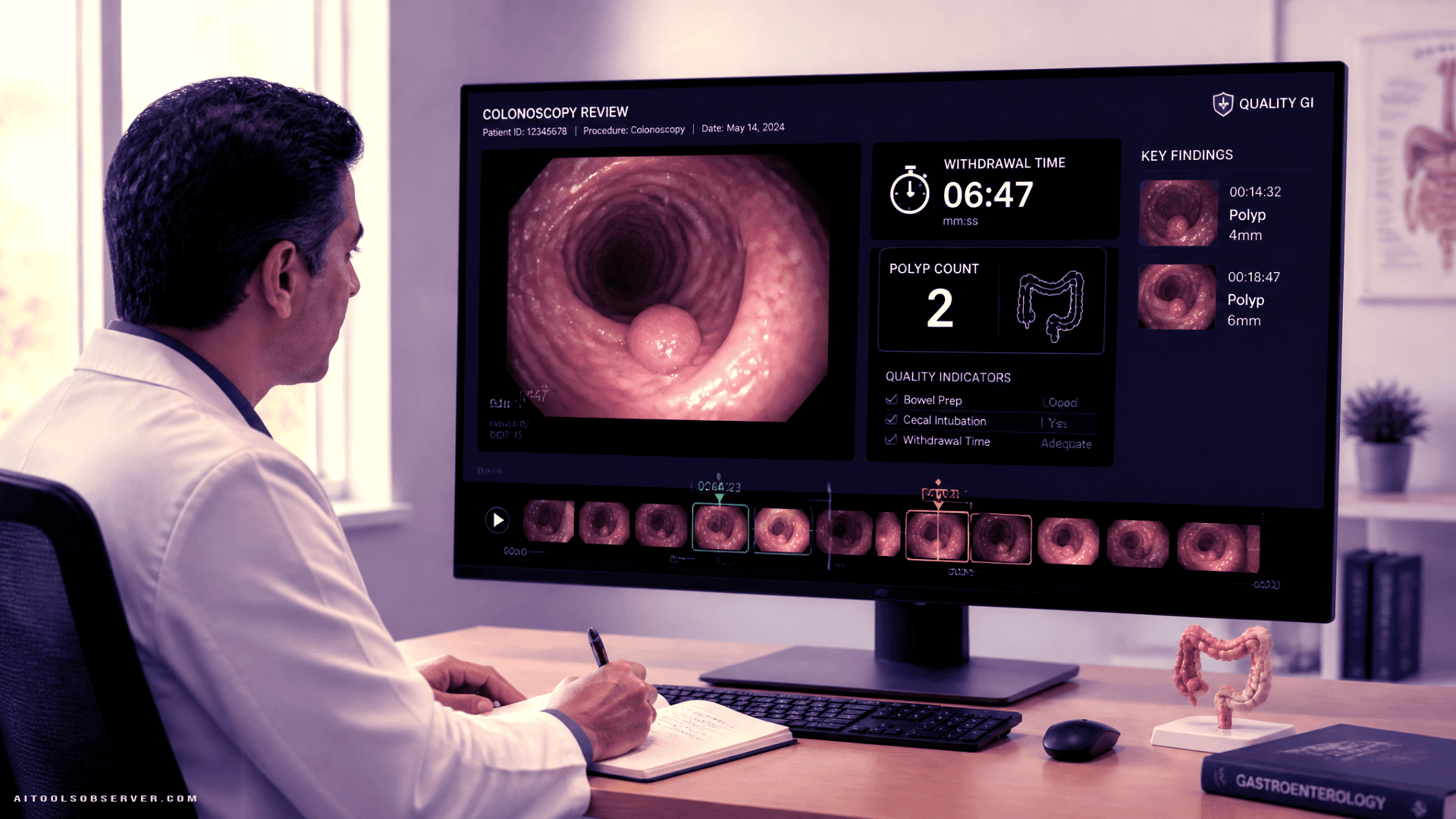
What the System Does
The tool, developed by a team at Northwestern University Feinberg School of Medicine, analyzes recorded colonoscopy footage and automatically identifies key procedural events: when the scope reaches the cecum (the start of the colon), when withdrawal begins, and when polyps are removed.
From these events, it calculates quality metrics that clinical societies already recommend tracking—most notably withdrawal time, which measures how carefully a physician examines the colon during scope removal. Insufficient withdrawal time is associated with missed polyps and reduced cancer prevention effectiveness.
The system was validated against 18,600 procedures performed by 55 physicians over 11 months at Northwestern Medicine. Its withdrawal time measurements closely matched those recorded manually by nurses, establishing a strong accuracy baseline.
Why Scale Changes the Equation
The more significant finding may not be accuracy on known metrics, but the system’s ability to track indicators that are simply impractical to measure manually at scale.
These include:
- Total polyp count per procedure across thousands of cases
- Cold snare polypectomy usage rate—a guideline-recommended technique for small polyp removal that is rarely tracked systematically in practice
Tracking whether physicians follow evidence-based removal techniques across an entire institution is, under manual review, essentially impossible. The AI makes it routine.
Clinical Validation Approach
The study, published in The American Journal of Gastroenterology, is described by its authors as the first demonstration of an AI tool comprehensively measuring quality across thousands of colonoscopies. The validation methodology—direct comparison against clinician-recorded data—grounds the accuracy claims in a concrete benchmark rather than internal model metrics alone.
Study lead Dr. Rajesh Keswani framed the tool’s purpose clearly: scalable quality measurement is a prerequisite for meaningful feedback, and feedback is what actually improves care.
The Deskilling Question
The Northwestern team acknowledges a legitimate concern raised by a 2025 Lancet study, which suggested that colonoscopists using AI polyp-detection assistance during procedures showed declining independent proficiency over time.
Keswani draws a meaningful distinction: this tool operates post-procedure only. It does not assist or intervene during the colonoscopy itself. Whether that design choice insulates it from deskilling effects remains an open question, but it does separate the use case from real-time AI assistance tools.
The team is currently studying AI’s role in colonoscopy training for medical trainees—a context where the feedback loop between AI assessment and skill development will be worth watching closely.
What This Means for Healthcare AI Adoption
This study is a useful reference point for anyone evaluating AI tools in clinical workflow automation and broader Healthcare AI Adoption. Several characteristics make it worth noting:
- Large-scale validation: Nearly 19,000 procedures across 55 physicians is a meaningful sample, not a proof-of-concept pilot.
- Comparison against human ground truth: Accuracy was measured against existing clinical records, not self-reported or model-internal benchmarks.
- Institutional scalability: The system is designed for deployment across hospitals or health systems, not individual practices.
- Post-hoc analysis only: The tool fits into existing workflows without requiring procedural changes.
The practical takeaway is straightforward: AI tools that automate quality measurement in high-volume clinical settings are most credible when validated against real-world data at scale and benchmarked against human reviewers. This study meets that bar—and sets a useful standard for similar tools in other procedural specialties.






Comments (0) No comments yet
Want to join this discussion? Login or Register.
No comments yet. Be the first to share your thoughts!