


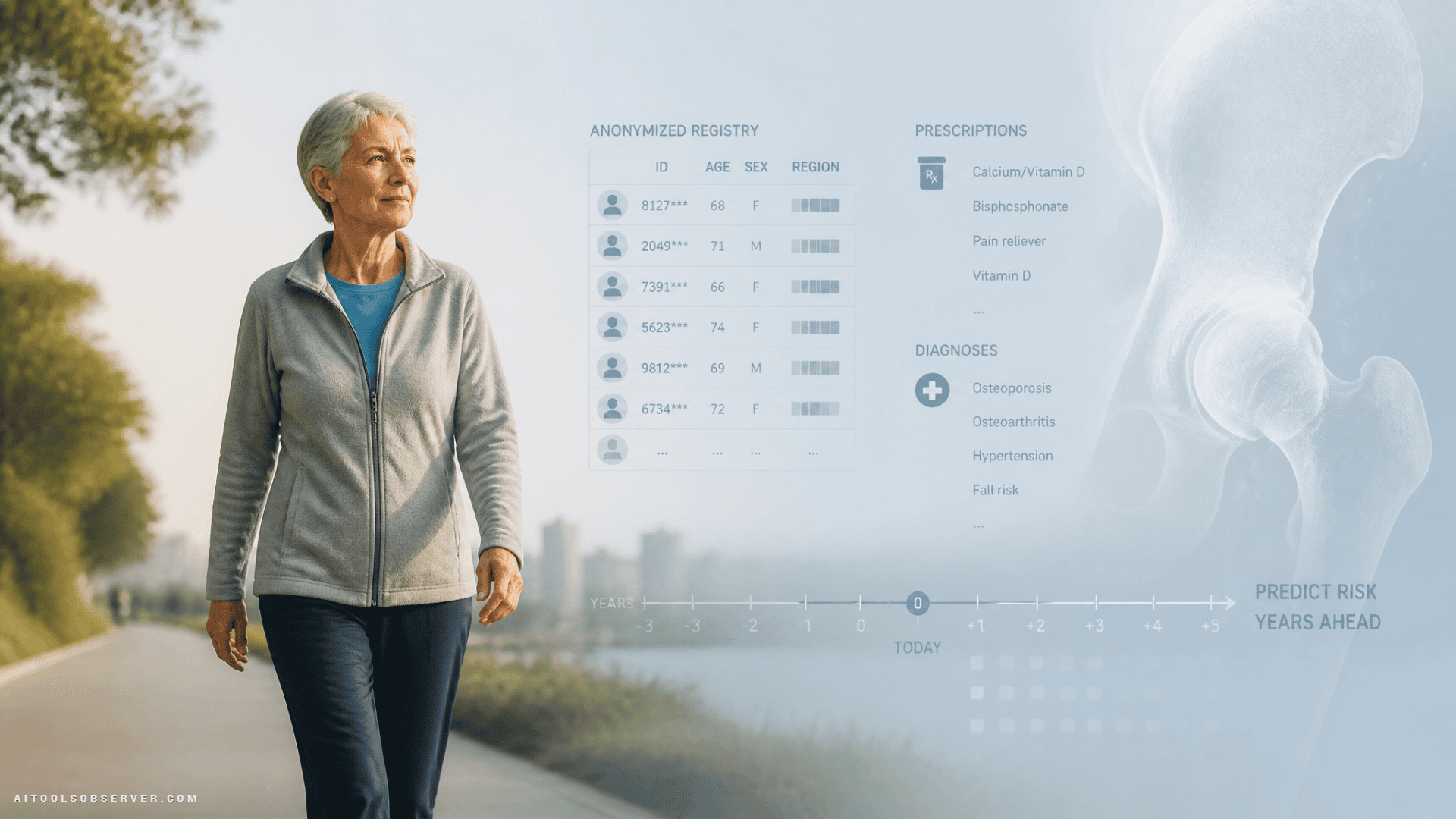
What FRACTURE-ML Actually Does
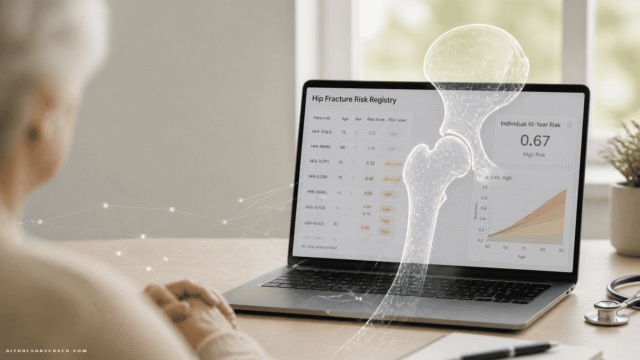
FRACTURE-ML is a machine learning-based clinical decision support tool that predicts an individual’s risk of hip fracture years before it happens. What sets it apart from existing fracture risk models is what it doesn’t need: no clinic visits, no patient questionnaires, no physical examinations.
Instead, it pulls entirely from data already sitting in national health registries — diagnoses, prescription records, medical procedures, and demographic and socioeconomic information. That makes it practical at a scale most clinical tools can’t reach.
The research behind it is substantial. The study, published in PLOS Medicine, analyzed data from more than 3.5 million people in Sweden aged 50 and older. Over the follow-up period, more than 142,000 of those individuals sustained a hip fracture — giving the model a large, real-world dataset to learn from.
The Gap It’s Closing
Today’s standard of care relies heavily on Fracture Liaison Services (FLS), which identify high-risk patients primarily after a fracture has already occurred. That’s reactive medicine at its most costly — both in human suffering and healthcare resources.
FRACTURE-ML shifts the window earlier. According to the researchers, the tool could identify nearly seven times as many people at high risk of hip fracture within a two-year window compared to current practice.
That’s not a marginal improvement. That’s a structural change in how preventive care could be delivered.
Why the Registry-Only Approach Matters
The decision to build FRACTURE-ML entirely on registry data isn’t just a technical choice — it’s a strategic one.
Most predictive health tools require some form of patient interaction to generate a risk score. That creates friction, limits scale, and places additional burden on already-stretched healthcare systems. By relying on data that’s already collected and structured, FRACTURE-ML can function as a population-level screening layer without adding workload to clinicians or patients.
Kristian Axelsson, first author of the study, framed it directly: the registry-based approach “creates opportunities for earlier intervention and more precise prevention” precisely because it doesn’t require extensive patient assessments to operate. This places it within a broader set of clinical tools designed to work with healthcare data already in use.
What Happens After a High-Risk Flag
FRACTURE-ML is positioned as an initial screening tool — not a final diagnosis. When it flags someone as high risk, the next step is referral for further evaluation.
That evaluation might include:
- Bone density testing to assess skeletal health
- Fall prevention interventions tailored to the individual
- Osteoporosis medication where clinically appropriate
The tool doesn’t replace clinical judgment. It directs it toward the people who need it most, earlier than current systems allow.
Where It Goes From Here
The University of Gothenburg team is clear that FRACTURE-ML is not yet deployed at scale. The next phase involves evaluating the model in additional countries and working out how it integrates into real clinical workflows.
That’s an important caveat. Sweden’s national health registries are unusually comprehensive and well-structured. Replicating the same approach in countries with fragmented or less standardized health data systems will require adaptation — and likely additional validation work.
Still, the underlying concept is transferable. Any healthcare system with structured longitudinal data on diagnoses, medications, and demographics has the raw material to build something similar.
The Bigger Picture for Healthcare AI
FRACTURE-ML is a useful example of what clinical AI looks like when it’s built around existing infrastructure rather than new data collection. It doesn’t ask the system to do more — it asks it to use what it already has more intelligently.
For healthcare providers, policymakers, and health tech builders watching this space, the practical takeaway is straightforward: the most scalable preventive care tools may not be the ones that gather the most new data, but the ones that extract the most signal from data that’s already there.
Hip fracture prevention is the use case here. The model is worth watching for what it demonstrates about population-scale AI screening more broadly.





Comments (0) No comments yet
Want to join this discussion? Login or Register.
No comments yet. Be the first to share your thoughts!