


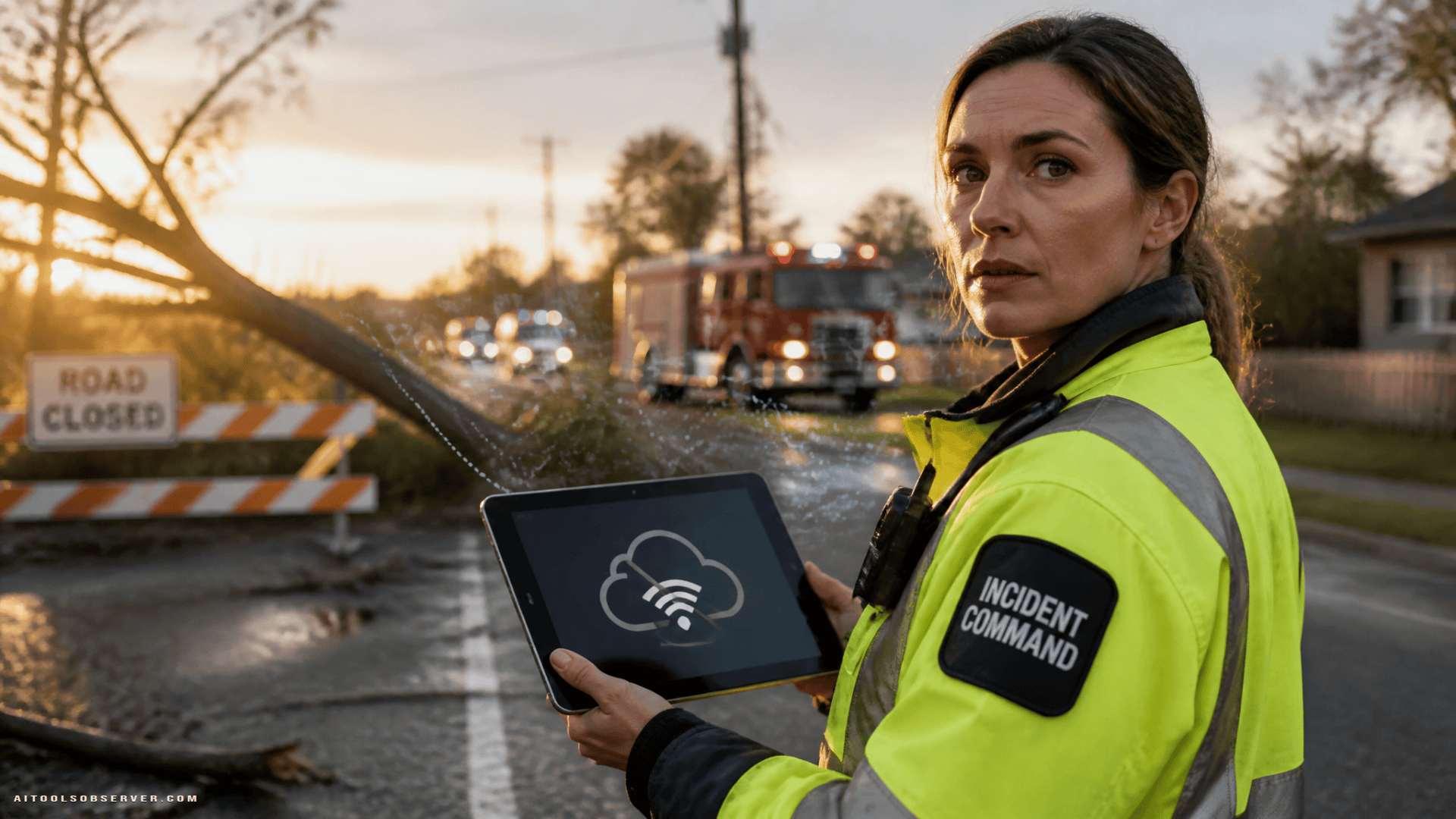
The main finding is simple, but the implication is not
On paper, AI can support emergency management in several ways: planning, translation, data triage, damage assessment, resource coordination, and public communication. In practice, the study suggests that many of these tools depend on infrastructure that may be degraded precisely when demand is highest.
The internet dependency matters because emergency management is not one workflow. It is usually split into three distinct phases:
- Preparedness
- Response
- Recovery
This distinction changes how serious the connectivity problem is.
Why internet dependence matters most during response
Preparedness happens before a disaster. Recovery can continue for months or years after. In both cases, interrupted connectivity is still inconvenient, but often manageable.
Response is different. This is the period when agencies need to coordinate in real time, track conditions, route resources, support shelters, and communicate under pressure. If a product requires uninterrupted broadband or cloud access, that requirement becomes a direct operational risk.
According to the context provided, many of the reviewed tools were marketed for the response phase. That is where the mismatch becomes most visible. A response-oriented tool that assumes stable connectivity may be useful in normal conditions, but fragile in the field.
The study also found that only a relatively small share of tools could tolerate intermittent connectivity. That suggests offline resilience is still the exception, not the standard.
This does not mean connected AI tools are useless
There is an important nuance here. Not every emergency management workflow happens at the disaster edge.
Some tools are used inside emergency operations centers, which may have backup power, redundant communications, or be located outside the most heavily affected zone. In those environments, internet-dependent systems may remain viable even during a crisis.
There is also a difference between tools that stop functioning entirely offline and tools that can continue partial work, then sync once connectivity returns. That distinction matters more than a simple online versus offline label.
So the right conclusion is not “avoid AI tools that need the internet.” It is more specific: agencies should match connectivity assumptions to actual deployment conditions.
A practical way to evaluate AI tools in disaster settings
For buyers, the study points toward a more disciplined procurement question set. Instead of asking only what the tool can do, agencies should ask what the tool needs in order to keep doing it.
Useful questions include:
- Does the tool require constant cloud access?
- Can it function with intermittent connectivity?
- What features break first when the network drops?
- Is it intended for field use or operations-center use?
- Can work be saved locally and synced later?
- What backup workflows exist if the tool becomes unavailable?
This is where many AI evaluations still fall short. Feature checklists are common. Failure-mode checklists are less common, but in emergency management they may matter more.
Privacy is not a side issue
The research also highlights a second adoption constraint: data governance.
Emergency tools may collect geolocation data, personal information, and other sensitive details about affected residents. In disaster conditions, that data can be necessary for coordination and aid delivery. But the fact that a vendor may also store or process that information introduces clear privacy and oversight questions.
The practical issue is not only what the tool captures. It is also:
- What the vendor retains
- Who can access the data
- How long the data is stored
- Whether the data is reused beyond the immediate emergency
- What rights the agency and the affected residents have over that information
In public sector environments, especially under crisis conditions, convenience can easily outrun governance. That makes procurement discipline essential. A tool that helps teams move faster but creates unclear data exposure may solve one operational problem while creating another, as seen in Michigan SNAP AI Case Review Tool Under Scrutiny.
Small agencies face the hardest tradeoffs
One of the most useful parts of the research is its attention to local capacity. Many emergency management offices operate with very limited staff. For small jurisdictions, the challenge is rarely just tool discovery. It is evaluation, implementation, oversight, and training.
That changes what “good adoption” looks like.
A large agency may be able to test multiple vendors, assess integration requirements, review privacy terms, and build fallback procedures. A small office often cannot. For those teams, the best tool is not necessarily the one with the broadest capabilities. It is the one that is understandable, usable, affordable, and dependable under constrained conditions.
Based on the available context, general-purpose tools such as large language models or translation tools may represent a practical entry point for low-resourced jurisdictions. The reason is straightforward: they tend to be easier to use and lower-friction than highly specialized platforms.
That does not make them sufficient for every need. But it does make them easier to pilot without committing to a complex procurement cycle.
The market signal: emergency AI is still structurally immature
The broader takeaway from the RAND and AIDE review is less about any single product category and more about market maturity.
A sector can look crowded and still be operationally immature. Reviewing more than 1,100 tools across more than 700 companies suggests there is no shortage of activity. But the study indicates that many products are still built around assumptions that do not align cleanly with disaster realities.
The main gaps appear to be:
- Offline reliability
- Tolerance for intermittent connectivity
- Clear privacy protections
- Fit for low-capacity public sector teams
- Procurement guidance grounded in actual emergency workflows
For AI buyers, this is a useful reminder that market volume is not the same as market readiness.
What this means for AI tool selection
If you are comparing AI tools in emergency management, the first sorting criterion should probably not be model sophistication. It should be operational fit.
A practical shortlist should favor tools that are:
- Clear about connectivity requirements
- Honest about offline limitations
- Specific about data handling
- Usable by small teams
- Designed for the actual phase of emergency management they claim to support
Preparedness, response, and recovery should not be treated as one buying category. A tool that is acceptable for planning may be unsuitable for live response. A tool that is strong in recovery may still fail under immediate field conditions.
That distinction helps cut through a lot of vendor ambiguity, alongside broader questions of governance and ownership raised in State Accountability for Deployed AI in 2026.
The useful takeaway
The RAND study does not argue that AI has no place in disaster response. It argues, more usefully, that reliability conditions matter as much as intelligence features.
For emergency teams, the next smart question is not “Should we use AI?” It is “Which tools still help when infrastructure is unstable, staffing is thin, and data sensitivity is high?” Start there, and the comparison process gets much sharper.








Comments (0) No comments yet
Want to join this discussion? Login or Register.
No comments yet. Be the first to share your thoughts!