



From Ramen to Robotics
Four MIT graduate students started Ginkgo with a conviction that sounds almost obvious in hindsight: programming cells would eventually matter more than programming computers.
In 2006, that idea was a fundraising disaster. “We were living on ramen, buying equipment on eBay, and we could not raise venture capital,” says co-founder Jason Kelly. Early investors weren’t buying it. Biology was messy, slow, and deeply human.
Then the AI boom arrived — and suddenly the pitch made perfect sense.
A 2014 blog post from Sam Altman (pre-OpenAI, pre-everything) sparked a conversation with Kelly about automating biotech the way software was automating everything else. Silicon Valley money followed. Today, Ginkgo operates an autonomous laboratory overlooking Boston Harbor, where robots do the pipetting and AI writes the experimental playbook.
What the Lab Actually Looks Like

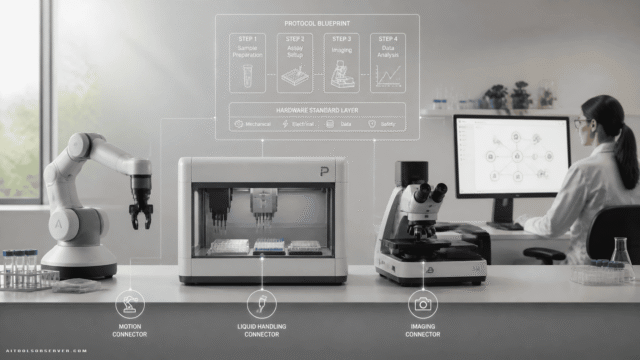
Walk into Ginkgo’s facility and you won’t find scientists hunched over benches. You’ll find one-armed robots encased in glass, each running a separate project. A large screen tracks every experiment in real time, color-coded by task. A miniature train track loops through the room, ferrying equipment — including petri dishes with live cells — from one robot to the next.
It looks like a factory floor crossed with a science museum. That’s intentional.
Human scientists still design the experiments. But they translate those designs into instructions that robots execute — handling the repetitive, precision-heavy work that used to consume entire workdays.
The projects span pharmaceuticals, agriculture, and government contracts. Engineering microbes for better fertilizer. Creating proteins that can generate snow or ice. Significant pharmaceutical research. The robots don’t care what the project is. They just run it.
The Moment Everything Shifted

The real inflection point wasn’t robots doing lab work. It was AI doing the thinking.
Co-founder Reshma Shetty recently collaborated with OpenAI, using ChatGPT to design a protein synthesis experiment — not just execute one. Normally, designing the experiment is the scientist’s job. The recipe-writing, not the cooking.
“The really, really wild moment was the first time I saw a lab notebook entry written by the model,” Shetty says.
The results were striking. The AI-driven approach delivered a 40% reduction in costs compared to human-led work and ran more than 30,000 experiments in six months. The paper hasn’t been peer-reviewed yet, but the numbers are hard to ignore.
Shetty’s own workflow has already changed. She used to rush through experiment design to get to the hands-on lab work. Now she spends more time designing — because the robot handles execution overnight.
That’s a meaningful inversion. The scientist becomes the architect. The machine becomes the builder.
The Workflow, Simplified
Here’s how the AI-to-robot pipeline actually functions at Ginkgo:
- Define the scientific question
Human scientists set the goals, constraints, and parameters. This is still irreducibly human work — for now. - AI designs the experiment
Using models like ChatGPT, the system generates experimental protocols — essentially writing the recipe from scratch. - Robots execute at scale
Instructions are translated into robotic tasks. The machines run experiments in parallel, around the clock, without fatigue or error drift. - Results feed back into the model
Data loops back, informing the next round of experimental design. The system learns as it runs.
The bottleneck shifts from execution to interpretation — which is where human judgment still earns its place.
The Part Nobody Wants to Talk About
Democratizing science sounds great until you think about who else gets access.
Drew Endy, a bioengineering researcher at Stanford, puts it plainly: AI removes the intellectual gatekeeping that has historically kept dangerous biology difficult. “Biology has traditionally been hard for people to really gain control over,” he says. “AI could nudge it a little bit more towards concentration of power.”
His concern isn’t theoretical. He and colleagues have published a report outlining how AI could be used to mass-produce viruses or enable other biosecurity threats — including potential bioweapons programs in other countries.
Endy is genuinely excited about AI in science. He’s also genuinely worried. Both things are true at once, and that tension is worth sitting with.
Kelly acknowledges the cultural collision coming. “I do think you’ll have a culture clash,” he says, “coming of what happens when everyday people can ask scientific questions.” He frames it as democratization. Endy frames it as risk. They’re probably both right.
What This Means for AI Adopters
Ginkgo’s story isn’t just a biotech case study. It’s a template for what happens when AI moves from assisting a workflow to redesigning it.
The pattern is consistent across industries:
- Repetitive execution gets handed to machines
- Design and judgment become the high-value human contribution
- Scale becomes accessible to teams that couldn’t previously afford it
- New risks emerge that regulations haven’t caught up to yet
If you’re evaluating AI tools for your own workflows, the Ginkgo model is a useful lens. The question isn’t just “can AI do this task?” It’s “what does my role look like when AI handles the execution layer?”
The Bigger Bet
Twenty years ago, four students believed programming cells would outpace programming computers. Most people thought that was absurd.
Today, an AI is writing lab notebooks. Robots are running 30,000 experiments while scientists sleep. And the hardest questions aren’t about whether this works — they’re about who gets to use it, and for what.
The science is moving faster than the guardrails. That’s not new. But the speed is.
Observe carefully. Choose what you build with this wisely.











Comments (0) No comments yet
Want to join this discussion? Login or Register.
No comments yet. Be the first to share your thoughts!