


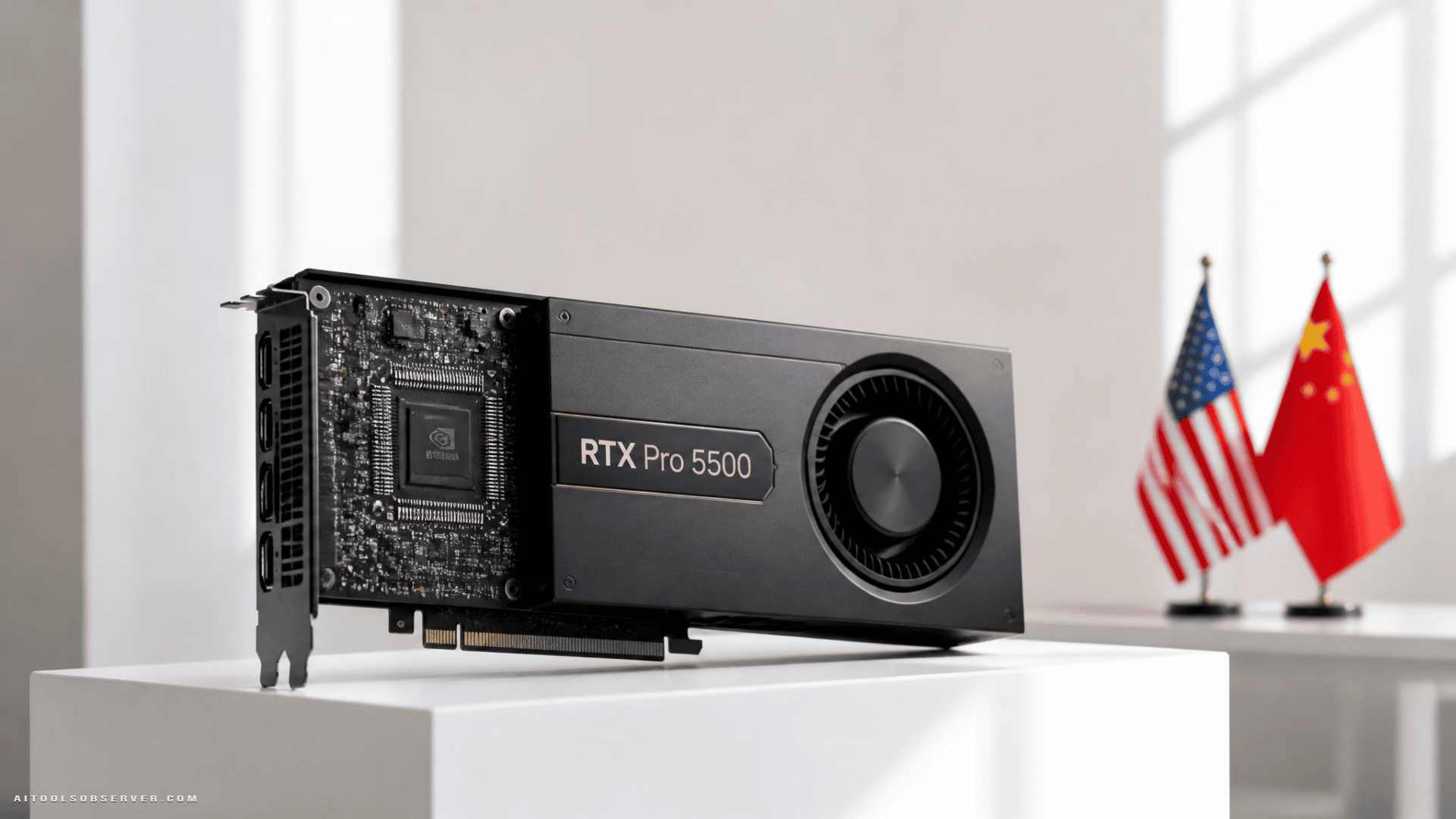
What the RTX Pro 5500 Actually Is
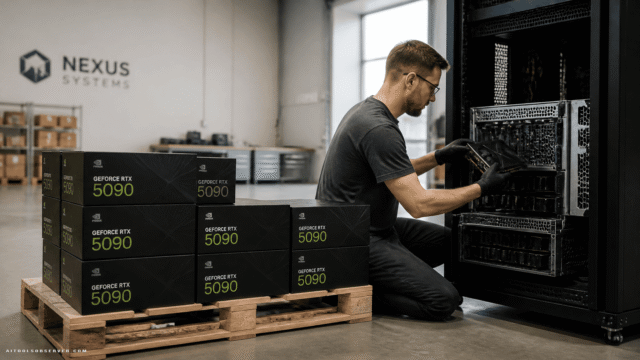
This isn’t the data-center hardware that’s been at the center of U.S.-China chip tensions since 2022. The RTX Pro 5500 is a workstation GPU—Blackwell architecture, 84 GB of GDDR7 memory, 21,760 CUDA cores, and a starting price reported above $6,000.
Nvidia positions it for AI agents, inference, and simulation. Because it’s classified as a professional workstation part rather than a data-center accelerator, it appears to sit outside the specific categories targeted by successive rounds of U.S. export controls. That regulatory gap is precisely what makes this conversation possible.
Why Beijing Is Even Asking
Chinese AI firms are short on compute. Chatbots and agents need inference capacity, and domestic alternatives haven’t fully closed the gap—despite real progress. Alibaba unveiled its own accelerator this month, reportedly running roughly three times faster than its predecessor. That’s meaningful. It’s also apparently not enough.
Permitting ByteDance and Alibaba to buy Nvidia workstation GPUs would be a quiet admission that domestic silicon isn’t quite there yet for every workload. Beijing has spent two years building toward chip self-sufficiency. Asking this question doesn’t erase that effort, but it does complicate the narrative around U.S.-China chip tensions.
What It Means for NVDA
Nvidia’s current quarterly forecast—around $108 billion—already assumes zero China data-center chip revenue. Any sales from an RTX Pro 5500 approval would land on top of that baseline, not replace something already priced in.
That framing matters. This isn’t a recovery story. It’s an upside scenario against a model that doesn’t need it to work.
NVDA closed at $225.07 on Friday. All 31 analysts tracked by TipRanks rate the stock a buy, with an average 12-month price target of $324.32. The stock has moved on China headlines before—including a 2.6% drop in September 2025 when Beijing told firms to stop buying the RTX Pro 6000D.
Sunday’s report landed days after President Trump hosted Xi Jinping in Washington, with the U.S. Trade Representative noting that national security export controls were taken “off the table” in those discussions. Timing isn’t causation, but it’s not nothing either.
The Two-Government Problem
Here’s the catch that tends to get buried: Beijing allowing purchases doesn’t mean Nvidia can sell. Washington still controls the export side, and American lawmakers are currently pushing to keep Chinese AI technology out of sensitive government systems—not loosen the rules.
Both governments have to agree. Neither has. The RTX Pro 5500’s workstation classification gives regulators on both sides more flexibility than they’d have with a data-center chip, but “more flexibility” isn’t the same as “approved.”
What to Watch
- Confirmation from Beijing or the companies — right now this is a reported inquiry, not a policy
- Washington’s response — export control posture has tightened repeatedly since 2022
- Scale of any approval — workstation GPUs at $6,000+ move the needle differently than bulk data-center orders
- Huawei and Cambricon’s reaction — they hold nearly 80% of China’s AI server market; any Nvidia re-entry is a competitive signal
The RTX Pro 5500 isn’t the chip that made Nvidia a $5+ trillion company. But in a market that’s been effectively zero for Nvidia, even a narrow reopening is worth watching closely—just not worth pricing in until it’s real, especially in a broader market defined by demand for compute.






Comments (0) No comments yet
Want to join this discussion? Login or Register.
No comments yet. Be the first to share your thoughts!