


The Core Problem in Immunotherapy Prediction
Immune checkpoint inhibitors have reshaped oncology since ipilimumab’s approval in 2011. Yet one fundamental challenge has persisted: reliably identifying which patients will actually respond to treatment before they receive it.
Response rates vary considerably across cancer types and individual patients. Those who do not respond face not only treatment failure but also exposure to potentially serious side effects and lost time — a clinical cost that is difficult to overstate in oncology.
Existing biomarkers such as PD-L1 expression and tumour mutational burden (TMB) have been the standard tools for patient stratification. Both, however, carry well-documented limitations in predictive reliability, particularly across diverse cancer types and treatment regimens.
What COMPASS Does Differently
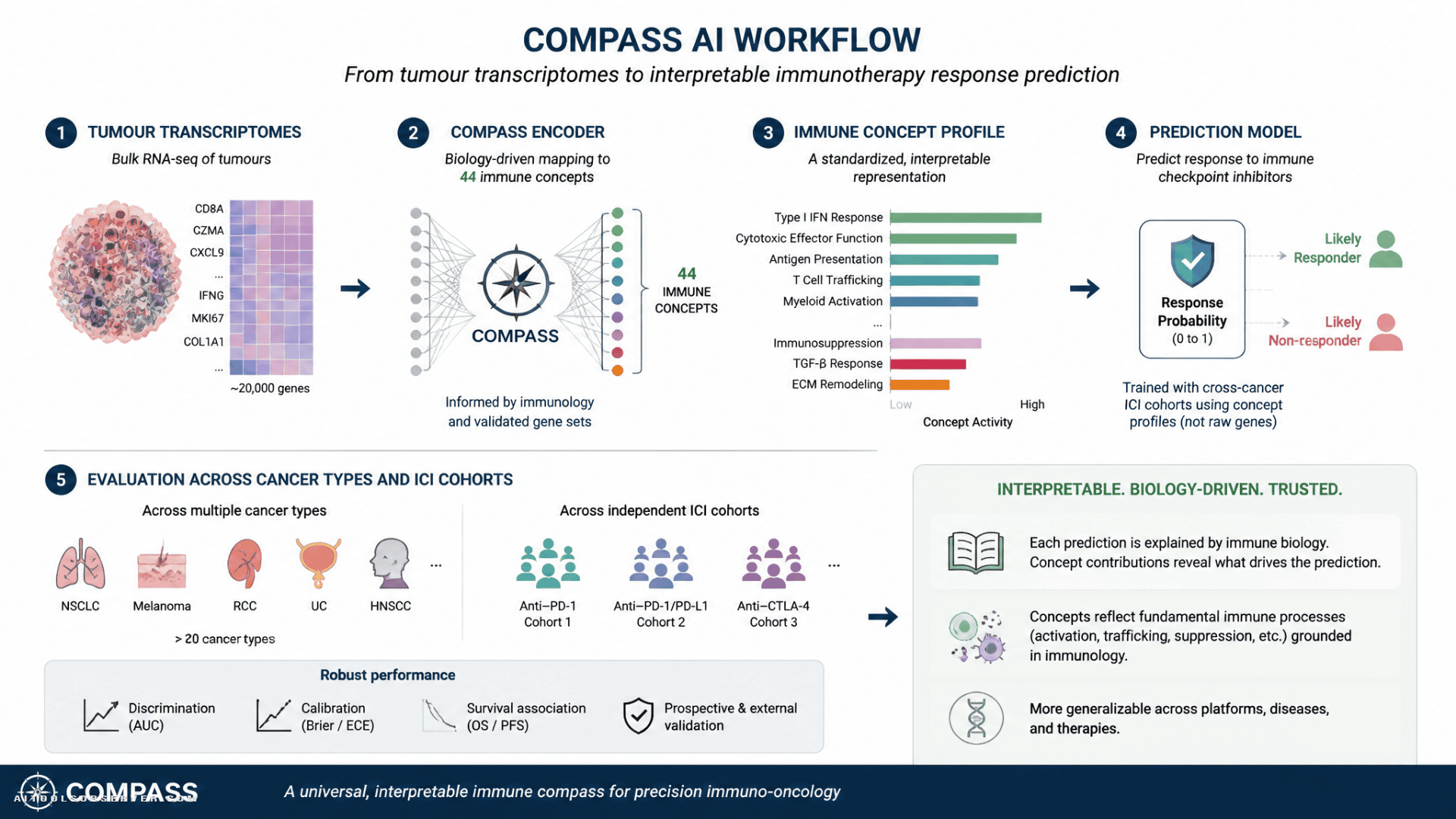
COMPASS, developed at Harvard Medical School, approaches the prediction problem from a different angle. Rather than relying on single-marker signals, the model encodes tumour transcriptomes into 44 immune concepts — structured representations of tumour-immune biology that capture mechanisms linked to both response and resistance.
These concepts include features such as cytotoxic T-cell activity, IFNγ signalling, and TGF-β pathway activation. This mechanistic grounding distinguishes COMPASS from approaches that treat prediction as a purely statistical pattern-matching exercise.
The model was trained on transcriptomes from 10,184 tumours spanning 33 cancer types. It was then evaluated across 1,133 patients drawn from 16 clinical cohorts, covering seven cancer types and six distinct immune checkpoint inhibitors.
Measured Performance Gains
Against existing approaches, COMPASS delivered an average improvement of 8.5% in prediction accuracy and a 15.7% gain in area under the precision-recall curve (AUPRC) across cohorts. These are not marginal differences in a domain where incremental improvements often define clinical utility.
In a held-out Phase II trial focused on metastatic urothelial cancer, patients identified by COMPASS as likely responders demonstrated significantly longer survival times. Critically, the model outperformed both TMB and PD-L1 immunohistochemistry biomarkers in this setting — the two most established clinical reference points.
The model also demonstrated generalisation to cancer types and treatment regimens not represented during fine-tuning, which is a meaningful indicator of robustness rather than overfitting to training conditions.
Interpretability and Clinical Adaptability
One of the more practically significant aspects of COMPASS is its interpretability. The 44 immune concepts are not opaque latent features — they correspond to biologically meaningful mechanisms, which means clinicians and researchers can interrogate why the model assigns a given prediction.
The architecture also supports rapid adaptation to specific indications and drug regimens without sacrificing that interpretability. This matters for translational research contexts where a model needs to be tailored to a particular trial design or patient population without becoming a black box in the process.
Researchers indicated that COMPASS could support biomarker-driven patient enrichment, indication selection, and broader translational research workflows.
Where the Boundaries Are
The authors are explicit about what COMPASS is not yet ready to do. It remains an exploratory tool. Prospective validation through clinical trials has not yet been completed, and the model should not be used in isolation to guide treatment decisions.
This is a necessary and appropriate qualification. Strong retrospective and held-out performance is a prerequisite for clinical consideration, not a substitute for prospective evidence. The distinction matters for anyone evaluating this tool in a research or early clinical planning context.
What This Means for AI in Precision Oncology
COMPASS represents a technically rigorous application of AI to one of oncology’s most consequential prediction problems. Its pan-cancer scope, mechanistic interpretability, and demonstrated performance gains over established biomarkers make it a credible candidate for further clinical investigation.
For researchers and oncology teams tracking AI tools in this space, the key signal here is not the headline accuracy numbers alone — it is the combination of biological grounding, cross-cohort generalisation, and adaptability. Those properties, if they hold under prospective validation, would make COMPASS genuinely useful rather than merely impressive on paper.
The immediate practical takeaway: COMPASS is worth tracking closely as prospective trial data emerges. It does not replace clinical judgment or established biomarkers today, but it offers a more structured and potentially more reliable framework for patient stratification than current single-marker approaches.













Comments (0) No comments yet
Want to join this discussion? Login or Register.
No comments yet. Be the first to share your thoughts!