


What changed
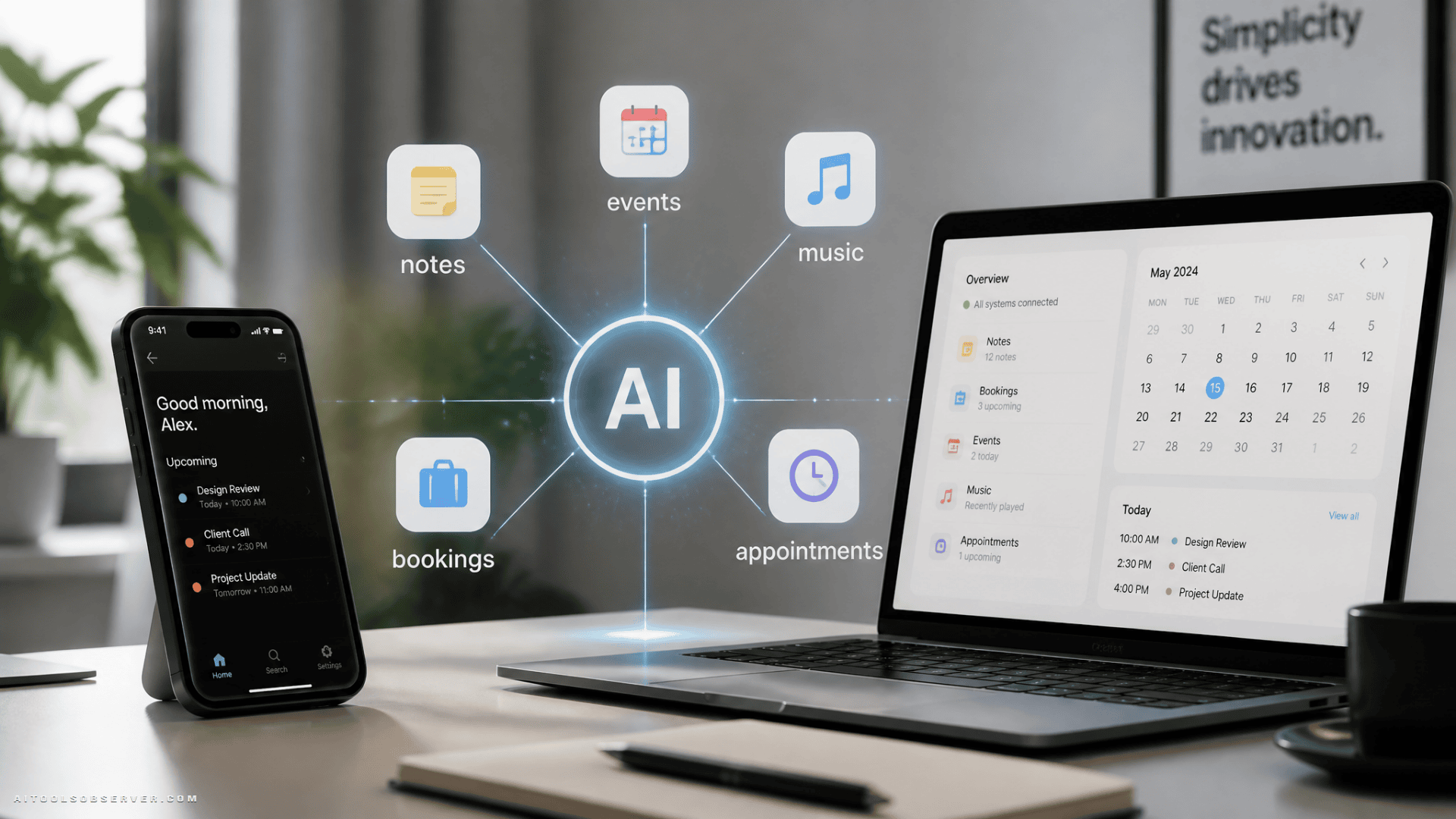
Gemini’s connected apps ecosystem is getting broader, not just bigger. The new additions suggest Google wants Gemini to sit closer to everyday tasks people already do across multiple services.
The newly added or expanded connected apps include:
- Otter.ai
- Wix
- Fever
- GetYourGuide
- Localiza
- OpenTable (UK)
- Ticketmaster
- iHeartRadio
- Pandora
- Angi
- Thumbtack
- Zocdoc
These now join an already large group of connected apps around Gemini, including services like Canva, GitHub, Google Home, Instacart, and WhatsApp.
One small but important detail: OpenTable was already available for users in the US. What appears to be new here is support for users in the UK.
Why this matters more than another feature drop
A lot of AI product updates sound impressive but don’t change behavior. Connected apps are different because they reduce switching costs.
If Gemini can help you move from question to action inside tools you already use, it becomes more than a writing assistant or search layer. It starts becoming an orchestration layer.
That matters for three reasons:
- It saves steps across fragmented workflows
- It makes AI more useful on mobile and everyday tasks
- It gives Google a stronger ecosystem story against other AI assistants
The bigger Gemini’s app network gets, the easier it is for users to stay inside Google’s AI experience rather than jumping between separate apps manually.
The practical use cases behind these integrations
The list is broad, but it becomes clearer when you group the apps by workflow.
Productivity and business tasks
Otter.ai and Wix stand out here.
Otter.ai points to meeting notes, summaries, and follow-up workflows. If Gemini can connect with a service built around conversations and transcription, that creates more obvious value for professionals who live in meetings.
Wix suggests website-related workflows, which could be useful for small businesses, solo operators, and marketers. For that audience, AI becomes more helpful when it can connect content, business presence, and operational tasks rather than just generate text.
Productivity and business use cases remain one of the clearest ways these connected apps can drive recurring value.
Bookings, events, and reservations
Ticketmaster, Fever, OpenTable, and Zocdoc all point toward intent-based actions. These are the kinds of services where users often start with a natural-language request anyway.
Examples might include:
- finding an event
- booking a dinner
- exploring activities
- scheduling an appointment
That’s where connected AI feels more natural. Instead of searching, comparing, opening tabs, and re-entering information, users can potentially move faster from idea to booking.
Travel and local discovery
GetYourGuide and Localiza suggest travel-oriented expansion, while Angi and Thumbtack push into home services and local task completion.
This is notable because it broadens Gemini beyond office productivity. Google appears to be positioning Gemini as a tool for real-world coordination, not just digital content generation.
That expands the value proposition considerably. People don’t just want AI to write emails. They want help getting things done.
Media and entertainment
iHeartRadio and Pandora are less about productivity and more about habitual use. That matters because assistants become sticky when they support low-friction, repeat behaviors.
Music, audio, and entertainment integrations can help keep Gemini present in more casual moments, not only work sessions.
What this says about Google’s Gemini strategy
The update points to a clear product direction: Gemini is being built as a central interface across apps, services, and intent-heavy tasks.
That doesn’t mean every integration will be equally useful. Some will likely feel more natural than others. But the pattern is easy to read: Google wants Gemini to be the layer users talk to before they decide where to go.
This is also why connected apps matter more than raw model talk for many users. Most people won’t evaluate an AI assistant on benchmark language. They’ll evaluate it on whether it helps book the table, find the contractor, pull the meeting notes, or surface the event.
The competitive angle
The AI assistant race is increasingly an ecosystem race. Model quality still matters, but distribution and integrations shape day-to-day adoption.
By adding services across categories like productivity, travel, appointments, entertainment, and local services, Google is strengthening Gemini’s case as a general-purpose assistant. That puts pressure on other AI platforms to deepen their own action layer, not just improve chat quality.
For users, this is usually good news. More integrations tend to mean more practical value, especially if the assistant can handle context across services.
What to watch next
The key question is not whether Gemini can connect to more apps. It’s whether those connections make tasks meaningfully faster and cleaner.
A few things are worth watching:
- which integrations become genuinely useful versus rarely used
- how smoothly users can move from prompt to completed action
- whether regional availability continues to expand
- how Google balances convenience with trust and user control
As connected app ecosystems grow, usability matters as much as breadth. A long integrations list looks good on paper, but users care about whether it works without friction.
What this means for AI tool buyers and adopters
If you evaluate AI tools for work or personal use, this update is a reminder to look beyond model performance. Integration depth is often the better signal of practical value.
Gemini’s expansion with Otter.ai, Wix, Ticketmaster, Zocdoc, and the rest makes it more relevant for users who want help across meetings, websites, bookings, travel, and local services. The smartest takeaway is simple: pay attention to which AI assistants are becoming action hubs, not just answer engines.


Comments (0) No comments yet
Want to join this discussion? Login or Register.
No comments yet. Be the first to share your thoughts!