



The Problem Worth Solving
Multiple myeloma doesn’t behave the same way in every patient. That’s the cruel irony of precision oncology — the disease is personal, but the tools to understand it historically weren’t.
Traditional research methods meant aggregating data across thousands of patients over years, running trials, waiting, and hoping the results translated into something clinically useful before it was too late for the people sitting in front of you.
Dr. Ken Shain, a clinical investigator and physician at Moffitt, put it plainly:
“Something that would take us five years to do for a thousand patients takes us hours now.”
That’s not a rounding error. That’s a different category of medicine.
The Setup: Lab Meets Algorithm

The workflow starts the old-fashioned way — in a dish.
Lab teams collect extra samples of cancer cells from patients, break them apart, and expose them to 31 different drugs or drug combinations. That’s the biological raw material. Then the AI takes over.
The platform ingests three data streams simultaneously:
- Patient genetics
- Clinical history and data
- Drug response profiles
It runs the numbers across thousands of patient scenarios at once, cross-referencing what the cells did in the lab with what the data predicts will work in the body. The output? A tailored treatment recommendation delivered within six days.
For context, six days used to be the time it took to schedule the follow-up appointment.
What the AI Actually Does (And Doesn’t Do)
This is worth being precise about, because the hype around “AI in healthcare” tends to blur the line between tool and oracle.
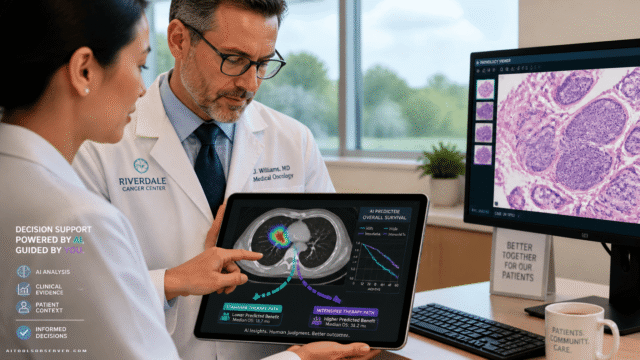
Moffitt’s platform is a clinical decision support tool — it surfaces better information faster so that physicians can make more informed calls. It doesn’t replace the doctor. It replaces the five-year wait.
Shain framed it well:
“It’d be even better if I had a way to make that decision easier and based on more information. That’s what we hope AI does.”
That framing matters. The AI is doing the heavy computational lifting so the human can focus on the judgment call. That’s the right division of labor.
Privacy and the Regulatory Runway

The platform is currently being tested with protected patient data before any broader rollout. Multiple security layers ensure researchers only access what they’re cleared to see — standard clinical research protocol, applied rigorously.
Moffitt senior researcher Ariosto Silva was candid about what comes next: scaling this to the rest of the world means navigating several regulatory levels. There’s no confirmed timeline yet for a global release.
Silva also made a quiet but important point about what makes any of this possible in the first place:
“Whenever you have a chance to actually consent to giving samples for research, or your data as well, please do so. It makes a big difference.”
Patient participation isn’t a footnote here. It’s the fuel.
Results, So Far
The numbers are striking even at this early stage:
- 31 drugs or combinations tested per patient sample
- Hours to process what previously took years
- 6 days to deliver a personalized treatment recommendation
- Several months of real patient use by Dr. Shain already underway
This isn’t a proof-of-concept living in a research paper. It’s being used on actual patients, right now, in Tampa.
Limitations Worth Noting
No case study is complete without the honest part.
The tool is still in a controlled research phase. Regulatory approval for broader deployment is pending, and the timeline is genuinely unknown. The platform’s effectiveness beyond Moffitt’s specific patient population hasn’t been independently validated yet.
And like any AI system trained on patient data, its quality is only as good as the data it learns from — which is exactly why Silva’s call for research consent matters so much.
The Takeaway
Moffitt isn’t trying to replace oncologists. They’re trying to give oncologists a superpower: the ability to see five years of research insight before the next appointment.
For a disease as personal as multiple myeloma, that’s not just an efficiency gain. It’s a fundamentally different relationship between data, time, and patient outcomes.
The AI tools ecosystem is full of productivity hacks and content generators. This is a reminder of what the technology looks like when the stakes are actually high — and when the people building it are playing a long game worth watching.






Comments (0) No comments yet
Want to join this discussion? Login or Register.
No comments yet. Be the first to share your thoughts!