



The Real Problem: IEPs Take Hours That Teachers Don’t Have

Every student with a disability in the U.S. is entitled to an Individualized Education Program — a detailed legal document outlining their current needs, annual goals, and the services required to meet those goals. For over 8 million students, IEPs are non-negotiable.
They’re also enormously time-consuming to produce.
Mary Acebu, a special education teacher at Riverview Middle School in Bay Point, California, used to spend around 45 minutes developing just three or four IEP goals for a single student. Multiply that across a full caseload, add meetings, progress tracking, and differentiated learning materials, and you start to understand why teachers like her were arriving at 6:30 a.m. and leaving after dark.
“I don’t do that anymore,” she says with a laugh.
That change came from experimenting with AI — and it’s not just her story.
The Numbers Behind the Shift

According to a 2024–25 survey by the Center for Democracy and Technology (CDT), 57% of special education teachers reported using AI to help develop individualized plans for students. That’s up from 39% the previous school year.
The jump is significant. It tells you this isn’t a niche experiment anymore — it’s becoming standard practice in classrooms across the country.
Research from the University of Virginia and the University of Central Florida backs up the instinct. When used appropriately, AI can help special educators craft IEPs of equal or higher quality than those produced without AI assistance. And the time saved translates directly into better student outcomes.
“The more face time a student with a disability has with a teacher, that often yields better outcomes for them — both educationally and functionally, just across the board,” says Olivia Coleman, a researcher and professor at UCF who studies AI’s role in special education.
What AI Actually Does in a Special Ed Classroom

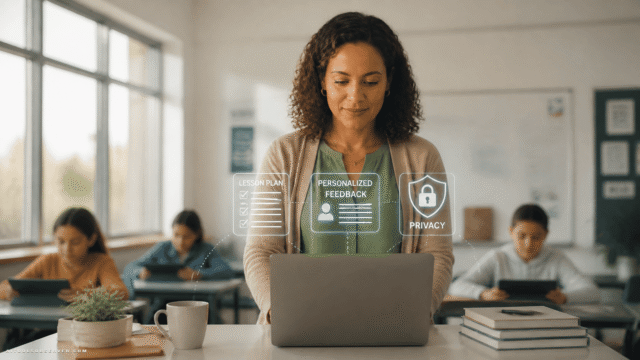
This isn’t about replacing teachers. It’s about removing the friction between a teacher’s expertise and the paperwork that documents it.
Here’s how educators like Acebu are putting AI to work:
Writing IEP Goals Faster

Acebu used to flip through a five-inch-thick binder of California education standards to match each student’s unique needs to the right benchmark. Now she uses district-vetted AI tools — including MagicSchool AI and Google Gemini — to generate draft IEP goals aligned to state standards in a fraction of the time.
The key word is draft. She reviews and refines everything.
“You’re double-checking everything. Like you have to put that human touch — that’s the final step.”
Synthesizing Complex Data for Parents

Paul Stone, a 22-year veteran at Riverview, was skeptical of AI until his caseload ballooned and the stress became unsustainable. After a tutorial from Acebu, he tried her chatbot and was surprised.
One immediate win: using AI to produce clear, plain-language summaries of complicated assessment data to share with parents at IEP meetings.
“It’s an amazing time-saver so far,” he says. “I still have to go through and check it all — but it’s a start.”
Creating Differentiated Learning Materials

Acebu uses AI to build personalized worksheets tailored to individual student needs — something that previously required significant manual effort for every learner in a class where, by definition, no two students are the same.
Tracking Student Progress

Teachers are also using AI to help organize and synthesize progress data over time, making it easier to identify what’s working and adjust goals accordingly.
The Tools Special Educators Are Actually Using

Not all AI tools are created equal — and in a highly regulated environment like special education, the choice of tool matters enormously.
District-approved platforms that have signed data protection agreements include:
- MagicSchool AI — purpose-built for educators, with IEP-specific features
- Google Gemini — integrated into district Google environments with enterprise privacy controls
- Playground IEP — designed specifically for special education workflows
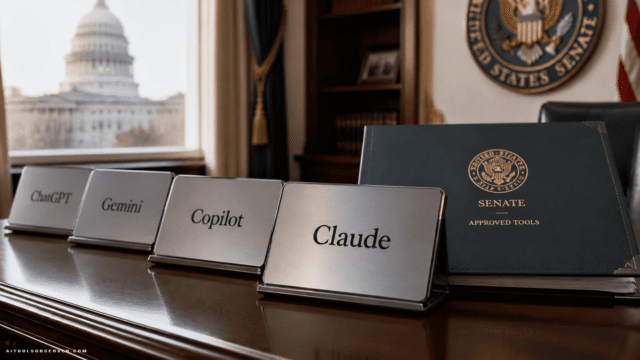
Consumer platforms like ChatGPT and Claude are also widely used, but without formal data agreements. CDT’s research found educators using both formal and informal tools — which creates real risk when sensitive student information is involved.
Acebu’s district, Mt. Diablo Unified, entered formal agreements with vetted vendors before rolling out AI tools. She then customized chatbots trained on state standards, assessments, and special education data — creating what she calls her “little assistants.”
That level of intentionality isn’t universal. And that’s where the conversation gets complicated.
The Risks You Can’t Ignore

AI in special education isn’t without serious concerns. The CDT report that highlighted adoption rates also flagged significant risks.
Student Privacy Is the Top Issue

Special education records contain some of the most sensitive information about a child — learning disabilities, behavioral data, medical context. Entering that data into an unvetted AI platform creates real exposure.
“Student privacy is number one,” says Acebu. “Don’t put information there that’s gonna identify your students.”
Even with vetted vendors, data breaches remain a possibility. The safeguard isn’t just choosing the right tool — it’s understanding what data you’re inputting and why.
AI Models Can Be Biased Against People with Disabilities

Ariana Aboulafia, lead author of CDT’s report and director of the Disability Rights in Technology Policy Project, points out that AI systems trained on broad datasets can reflect and reinforce biases — including against people with disabilities.
That’s a serious concern when those systems are being used to shape educational goals for disabled students.
Pattern Recognition vs. True Individualization

IEPs are legally required to be individualized. AI, by its nature, works through pattern recognition — identifying what’s common, not what’s unique.
Aboulafia argues this creates a fundamental tension:
“AI models built on pattern recognition are, to a certain extent, inherently incompatible with a process that legally requires individualization.”
The 15% Problem

CDT’s survey found that 15% of teachers are relying entirely on AI to develop IEPs — with no meaningful human review. That’s the scenario that concerns researchers and advocates most.
There must always be a human in the loop. Not as a formality, but as the actual decision-maker who knows the student.
How to Use AI in Special Education Responsibly

Researchers Coleman and Waterfield developed a decision tree to help teachers navigate ethical AI use. The core principles are straightforward:
- Use district-approved tools whenever possible. Vetted vendors have signed agreements to protect student data. Consumer platforms have not.
- Never input personally identifiable student information into unvetted platforms. Anonymize or generalize where possible.
- Treat AI output as a first draft, not a final product. Every goal, summary, or material generated by AI needs human review and refinement.
- Know your student first. AI can help you write the IEP faster. It cannot replace the relationship and observation that informs what goes into it.
- Stay current on your district’s AI policy. This space is evolving fast. Policies that didn’t exist last year are being written now.
What the Outcomes Actually Look Like

King, one of Acebu’s eighth graders, arrived in seventh grade as a non-reader. He’s reading now. He also attends math class without additional support — something Acebu describes as “the dream of every special educator.”
That outcome didn’t come from AI. It came from intentional, hands-on teaching. But AI gave Acebu the time to do that teaching.
She now arrives 30 minutes before her students — not 90. She leaves when the bell rings. Her work-life balance has improved, and by her own account, so has the quality of her teaching.
Paul Stone, still skeptical in some ways, acknowledges the mental health dimension directly.
“It would be kind of nice if there were two jobs — like one paperwork job and one working with the kids.”
AI isn’t two jobs. But it’s moving the ratio in the right direction.
Is AI a Real Solution or Just a Band-Aid?

CDT’s Aboulafia calls AI tools “a Band-Aid” for the deeper systemic problems in special education — chronic underfunding, unsustainable caseloads, inadequate support structures.
She’s not wrong. AI doesn’t fix teacher shortages. It doesn’t reduce class sizes or increase pay. It doesn’t address the structural inequities that make burnout worse in schools serving low-income communities.
But a Band-Aid isn’t nothing when you’re bleeding.
For teachers like Acebu and Stone, AI is buying time — literally. Time to sit with a struggling reader. Time to build the relationship that makes a student trust the process. Time to do the hard, human work that no algorithm can replicate.
The Bottom Line for Educators and Administrators

If you’re a special education teacher, the question isn’t whether to use AI — it’s how to use it responsibly.
Start with your district’s approved tools. Learn what data protections are in place. Use AI to draft, synthesize, and organize — then apply your expertise to refine and validate every output. Never let the tool replace your judgment about a student you know.
If you’re an administrator or policy maker, the priority is clear: establish AI guidelines before your teachers are left to figure it out alone. Districts that have done this — with vetted vendors, training, and clear policies — are seeing real benefits without the worst risks.
The teachers who are thriving with AI aren’t the ones who handed over the work. They’re the ones who used AI to get back to the work that actually matters.





Comments (0) No comments yet
Want to join this discussion? Login or Register.
No comments yet. Be the first to share your thoughts!