



What stands out in Granite 4.2
The headline change is clear: Granite 4.2 is positioned as a reasoning-focused release in the Granite family, with support for 128K context and options designed for local or enterprise deployment.
That combination matters because it targets a specific buyer mindset. This is less about chasing the loudest benchmark cycle and more about making self-hosted or on-premise AI usable for real tasks that involve long inputs, multiple steps, and tighter operational control.
The context provided also suggests IBM is offering models across multiple sizes, which is important for deployment planning. In practice, model size determines much of the tradeoff between capability, latency, hardware requirements, and cost.
Why 128K context matters in local AI
A 128K context window changes what a local AI model can realistically handle. Longer documents, larger codebases, extended chat history, internal manuals, policy sets, and multi-file analysis all become more feasible without aggressive trimming.
For enterprises, that reduces one common source of friction: splitting work into smaller fragments just to fit model limits. For developers and researchers, it makes local experimentation more practical when the task depends on broader context rather than short prompt-response turns.
That said, larger context windows are not free. They usually increase memory pressure and can slow inference, especially in local environments where hardware is finite and carefully budgeted.
The reasoning angle, without the marketing fog
IBM’s framing around reasoning should be read carefully and practically. In model terms, reasoning usually refers to better handling of multi-step tasks, intermediate logic, and structured problem solving rather than human-like understanding.
That can be useful in areas like:
- document analysis with several constraints
- code assistance that depends on prior steps
- task decomposition across workflows
- enterprise Q&A where the model must connect multiple parts of a long source
The tradeoff is straightforward. Reasoning-oriented behavior can improve response quality on some tasks, but it often comes with slower responses and higher compute demands.
For local deployment, that matters a lot. A model that is smarter per query but too slow for day-to-day use may still lose to a smaller or narrower model in production.
IBM’s real pitch: predictable deployment
Granite rarely appears positioned as the flashiest model family. The stronger signal here is operational stability.
That fits IBM’s broader enterprise logic. Many organizations do not need the most attention-grabbing model if they can get something easier to govern, easier to host internally, and easier to fit into existing infrastructure rules.
In that sense, Granite 4.2 appears to be less about headline spectacle and more about reducing risk in deployment decisions. For regulated environments, internal knowledge systems, or cost-sensitive teams, that can be the more relevant feature set.
Why this launch arrives at the right moment
Interest in local AI has increased for practical reasons, not ideological ones. Cloud-based frontier models remain powerful, but cost, latency, compliance, and infrastructure dependency are pushing many teams to evaluate self-hosted alternatives.
Granite 4.2 lands in that context. It speaks to organizations asking a very specific question: can we keep more inference on our own systems without giving up too much utility?
That question is also driving interest in model routing.
Granite 4.2 and the rise of model routing
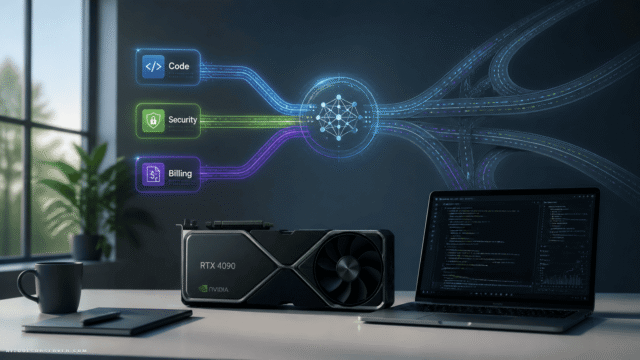
One of the more useful implications of this launch is how it fits into routing-based AI stacks. Not every task needs the same model, and forcing a single model to handle everything is often inefficient.
A practical setup might look like this:
- a smaller local model for lightweight requests
- a reasoning-focused Granite model for long-context or multi-step tasks
- a cloud model only for the hardest edge cases
This kind of routing helps balance speed, cost, and performance. Granite 4.2’s positioning suggests it could fit well as the “serious local model” in that stack: not necessarily the cheapest for every prompt, but useful when context length and structured reasoning matter.
This kind of model routing helps balance speed, cost, and performance.
Who this is actually for
Granite 4.2 looks most relevant for:
- enterprises with on-premise or private deployment requirements
- teams trying to reduce cloud inference dependence
- developers building internal assistants over large document sets
- AI infrastructure teams experimenting with model routers
- researchers and hobbyists interested in self-hosted reasoning-capable models
It may be less compelling for users who just want the fastest consumer-facing chat experience or the lowest-friction hosted API. The value here is control, not convenience theater.
The key tradeoff to watch
The main question is not whether reasoning and 128K context sound impressive. They do. The real question is whether the operational cost of those features matches the use case.
In local AI, every gain has a systems consequence:
- more context can mean more memory and slower throughput
- more reasoning depth can mean higher latency
- larger models can mean stricter hardware requirements
So the right evaluation lens is simple: does Granite 4.2 improve enough real work to justify its deployment footprint?
What this launch signals
This release reinforces a broader shift in the market. Local AI is maturing from hobbyist enthusiasm into infrastructure strategy.
IBM’s contribution here is not a vague promise of smarter models. It is a more concrete proposition: reasoning-focused, long-context models that are meant to live closer to enterprise systems and support more predictable inference patterns.
For teams evaluating AI stacks right now, that is the useful takeaway. Granite 4.2 is not just another model update to compare on abstract capability charts; it is a signal that local, self-hosted, and routed AI workflows are becoming a serious default option for production environments.














Comments (0) No comments yet
Want to join this discussion? Login or Register.
No comments yet. Be the first to share your thoughts!