


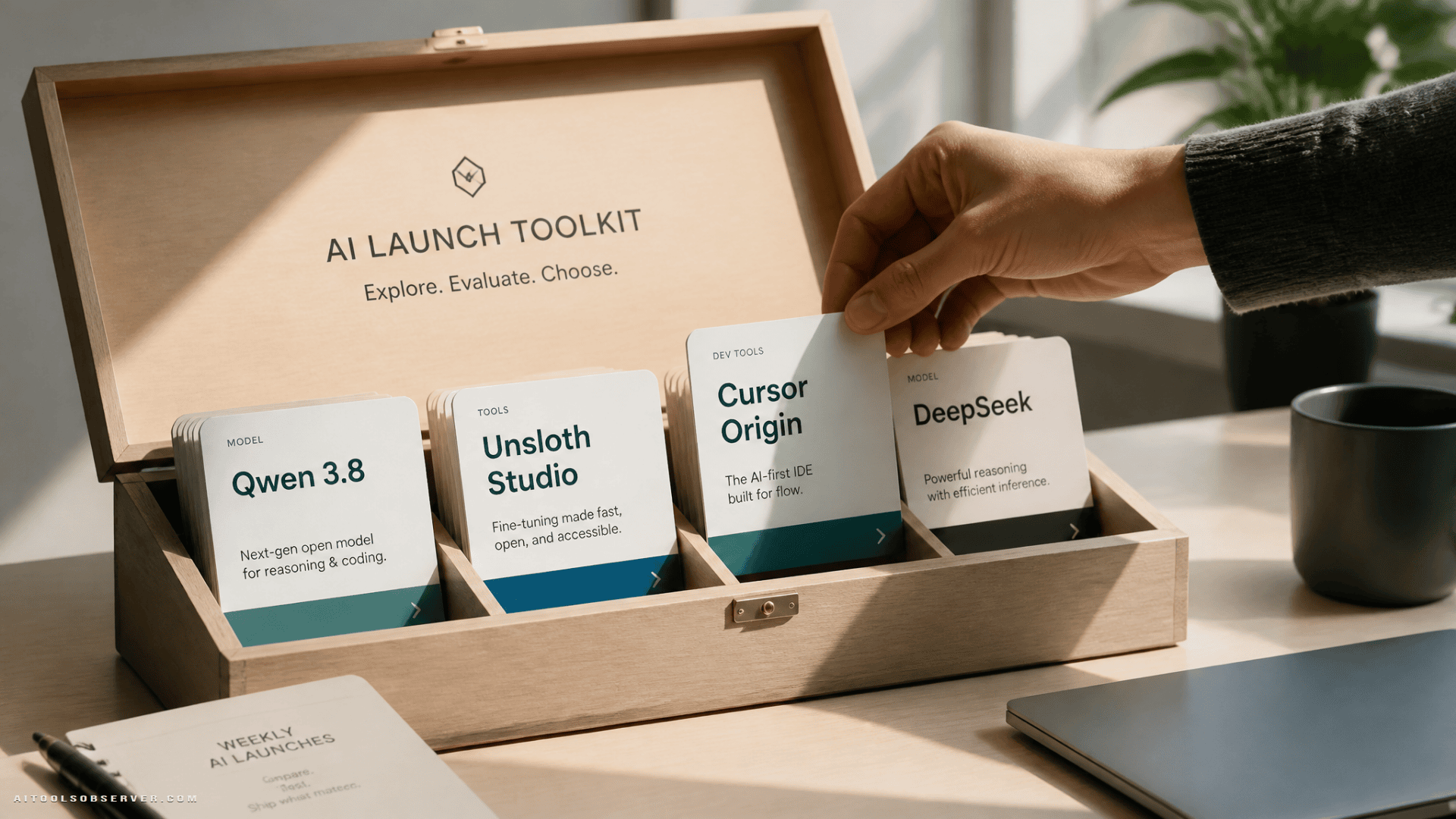
Qwen 3.8: Open Models, Explained Without the Jargon
Qwen 3.8 is an open model, which means you can run it yourself instead of routing every prompt through ChatGPT or Claude. That matters if you care about privacy, cost at scale, or just want more control over what’s happening under the hood.
The practical question isn’t “is it as good as GPT-4?” It’s “is it good enough for what I need, and does running it myself make sense for my situation?” For a growing number of use cases — internal tools, document processing, experimentation — the answer is increasingly yes.
Unsloth Studio: Local AI Without the Terminal Nightmare
Running AI locally has historically meant a long afternoon of error messages and Stack Overflow tabs. Unsloth Studio appears to be positioned as a friendlier on-ramp — a way to run and experiment with models on your own hardware without needing to be comfortable in a command line.
If you’ve been curious about local AI but kept bouncing off the setup friction, this is the kind of tool worth watching. The gap between “technically possible” and “actually usable” is where most people give up.
Hosting AI Locally: What’s Actually Changed
Running AI on your own hardware used to be a hobbyist project. It’s becoming a legitimate option for small teams and solo builders who want to avoid per-token costs or keep sensitive data off third-party servers.
The tradeoffs are real: you need decent hardware, some patience, and a clear reason to bother. But the tooling has improved enough that the conversation has shifted from “can you do this?” to “should you?”
Cursor Origin: Your Code Editor Wants to Host Your App Too
Cursor has been a popular AI-powered code editor for a while. With Cursor Origin, it appears to be expanding into hosting — meaning you could potentially write, build, and deploy from the same environment.
For developers building apps, websites, or internal tools with AI assistance, consolidating those steps is genuinely useful. The question worth asking: does tighter integration mean more convenience, more lock-in, or both?
DeepSeek Harness: What an “Agent Harness” Actually Is
“Agent harness” sounds like something you’d need a computer science degree to care about. It isn’t. An agent harness is essentially a framework for controlling how AI agents run tasks — what order, with what tools, under what constraints.
DeepSeek Harness is drawing developer attention as a structured way to manage that complexity. If you’re building anything where AI needs to take multiple steps in sequence, this category of tooling is worth understanding even if you don’t use this specific one.
Buzz + Berd: Reusing What You’ve Already Built
One of the quiet frustrations of working with AI tools is rebuilding the same setup every time you switch apps or start a new project. Buzz and Berd appear to be tackling that — offering ways to organize and reuse agents, skills, and tools across different AI applications.
It’s an unglamorous problem, but it’s a real one. Portability and reuse are underrated features in a space that loves to talk about raw capability.
The Bigger Picture This Week
A few threads worth noticing across all of these:
- Open and local models are getting easier to use. The tooling is catching up to the ambition.
- Developer tools are expanding their surface area. Cursor hosting code is one example of editors becoming platforms.
- Agent infrastructure is maturing. Harnesses, skill libraries, and reuse patterns are signs that people are building seriously with agents, not just experimenting.
What’s Actually Worth Trying
If you’re a developer or technical builder, Cursor Origin and DeepSeek Harness are worth a closer look this week. If you’ve been curious about running models locally, Qwen 3.8 paired with Unsloth Studio is a reasonable starting point that doesn’t require turning your afternoon into a debugging session.
If none of these feel immediately relevant — that’s fine too. Not every week’s launches are for every person. Knowing what to skip is half the value of paying attention.












Comments (0) No comments yet
Want to join this discussion? Login or Register.
No comments yet. Be the first to share your thoughts!