


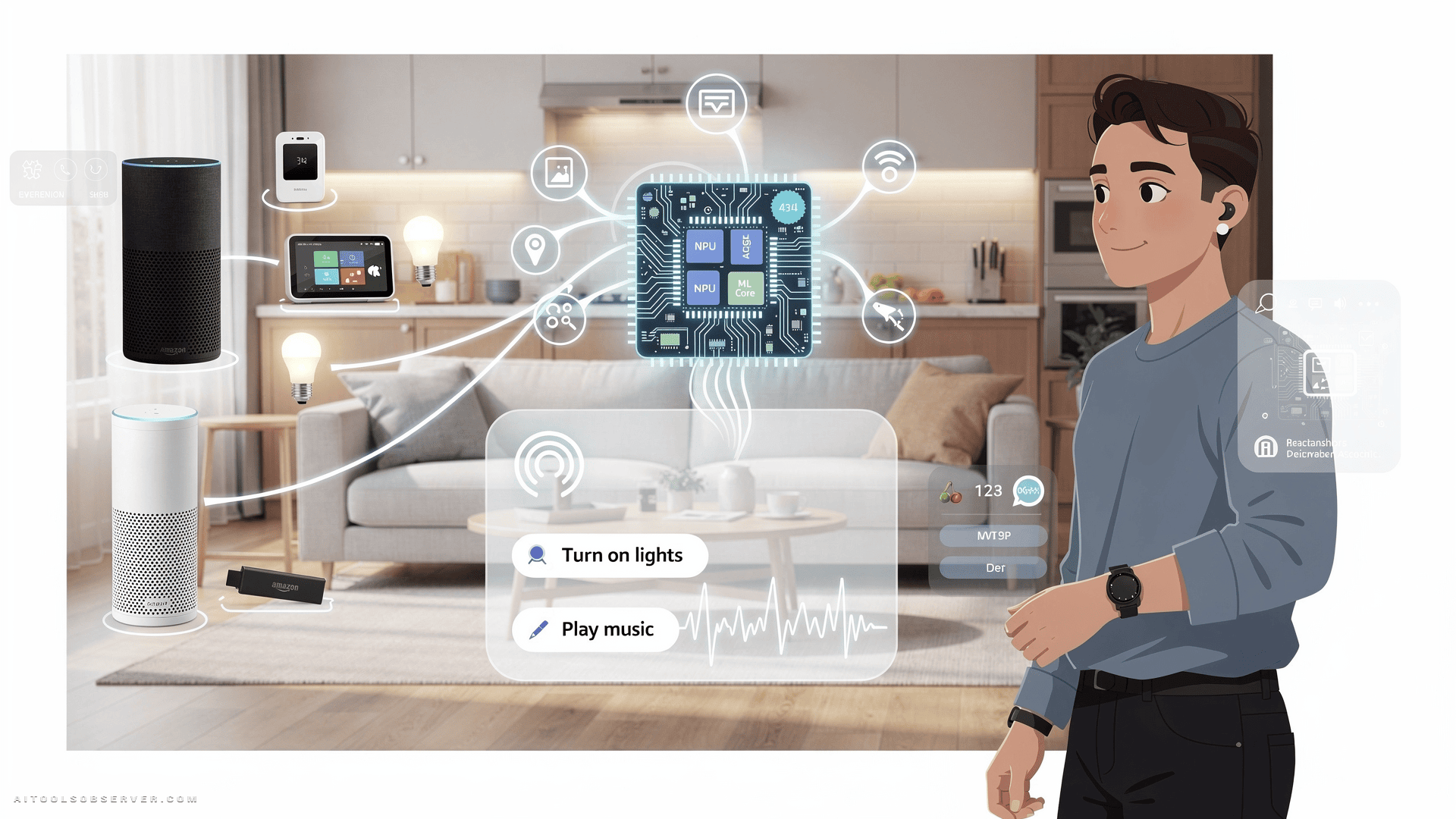
The AZ3 Chip: Why Custom Silicon Is Now Strategic, Not Optional

Amazon unveiled its AZ3 and AZ3 Pro chips in October, designed specifically to run AI models on-device rather than routing inference through the cloud. The chips are already deployed in the Echo Show 8, Echo Show 11, and Fire TV — devices that sit at the center of Amazon’s home ecosystem.
The decision to build end-to-end silicon mirrors what Apple has done for years with its own chip architecture. Control over the hardware-software interface is not a luxury at this level of AI integration — it is a prerequisite. Latency, privacy, and reliability all depend on it.
Panay was explicit about the reasoning: delivering an ambient home experience in a secure way requires thinking about hardware delivery from the ground up. Amazon still sources chips from Qualcomm for certain devices, but the strategic priority is clear — critical devices get custom silicon.
What “On-Device AI” Actually Changes
Running AI locally is not simply a performance optimization. It changes the trust model entirely. Queries that never leave the device cannot be intercepted, logged externally, or delayed by network conditions.
For a company whose devices sit in bedrooms, kitchens, and living rooms, this matters enormously. The AZ3 architecture positions Amazon to make credible privacy claims at a moment when consumers are increasingly skeptical of cloud-dependent assistants.
Alexa+: From Command Interface to Contextual Intelligence

Alexa+ reached general availability in the United States this year, and it represents a meaningful departure from the original Alexa model. Where the first generation responded to discrete commands, Alexa+ is designed to learn context, retain user patterns, and handle complex, multi-step tasks.
The strategic purpose is ecosystem cohesion. Amazon operates an unusually broad hardware portfolio — Echo devices, Fire TV, Ring doorbells, and now wearables. Alexa+ is the connective layer that makes these products function as a unified system rather than a collection of separate gadgets.
This positions Amazon directly against OpenAI’s ChatGPT and Google Gemini, both of which are aggressively pursuing the consumer AI assistant market. Google has the structural advantage of Android’s distribution reach, and Samsung is embedding Gemini deeply into its device lineup. Amazon’s counter is ecosystem lock-in through hardware ownership — a moat that pure software players cannot easily replicate.
The Competitive Pressure Is Real
The assistant market is consolidating quickly. Users will not maintain three or four competing AI assistants indefinitely. The platform that best integrates with daily physical environments — home, commute, workplace — will capture the most durable engagement.
Amazon’s hardware breadth is an asset here that Google and OpenAI do not possess. The question is whether Alexa+ can deliver the contextual quality that justifies that ecosystem investment.
Ambient Computing: The Design Philosophy Behind the Roadmap
Panay’s most significant statement was not about a specific product — it was about a paradigm shift.
“I think we might be moving away from a world of apps and screens,”
he said, pointing to conversation and context as the defining interaction model for AI assistants.
This is not a novel observation in technology circles, but hearing it from the executive overseeing Amazon’s device portfolio gives it operational weight. It signals that future Amazon hardware will be designed around ambient presence rather than active engagement.
The implications for product design are substantial. Devices optimized for ambient intelligence are always-on, contextually aware, and architecturally invisible. They collect data continuously, maintain state across locations, and surface information without requiring the user to initiate a query.
Wearables as the Mobile Layer
Amazon’s acquisition of Bee — a startup producing $49.99 voice-enabled wristbands — makes considerably more sense in this context. The wristband captures voice, creates lists, answers questions, and drafts notes. It is a low-friction, always-present data collection and interaction point.
Panay described a “whole roadmap of on-the-go devices” — gadgets people carry, talk to, and collect data through. The design goal is continuity: when a user moves from home to commute to office, their context travels with them. “That connection stays consistent and contextual,” he said, adding that Amazon’s first product in this category would arrive soon.
This is the ambient computing vision made concrete. The wristband is not the endpoint — it is the proof of concept for a broader mobile-ambient integration strategy.
What This Means for the AI Tools Ecosystem
Amazon’s hardware roadmap has direct implications for how AI tools and platforms compete in the consumer space. The company is not building isolated gadgets — it is constructing a vertically integrated AI delivery system, from custom silicon to cloud services to physical form factors.
For AI tool builders and platform developers, this raises a pointed question: if Amazon succeeds in making Alexa+ the ambient intelligence layer of the home and the body, what distribution channels remain accessible to independent AI applications?
The app-and-screen model that Panay is moving away from is precisely the model that most consumer AI tools currently depend on. A shift toward voice-first, context-persistent, ambient interfaces would restructure the entire consumer AI stack.
Three Signals Worth Tracking
- Custom silicon adoption across Amazon’s device lineup will indicate how quickly the company can scale on-device AI capabilities. Watch for AZ3 deployment expanding beyond current Echo and Fire TV models.
- Alexa+ retention and engagement metrics will reveal whether contextual AI actually changes user behavior or remains a premium feature with limited adoption. Amazon has not yet published detailed figures.
- The wearable product launch Panay referenced will be the first concrete test of Amazon’s ambient, on-the-go device thesis. Its design, pricing, and integration depth will signal how seriously Amazon is pursuing this category.
Closing Reflection
Amazon’s AI hardware strategy is disciplined and architecturally coherent. Custom silicon, a more capable assistant, and a portfolio of ambient devices are not separate bets — they are interlocking components of a single infrastructure play.
The shift from screen-centric to ambient-contextual computing is real, and Amazon is positioning itself to own the physical layer of that transition. For anyone tracking the AI tools ecosystem, the more important question is not whether Amazon’s devices will improve — they will. The question is what kind of AI experiences remain possible outside the walled gardens that companies like Amazon are quietly, methodically constructing.







Comments (0) No comments yet
Want to join this discussion? Login or Register.
No comments yet. Be the first to share your thoughts!