


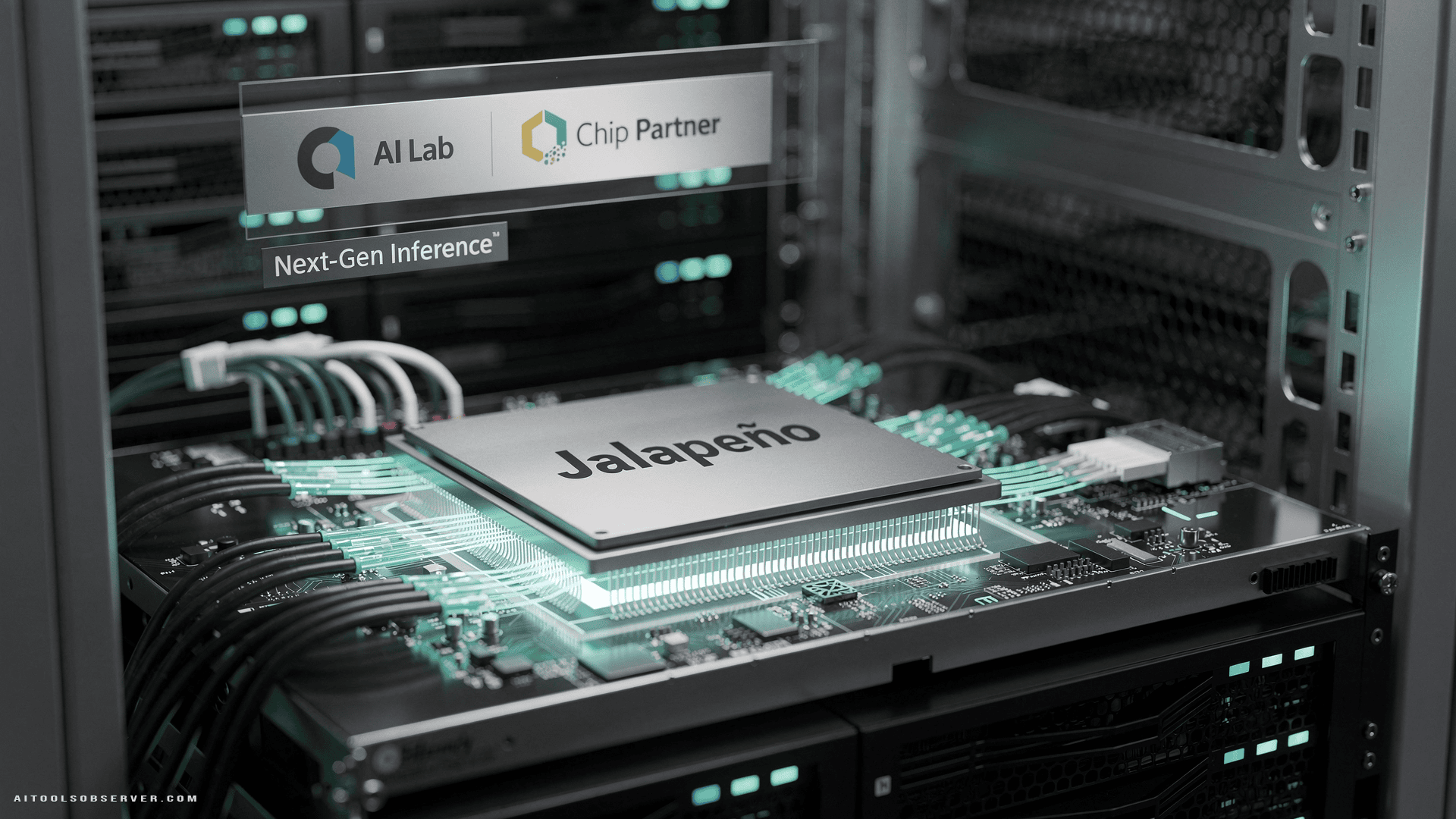
What Jalapeño Actually Is

Jalapeño is an ASIC — an Application-Specific Integrated Circuit. Unlike Nvidia’s general-purpose GPUs, which can handle a wide range of compute tasks, an ASIC is purpose-built for a narrower set of operations. In this case, that means running AI inference: the process of serving model outputs to users in real time across ChatGPT and OpenAI’s broader product suite.
The trade-off is well understood in the industry. ASICs sacrifice flexibility for efficiency. They cost less to operate at scale, consume less power per unit of compute, and can be optimized precisely for the workload they are designed to handle. For a company running inference at the scale OpenAI does, that efficiency gap compounds into significant savings.
OpenAI says it designed the chip in nine months — a notably compressed timeline for custom silicon development. The company also claims to have designed large portions of the surrounding computer system, reinforcing the “full stack” framing that OpenAI president Greg Brockman emphasized in the official statement.
The Strategic Logic: Full-Stack Control

OpenAI’s ambition here extends beyond cost reduction. The company is explicitly positioning Jalapeño as part of a broader infrastructure strategy — one where owning more of the compute stack translates directly into competitive advantage.
“By designing more of the stack ourselves, we can serve more intelligence with greater efficiency and keep pushing advanced AI toward broader access.” — Greg Brockman, President, OpenAI
This framing matters. It signals that OpenAI is no longer content to be a pure software and model company sitting atop third-party hardware. The move mirrors what Google did with its TPUs and what Amazon has pursued with Trainium — vertical integration as a lever for both cost control and differentiation.
The scale ambitions are substantial. OpenAI and Broadcom have previously stated a target of building enough chip infrastructure to require 10 gigawatts of power — a figure that underscores just how seriously OpenAI is treating its hardware buildout.
Why Now, and Why Broadcom
The timing is driven by demand. Since the generative AI boom OpenAI itself ignited in late 2022, the company has been one of Nvidia’s largest GPU customers. But GPU supply is constrained, expensive, and not optimized for inference at scale. OpenAI’s user growth has outpaced what a single-vendor hardware strategy can comfortably support.
Broadcom is a natural partner for this kind of work. The chipmaker has become one of the primary beneficiaries of the custom silicon trend, having already helped hyperscalers like Google and Meta design their own AI accelerators. Broadcom’s stock has risen roughly sevenfold since the end of 2022 — a direct reflection of how central custom chip design has become to the AI infrastructure economy. Following Wednesday’s announcement, shares climbed an additional 2%.
The relationship also fits into a broader pattern of OpenAI diversifying its silicon supply chain. Earlier in 2026, the company signed agreements with AMD, Cerebras (which went public in May), and Amazon Web Services for access to Trainium chips. Jalapeño is not a replacement for these partnerships — it is an addition that gives OpenAI a chip it fully controls.
Deployment Timeline and What Comes Next
The companies are targeting initial deployment of Jalapeño by the end of 2026, with expansion planned in subsequent years. The chip is being described as the first component in a broader platform the two companies are building together — branded as an “Intelligence Processor” and positioned as an AI accelerator designed to make inference faster, more reliable, and more cost-accessible.
The platform framing is deliberate. Jalapeño is not presented as a one-off chip but as the foundation of an ongoing hardware roadmap. That distinction matters for anyone evaluating OpenAI’s long-term infrastructure trajectory.
What This Means for the AI Tools Ecosystem
For founders and product teams building on top of OpenAI’s APIs, the near-term impact is indirect but directionally positive. More efficient inference infrastructure typically translates into lower operational costs — and historically, those savings have eventually flowed through to API pricing.
For the broader AI hardware market, the signal is clear: the GPU monoculture is fracturing. Nvidia remains dominant in training workloads, but inference — the part of the stack that scales with user demand — is increasingly being contested by custom silicon from multiple directions. OpenAI entering this space with its own chip accelerates that shift.
The Jalapeño announcement is, in essence, OpenAI declaring that it intends to compete not just at the model layer, but at the infrastructure layer beneath it. That is a meaningful strategic commitment, and one that will take years to fully evaluate. The chip arriving on schedule, at the end of 2026, will be the first real test of whether the ambition holds.















Comments (0) No comments yet
Want to join this discussion? Login or Register.
No comments yet. Be the first to share your thoughts!