


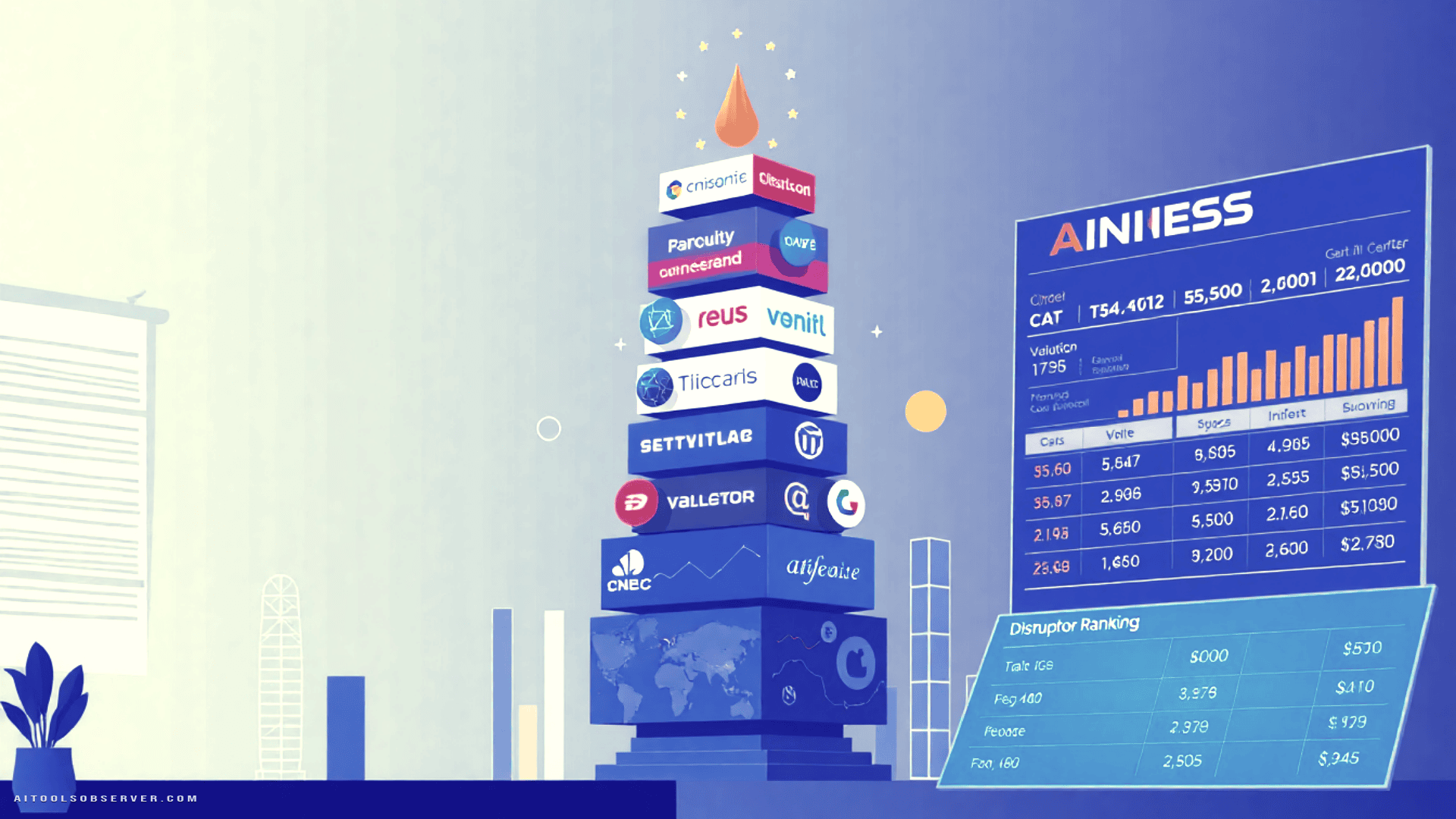
A New No. 1 — and What It Signals

Anthropic climbs to the top spot in 2026, displacing OpenAI for the first time. That’s not just a ranking shuffle — it’s a market signal.
Enterprise buyers have been quietly voting with their procurement budgets. Anthropic’s Claude has earned a reputation for reliability, safety-conscious design, and the kind of predictable behavior that CTOs actually sleep well after deploying. OpenAI still holds massive mindshare, but Anthropic is closing the valuation gap fast.
Two AI labs. One list. Zero signs of slowing down.
The Numbers Are Not Normal

Let’s just sit with these for a second.
Total funding across the 2026 Disruptors hit $337 billion — up from $127 billion in 2025. That’s a 2.5x jump in a single year. Total implied valuation went from $798 billion to $2.4 trillion, roughly tripling year over year.
The top AI firms are pulling the average up dramatically, but the broader signal is clear: venture capital has made its bet, and it’s spelled A-I in capital letters.
43 Out of 50 — AI Is the Default, Not the Differentiator

Here’s the stat that reframes everything: 43 of the 50 companies on this year’s list say AI is essential to their disruptive business model.
That means “we use AI” is no longer a pitch — it’s table stakes. The real question investors and buyers are asking now is how you use it, where in the stack you sit, and whether your AI integration is load-bearing or decorative.
The companies that make this list aren’t sprinkling AI on top. They’re building from it.
Silicon Valley’s Gravitational Pull

Geography still matters, even in a remote-first world.
Fourteen companies are headquartered in San Francisco. Eighteen sit in the broader Bay Area. Nearly half the entire list — 23 companies — are California-based. All of the top five are California companies except Ramp, which holds the No. 5 spot and represents the financial infrastructure layer that every AI-heavy company quietly depends on.
The concentration isn’t surprising. But it is a reminder that the AI ecosystem has a center of gravity, and it’s still very much in the Bay.
Vibe Coding Goes Mainstream

Cursor (No. 37) and Lovable (No. 39) are the headline acts here, with Replit (No. 42) rounding out a trio that’s redefining who gets to build software. Vibe coding — the idea that you describe what you want and the AI writes it — is no longer a novelty. It’s a workflow. These tools are compressing the gap between idea and shipped product to something approaching zero.
Prediction Markets Get Serious

Kalshi (No. 43) and Polymarket (No. 48) both make the list, signaling that prediction markets have crossed from crypto-adjacent curiosity into legitimate financial infrastructure. When CNBC puts two prediction market platforms on the same Disruptor list, the mainstream has arrived.
Europe Finally Shows Up

Mistral AI lands at No. 7 — the major European AI player making its first appearance on the list. Open-source, Paris-based, and increasingly relevant to enterprises that want AI without full dependency on American hyperscalers. Mistral’s inclusion isn’t just a nod to geography. It’s an acknowledgment that the AI stack is becoming genuinely global.
The Vertical Spread Is Real

AI infrastructure gets the headlines, but the 2026 list shows how deep the vertical penetration goes.
- Healthcare: Abridge (No. 30), Thyme Care (No. 18), Transcarent (No. 12), WHOOP (No. 44), Iambic (No. 33)
- Legal: Harvey (No. 24), Legora (No. 36)
- Defense: Anduril (No. 4), Shield AI (No. 49), Saronic (No. 40)
- Agriculture: Carbon Robotics (No. 22)
- Cybersecurity: Cyera (No. 9), Abnormal AI (No. 46), Vanta (No. 47)
- Robotics: Apptronik (No. 50)
From the farm to the law firm, from the operating room to the battlefield — the 2026 list reads like a map of every industry AI is currently rewriting.
What This Means for AI Tool Buyers

If you’re evaluating AI tools right now, the Disruptor 50 is a useful pressure test. Not because every company on it is the right fit for your stack — but because the list reveals where the market is moving, not just where it’s been.
A few practical reads:
Enterprise AI is consolidating around reliability. Anthropic’s rise isn’t about hype. It’s about consistent, deployable performance. Buyers are maturing.
The coding layer is being commoditized fast. Cursor, Lovable, and Replit competing on the same list means the “who builds software” question is being permanently disrupted. If your workflow still assumes only engineers ship code, that assumption has an expiration date.
Vertical AI is the next wave. The generic AI assistant is becoming a commodity. The specialized tool — trained on legal documents, medical records, or industrial sensor data — is where defensible value is being built.
The Stack Has a Shape Now

A year ago, the AI market felt like a gold rush with no map. The 2026 Disruptor 50 suggests the map is being drawn.
There’s a foundation layer (Anthropic, OpenAI, Databricks), a tooling layer (Cursor, Replit, Glean, Notion), a vertical layer (Harvey, Abridge, Carbon Robotics), and an infrastructure layer holding it all together (Ramp, Rippling, Vanta).
$2.4 trillion is a big number. But what it’s describing isn’t a bubble — it’s a stack. And the companies that understand where they sit in it are the ones worth watching.
The rest are just vibing.










Comments (0) No comments yet
Want to join this discussion? Login or Register.
No comments yet. Be the first to share your thoughts!