



The Job Description Nobody Expected

Meet Tanisha Reddy. Schoolteacher by day, robot trainer by morning and evening.
She records first-person videos of herself cooking, cleaning, and packing lunch — generating three to four hours of footage daily for Qanat Consulting Services, a firm in Andhra Pradesh. Her rate: under $4 per hour. Her verdict: “I am very happy.”
It sounds almost too simple to matter. But multiply Tanisha by thousands of workers across India, and you start to see the infrastructure taking shape beneath the next wave of robotics.
Why India, Why Now
India isn’t in the humanoid robot race by design. It’s in it by circumstance — and that’s actually the more durable kind of advantage.
The world’s second-largest workforce, combined with relatively low labor costs, makes India a natural fit for the most labor-intensive part of AI development: data collection. Robots built in labs need to learn the real world. That learning requires video. Lots of it.
Several companies have emerged in under a year to fill exactly this gap — recruiting workers to record egocentric footage, annotate it, and ship it to clients in the U.S. and China. The pipeline is simple. The scale is not.
The Market They’re Feeding

The numbers behind humanoid robotics are hard to ignore.
Barclays projects the humanoid robot market will hit $200 billion within a decade. Morgan Stanley goes further — forecasting it surpasses $5 trillion by 2050, with a global fleet approaching one billion robots.
Every one of those robots needs to learn dexterity. How to hold an egg without cracking it. How to grip a water bottle without crushing it. That distinction — pressure, texture, resistance — requires millions of hours of human demonstration video before a robot hand can approximate it.
Neocambrian AI, a Noida-based startup, estimates it would take 100 million hours of video to reach human-level dexterity. India is working on it.
From Collectors to Converters
Here’s the tension hiding inside this opportunity: data collection is already being commoditized.
Thaslim Pattan, founder of Qanat Consulting Services, told CNBC that contract prices have halved within months as competition multiplies. The work is real, but the margins are shrinking fast. Sound familiar? It’s the classic outsourcing trap — volume without ownership.
The smarter players are already pivoting.
Neocambrian AI isn’t waiting for client briefs. It builds datasets proactively, retains ownership, and sells pre-built data products. Founder Abhinav Kukreja frames it plainly:
“Across the AI stack, this is the only layer where India can not only participate but win.”
Humyn Labs is taking a similar angle — focusing on data conversion rather than raw collection, sourcing from Latin America (50%), India (35%), and elsewhere in Asia (15%), and building diversified datasets it controls. Co-founder Manish Agarwal puts the strategic imperative in four words:
“evolve from collector to converter.”
The OS Analogy Worth Remembering
Experts draw a useful parallel: robots, like smartphones, have hardware and an operating system.
India has a long road ahead on the hardware side. But the OS layer — the data, the training logic, the dexterity models — is where Indian firms could carve out lasting relevance. It echoes the country’s IT services playbook, except this time the output isn’t code. It’s robot cognition.
That’s a different kind of leverage.
What This Means for the AI Tools Ecosystem
For anyone tracking where AI development actually happens — not just where it gets announced — India’s data factory moment is a signal worth watching.
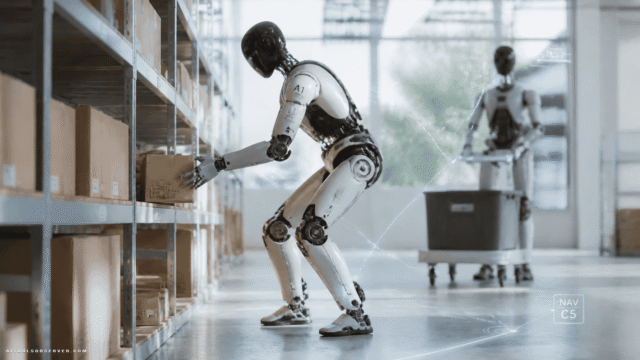
The robotics stack is hungry. The demand for high-quality, real-world human demonstration data is only going to grow as humanoid deployments scale from labs to warehouses to homes. Whoever owns the best datasets, not just the most data, will have pricing power.
The companies that survive this wave won’t be the ones with the most workers recording videos. They’ll be the ones that turned those videos into proprietary, structured, dexterity-focused datasets that robotics firms can’t easily replicate elsewhere.
The Takeaway
India’s entry into the AI race isn’t through chips or foundation models. It’s through something more fundamental — human behavior, captured at scale, converted into machine intelligence.
The workers wearing smartphones on their heads in Chennai aren’t just earning side income. They’re quietly writing the curriculum for the next generation of robots.
The question for Indian startups isn’t whether the opportunity is real. It clearly is. The question is whether they move up the value chain fast enough before the window closes — because in AI, commoditization doesn’t wait.







Comments (0) No comments yet
Want to join this discussion? Login or Register.
No comments yet. Be the first to share your thoughts!