


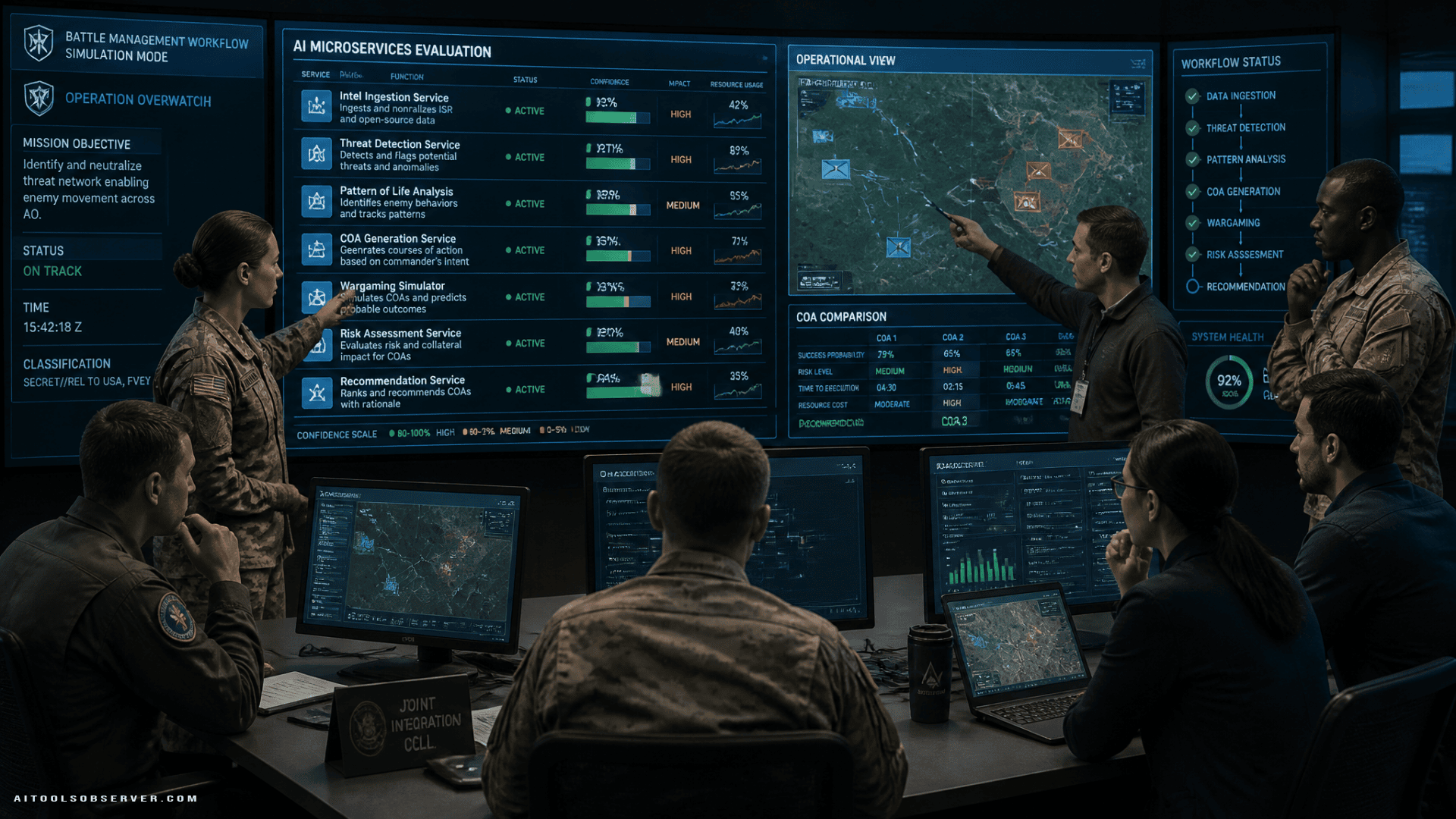
What MASH Actually Is — and Why It Matters

MASH is the latest evolution of the Air Force’s ongoing experimentation campaign under the Advanced Battle Management System (ABMS) Cross-Functional Team, run in partnership with the Air Force Research Laboratory, the U.S. Space Force, and the 805th Combat Training Squadron — better known as the Shadow Operations Center-Nellis (ShOC-N).
Its predecessor, the Decision Advantage Sprint for Human-Machine Teaming (DASH), focused on building and testing AI tools for individual subfunctions of the command-and-control process. MASH raised the complexity significantly: it integrated multiple subfunctions into a single, cohesive operational workflow and stress-tested that workflow through repeated simulated combat scenarios.
Six industry teams and the 805th’s own software engineers participated, each tasked with building purpose-built AI tools targeting three core decision-making functions: entity identification and categorization, capability matching, and course-of-action generation. The goal was not to build one monolithic AI system, but to assemble modular microservices that could operate together seamlessly.
The 80% Figure: What It Represents

The headline number comes directly from the operators who used the tools. Captain Adam Sochia, an air battle manager from the 552nd Operations Support Squadron, described the shift in plain terms: a tasking process that previously took his team 50 to 60 minutes could now produce five or six completed taskings in the same window.
That is not a marginal efficiency gain. It is a structural change in throughput — the kind of improvement that alters what is operationally possible during high-tempo engagements.
Colonel John Ohlund, director of the ABMS CFT, framed it at the strategic level: initial data trends confirm a significant acceleration in decision-making speed, validating the potential for human-machine teaming to expand the volume of viable options available to commanders. More options, delivered faster, under pressure — that is the core value proposition MASH is proving out.
Microservices Over Monoliths

The design philosophy at the heart of MASH deserves careful attention. Rather than building a single, integrated AI platform, the Air Force is deliberately pursuing a modular microservices architecture where different industry teams compete to deliver best-of-breed solutions for specific subfunctions.
This approach mirrors patterns that have proven durable in commercial software engineering — but applying it to defense-grade, real-time decision systems introduces serious integration challenges. Different companies produce different data formats, ontologies, and metadata structures. Without a unifying layer, the architecture collapses into incompatibility.
The AFRL Orchestrator: The Critical Enabler

The solution came from the Air Force Research Laboratory, which developed an orchestration tool capable of ensuring seamless data exchange between independently built microservices. Ohlund described it directly: AFRL built an orchestrator that allows different companies to exchange data, ontologies, and metadata without friction.
This is the architectural breakthrough that makes the entire system viable. The orchestrator functions as the connective tissue between competing, modular AI components — enabling a plug-and-play model where the government can continuously select and swap in superior services as the market matures. Competition becomes a feature, not a complication.
Space Force Integration: A Signal About Multi-Domain C2

MASH was the first ShOC-N experiment to include active participation from Space Force guardians alongside Air Force airmen. This was not symbolic. Guardians brought domain-specific expertise for the space environment and provided direct feedback to developers on the AI tools’ decision logic and operational limitations.
The insight that emerged is architecturally significant: despite operating across vastly different timelines and distances, the air and space domains share an identical fundamental requirement — rapid, synchronized decision-making. The battle management software was built from the ground up to reflect that shared requirement.
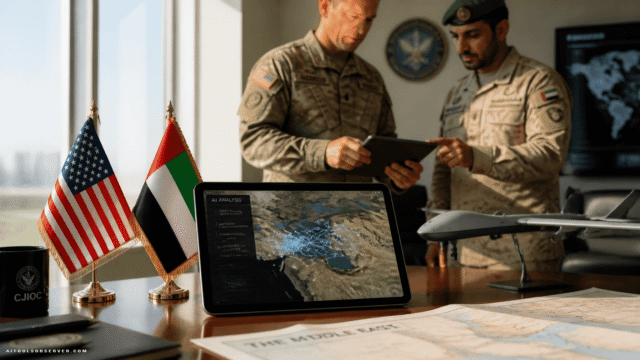
This points toward a broader trajectory. The Air Force intends to invite members from all military services into future experiments, progressively building an operational blueprint for multi-domain command and control. MASH is not an Air Force experiment that happens to include Space Force. It is the early prototype of a joint, multi-domain C2 architecture.
The Workflow Logic: What the AI Actually Does

It is worth being precise about what these AI tools automate, because the framing matters for anyone evaluating analogous enterprise applications.
The three automated functions — entity identification, capability matching, and course-of-action generation — represent the analytical groundwork that precedes a commander’s decision. The AI does not make the decision. It processes incoming data streams, categorizes the situation, identifies available assets, and generates a ranked menu of options. The human commander then chooses.
Ohlund articulated this division of labor clearly: the computers ruminate over every possible multi-domain effect so that the highest quality menu of decisions can be presented to the right commander, faster than ever before. The AI handles cognitive volume. The human retains decision authority.
This is a precise and replicable model for human-machine teaming — one that has direct parallels in commercial AI deployment across legal, financial, and operational domains.
Modular AI Is Becoming the Dominant Architecture

The MASH experiment validates a design pattern that is increasingly visible across enterprise AI: purpose-built microservices, connected by orchestration layers, outperform monolithic platforms in complex, high-variability environments. The Air Force is not unique in discovering this — but it is demonstrating it under conditions that are far more demanding than most commercial deployments.
For AI tool builders and enterprise adopters, the implication is clear. Interoperability and orchestration capability are becoming primary selection criteria, not secondary features. A tool that cannot exchange data cleanly with adjacent systems is a liability in any integrated workflow.
Continuous Competition Drives Quality
The plug-and-play model the Air Force is building has a deliberate competitive dynamic embedded in it. Because individual microservices can be swapped out as better options emerge, vendors face ongoing pressure to improve. The government retains the ability to select best-of-breed at each layer of the stack.
This is a procurement philosophy with direct relevance to how organizations should structure their own AI vendor relationships — favoring modular contracts over platform lock-in, and building internal orchestration capability that preserves optionality.
Speed of Iteration Is the New Moat

The two-week sprint format of MASH — with operators providing immediate feedback to developers in a co-creation environment — compressed what would traditionally be a multi-year development cycle into days. The software development cycle accelerates precisely because the people using the tools are in the same room as the people building them.
This user-producer co-creation model is not new in agile software development. What is new is its application to defense-grade AI systems under simulated operational stress. The speed of iteration, not the sophistication of any single tool, is what drives compounding improvement.
The Road Ahead
The ABMS CFT and the 805th will continue running AI wargames through the remainder of 2026, progressively expanding participation across military services and increasing the complexity of the scenarios tested. Each iteration is designed to refine the operational blueprint for multi-domain C2.
The trajectory is deliberate and methodical. DASH proved individual microservices. MASH proved integrated workflows. The next phase will likely prove joint-force interoperability at scale.
Closing Reflection
MASH is a case study in what disciplined AI experimentation looks like when it is designed to produce actionable results rather than demonstrations. The 80% reduction in tasking time is not a marketing claim — it is an operator’s direct account of what changed in their workflow.
The deeper lesson is architectural. Modular microservices, connected by a robust orchestration layer, tested under realistic conditions, and iterated rapidly through user feedback — this is the pattern that produced the result. It is replicable, and it is already pointing toward how the most demanding real-time decision environments will be structured in the years ahead.
For anyone building, evaluating, or deploying AI tools in complex operational contexts, MASH is worth studying closely. The Air Force is not just testing technology. It is defining a methodology.














Comments (0) No comments yet
Want to join this discussion? Login or Register.
No comments yet. Be the first to share your thoughts!