



The Problem Olive Young Was Trying to Solve

Enterprise AI adoption has a well-documented gap. Tools get deployed. Employees get access. And then almost nothing changes at scale.
Deloitte’s 2026 State of AI in the Enterprise report found that while AI tools are now available to workforces at roughly 60 percent of surveyed organizations globally, moving from pilot to production remains the defining challenge. Most companies are stuck in the middle — employees can technically access AI, but they don’t reliably deploy it into real workflows.
Olive Young also faced a more specific risk: shadow AI. When staff paste sensitive product data, customer records, or logistics information into public AI interfaces to meet deadlines, that data can feed external model training pipelines. For a retailer with proprietary catalog data and a fast-growing international customer base, that’s an unacceptable exposure.
The sandbox was built to solve both problems at once.
What the AI Sandbox Actually Is

The sandbox functions as a secure, isolated environment — a walled garden where employees can share AI-driven projects, test in-house features, and validate outputs without touching production systems or exposing proprietary data externally.
Inside it, employees can experiment with AI agents and open Model Context Protocol (MCP) integrations. Completed work gets shared internally, reviewed, and validated before it moves anywhere near live systems. The environment doubles as a collaboration hub, designed to raise AI literacy across the organization rather than concentrate it in technical teams.
CJ Olive Young CTO Kim Hwan framed the philosophy clearly at AWS Summit Seoul on May 21, 2026: as AI increasingly handles engineering tasks, the human premium shifts toward adaptability.
“We need to build sophisticated infrastructure so engineers can focus purely on innovation,” he said.
The sandbox is that infrastructure — not just for engineers, but for everyone.
The Infrastructure Layer: Gemini Enterprise

Underneath the sandbox sits Olive Young’s April 2026 deployment of Google’s Gemini Enterprise — making it the first retailer in Korea to roll out the platform across its entire workforce.
Gemini Enterprise isn’t a generic chatbot layer. It lets organizations build and deploy customized AI tools on top of their own proprietary data. For Olive Young, that means AI tools trained on internal product catalogs, sales patterns, logistics records, and customer interaction data — not public model knowledge that has no idea what a Korean beauty retailer’s inventory looks like.
That distinction matters enormously. An AI tool that knows Olive Young’s actual data can surface actionable insights. One that doesn’t is just autocomplete with extra steps.
The company plans to extend the platform across logistics networks, real-time in-store inventory monitoring, and localized product recommendations tailored to the language and buying habits of customers in each international market — a capability that becomes critical as global expansion accelerates.
The Most Significant Part: Non-Developers Are Building Tools

Here’s where Olive Young’s approach separates from the pack.
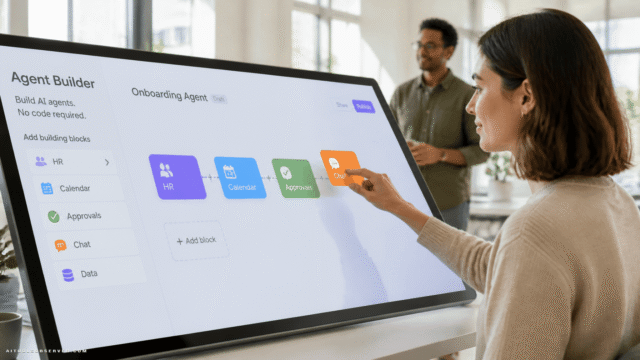
Merchandisers and marketing staff — roles that have historically been downstream consumers of AI outputs — can now build their own AI tools directly. Tasks that previously required a developer ticket or were completed manually, including market research compilation and customer data analysis, become self-service under the new model.
How the Training Works
Olive Young is launching a series of AI workshops calibrated specifically for non-developers. The goal isn’t to turn marketing managers into prompt engineers. It’s to give those managers enough working fluency to automate the specific, repetitive tasks they currently do by hand.
That’s a meaningful distinction. Olive Young isn’t asking non-technical staff to learn AI broadly — it’s asking them to identify one or two tasks they do every week and figure out how to stop doing them manually.
The AI Frontier Program
To sustain momentum beyond the initial training push, Olive Young is rolling out an internal AI Frontier Program that formally recognizes employees who use AI to produce measurable productivity gains or change how their teams work.
This is smart organizational design. One-off training events rarely produce lasting behavior change. Tying recognition to demonstrated, replicable improvements turns AI adoption into an ongoing habit rather than a box-checking exercise.
How This Compares to What the Rest of Retail Is Doing

Olive Young’s internal-first model runs counter to the dominant retail AI pattern of 2026, which has focused primarily on customer-facing applications.
Ulta Beauty, for example, announced at Google Cloud Next on April 22, 2026 that it was deploying a Gemini-powered customer-facing AI shopping assistant. That’s a logical place to start — visible ROI, direct revenue connection, easier to measure.
Olive Young is inverting that sequence entirely. It’s building internal AI competency first, across every organizational layer, before fully turning AI outward toward consumers. The bet is that a workforce that genuinely knows how to use AI will eventually build better customer experiences than one that simply has AI tools bolted onto the front end.
It’s a longer game. But it’s a more structurally durable one.
What the Numbers Say About the Opportunity

The business case for getting this right is significant.
Olive Young’s global online mall reported overseas sales up 70 percent year-on-year in the first half of 2025, with order volumes up 60 percent. That growth rate increases both the opportunity and the pressure to deliver differentiated, localized experiences at scale — exactly what AI-powered inventory monitoring and regional product recommendations are designed to support.
More than 60 percent of Korean companies already used multiple AI models in daily operations as of early 2026, according to AWS Korea data citing IDC research. The competitive baseline is rising fast. Companies that are still in pilot mode by the end of 2026 will be playing catch-up.
The Consumer Payoff: Personalization at Scale

The eventual customer-facing output of all this internal work is personalization that actually reflects local context.
Olive Young has signaled that AI will power real-time product display monitoring and inventory management in physical stores, as well as product information localized by language and regional customer profile for its international platforms. For a retailer expanding into the US market while managing a massive cross-border e-commerce operation, that localization capability is a genuine competitive differentiator.
“Our goal isn’t just to introduce AI tools or models,” an Olive Young spokesperson said. “We want to build the processes and the environment that let Olive Young’s way of working evolve hand-in-hand with AI.”
That framing is worth paying attention to. It signals that Olive Young isn’t treating AI as a feature to deploy — it’s treating it as a capability to build into the organization’s operating model.
Limitations Worth Noting
No case study is complete without an honest look at what’s still unproven.
Olive Young’s sandbox and Gemini Enterprise deployment are recent. The April 2026 rollout gives the company months of operational data at best. Long-term results — whether non-developer tool-building actually sticks, whether the AI Frontier Program produces sustained behavior change, whether internal AI competency translates into measurable customer experience improvements — remain to be seen.
The approach also requires significant organizational investment. Running AI workshops, maintaining a secure sandbox environment, and building a recognition program takes resources. Smaller retailers without Olive Young’s scale and infrastructure budget will find this model harder to replicate directly.
And the internal-first sequence, while strategically coherent, delays the customer-facing AI capabilities that competitors are already shipping. That’s a calculated trade-off, not a costless one.
The Takeaway for AI Tool Observers

Olive Young’s AI sandbox is one of the clearest real-world examples of what enterprise AI adoption looks like when it’s designed for the whole organization rather than a technical subset of it.
The combination of a secure experimentation environment, proprietary-data-trained tools via Gemini Enterprise, non-developer-focused training, and a formal recognition program addresses the four most common failure points in enterprise AI rollouts: data risk, generic outputs, skill gaps, and adoption decay.
Whether the results match the ambition will take time to verify. But the structural design is sound — and for anyone comparing how retailers are approaching AI in 2026, Olive Young’s internal-first model is the clearest counterpoint to the customer-facing-first default.
The companies that figure out how to make AI a workforce capability rather than a department tool will have a durable advantage. Olive Young is betting it can be one of them.












Comments (0) No comments yet
Want to join this discussion? Login or Register.
No comments yet. Be the first to share your thoughts!