


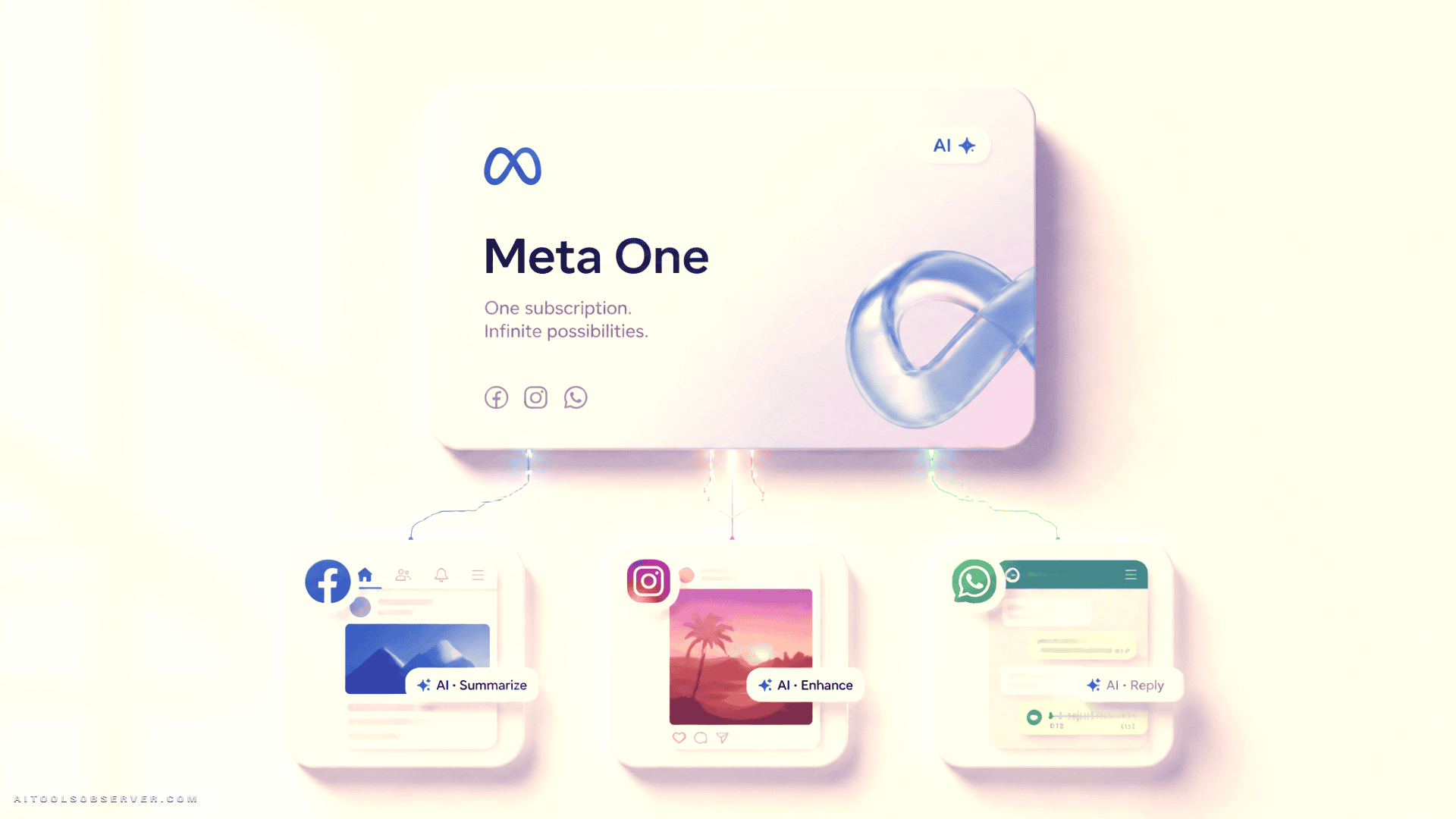
What Meta One actually is
Meta One is positioned as a bundled subscription for Facebook, Instagram, and WhatsApp. It appears to bring together features previously tied to separate paid plans such as Instagram Plus, Facebook Plus, and WhatsApp Plus, while emphasizing access to more advanced AI capabilities.
The key idea is not just convenience. It is packaging AI as a cross-app consumer service rather than as a feature inside one product.
That matters because Meta’s apps serve different jobs:
- Facebook for communities, feeds, and identity
- Instagram for content creation and audience presence
- WhatsApp for messaging and direct communication
A single subscription across those surfaces gives Meta a cleaner way to sell AI assistance everywhere a user posts, edits, shares, or chats.
Why this launch matters
Meta is not only selling premium app features. It is also training users to think of AI as a recurring consumer utility.
That is a meaningful shift. For a long time, AI subscriptions were mostly associated with standalone assistants, writing tools, or image generators. Meta One suggests a different packaging model: AI embedded inside familiar social and messaging products, sold as a lifestyle bundle.
For consumers, the pitch is straightforward: get more features and AI built into the apps you already use.
For the market, the signal is broader: large platforms increasingly believe AI is easier to monetize when it is attached to habit, not novelty.
How Meta One compares to Apple One
The comparison to Apple One is useful, but the products are not identical in purpose.
Apple One is broadly understood as a services bundle built around convenience, retention, and ecosystem depth. Meta One appears to follow that same commercial logic, but with a stronger emphasis on AI-driven creation, personalization, and communication features. In the context of Apple Intelligence, the distinction becomes clearer.
Here is the clearest way to think about the difference:
- Apple One bundles services across media, storage, and device ecosystem value
- Meta One appears to bundle app-level premium features with AI across social and messaging use cases
In other words, Apple’s bundle is about making its ecosystem more complete. Meta’s bundle appears more focused on making its apps more capable.
That distinction matters for buyers. If you want one subscription to simplify entertainment, storage, and device-linked services, Apple’s model is familiar. If you want AI features where you already post, message, and create social content, Meta One is aiming at that daily workflow.
The real product is cross-app AI behavior
The most important part of Meta One may not be the bundle itself. It may be the behavioral loop the bundle encourages.
If one subscription unlocks AI assistance across three of the world’s most-used consumer apps, users no longer need to decide whether AI is worth paying for in a single isolated context. The value comes from repeated use across many small tasks.
Examples could include:
- drafting or refining posts
- helping create visual or text variations for Instagram content
- improving replies or communication inside WhatsApp
- applying personalization features across profiles and presence
Even without detailed feature breakdowns, the strategic direction is clear. Meta is trying to make premium AI feel ambient, frequent, and native to its apps.
Why Meta bundled now
Bundling usually solves three business problems at once:
- It raises perceived value
- It reduces friction from managing multiple subscriptions
- It improves retention by tying several products into one payment decision
Meta had already introduced app-specific premium plans earlier in the year, according to the provided context. A bundle is the next logical move.
Instead of asking users to evaluate Facebook Plus, Instagram Plus, and WhatsApp Plus separately, Meta One simplifies the decision. If a user gets value from two or more Meta apps, the bundle becomes easier to justify than individual add-ons.
That is the same playbook many subscription businesses follow. The difference here is that AI is no longer an extra feature. It is becoming the main reason the bundle exists.
What this means for users
For users, Meta One could be attractive for one reason above all: consolidation.
If someone already uses Meta’s apps heavily, a unified plan may reduce both cost complexity and feature fragmentation. Instead of premium tools being scattered across separate subscriptions, the user gets one package tied to the apps they open every day.
Still, there are practical tradeoffs.
Potential upside
- One subscription instead of several
- AI features available where users already spend time
- Better continuity across content creation, sharing, and messaging
- A simpler premium story for heavy Meta users
Likely concerns
- Users who rely on only one Meta app may see less value
- Bundles can hide whether individual features are truly useful
- AI inside social apps can be convenient without becoming essential
- Subscription overlap remains a real issue for users already paying for other AI tools
This is where the actual product experience will matter more than the packaging. A bundle can be neat on paper and still underdeliver if the included AI features save little time or solve only occasional problems.
What this means for the consumer AI market
Meta One adds pressure to a trend that is becoming harder to ignore: AI is being folded into broader subscriptions instead of remaining a standalone product category.
That changes how AI tools compete.
A standalone AI app has to prove direct value on its own. A bundled AI offering can win simply by being good enough and already included in services the user wants. This is one reason platform companies have an advantage. They can distribute AI through products with existing habits, audience scale, and billing relationships.
For smaller AI companies, this creates a tougher environment:
- Compete on depth, not convenience
- Focus on specialized workflows that bundled tools do not handle well
- Offer clearer ROI than general-purpose platform AI
For consumers, it means comparison gets more complicated. The question is no longer just “Which AI tool is better?” It becomes “Do I need a dedicated AI subscription if my existing platforms already include usable AI?”
A closer look at Meta’s positioning
The available description suggests Meta is presenting Meta One as a way to “create, connect and stand out” across its apps. That framing is notable because it blends utility with identity.
This is not only about productivity. It is also about self-expression, visibility, and communication quality within social environments.
That gives Meta a different angle from enterprise AI vendors and even from many general AI assistants. Its AI subscription appears tied to social performance and personal presence, not just task completion.
For creators, marketers, and power users, that could be relevant if the tools reduce the friction of posting, editing, iterating, and responding across channels.
What to watch next
The bundle announcement is the headline, but the more important questions come after launch.
Watch for these signals:
- whether users adopt Meta One because of AI or because of subscription convenience
- whether Meta keeps app-specific plans alongside the bundle
- whether the most compute-intensive AI features are reserved for paying subscribers
- whether bundled AI becomes sticky enough to reduce demand for separate tools
Those points will determine whether Meta One is merely a packaging change or a more durable shift in how consumer AI is sold.
Bottom line
Meta One looks less like a simple subscription cleanup and more like a strategic attempt to normalize paid AI across social and messaging apps. The Apple One comparison fits at the bundle level, but the underlying product logic is different: Meta is selling AI-infused participation inside its own app network.
If you already use Facebook, Instagram, and WhatsApp heavily, this is worth watching as a convenience play with potentially meaningful AI value. If you use only one Meta app, the bundle question is simpler: ignore the branding and ask whether the included AI features would save you time often enough to justify another subscription.













Comments (0) No comments yet
Want to join this discussion? Login or Register.
No comments yet. Be the first to share your thoughts!