



Oracle Health’s AI Patient Portal: Plain Language Meets EHR Integration
The core pitch here is straightforward. Oracle Health has built a patient portal that connects directly to its electronic health record and uses AI to translate clinical documentation into plain language that patients can actually understand.
Patients can ask questions like “How am I managing my diabetes?” or “Help me understand my cholesterol trends over the year,” and the AI responds using data pulled directly from their health record. No uploading documents. No third-party systems. The answers are grounded in the patient’s actual care plan.
This is another example of how EHR-connected AI is being positioned to support care understanding without requiring separate systems.
What It Does
- Explains diagnoses, test results, and treatment options in plain language
- Surfaces visit summaries, key conditions, medications, and outstanding tasks
- Enables natural language appointment scheduling, with AI recommending appropriate clinicians and time slots based on prior visits
- Shows lab and vital trends over time through chart-based insights
The portal is built with guardrails that prevent the AI from offering diagnoses or medical advice. When users push for clinical guidance, the system redirects them to their care team or, in emergencies, to 911. AI-generated responses are visually flagged and cite their sources—a practical transparency feature that matters in a healthcare context.
The Privacy Architecture
Patient data stays within Oracle’s secure clinical environment. No personal medical data is stored outside the Oracle system or shared with third-party models. For health systems already running on Oracle Health’s EHR, this is a meaningful integration advantage—patients get AI-assisted insights without their data leaving the existing infrastructure.
Oracle has positioned this as a tool that reduces administrative burden for care teams, not just a consumer-facing feature. When patients can self-serve answers about their records and schedule appointments without calling the front desk, that’s real operational relief.
In practice, these kinds of privacy and safety guardrails matter as much as the user experience.
Suvi Health: Ambient AI at the Bedside and Beyond
Suvi Health is solving a different but equally persistent problem: the information gap that opens up at the hospital bedside and widens after discharge.
Patients misremember what the doctor said. Families who weren’t in the room miss critical details. Instructions get lost between shift changes. Suvi Health’s ambient AI platform is designed to capture bedside conversations automatically and turn them into a shared, accessible record that patients, families, and care teams can all reference.
How the Technology Works
The platform uses device connectivity rather than manual activation. When a care team member enters a patient’s room, the system automatically starts recording the conversation on the patient’s phone. When the clinician leaves, recording stops. The patient can review that conversation in near real-time through the Suvi app.
That’s a meaningful design choice. It removes friction for both patients and clinicians—no one has to press a button, remember to activate anything, or interrupt their workflow.
Post-discharge, patients can use those recorded conversations to:
- Review medication schedules and complex instructions
- Share accurate details with family members and caregivers
- Prepare for follow-up appointments
- Track recovery tasks tied to discharge goals
The app also includes a chatbot, but it operates within a bounded knowledge engine. Answers can only come from the patient’s recorded care conversations or the Mayo Health Information Library. If the system can’t source an answer from those two places, it won’t generate one—a direct response to the hallucination problem that makes many healthcare AI deployments risky.
That bounded design reflects the kinds of constraints increasingly shaping patient-facing AI and broader ambient AI use in healthcare.
The Mayo Clinic Florida Pilot
Suvi Health partnered with Mayo Clinic Florida on co-development and is piloting the platform with heart failure patients. The goal is to improve care coordination and reduce length of hospital stay—a metric that matters both clinically and financially.
Heart failure patients typically face complex, multi-layered care plans. Better patient comprehension of those plans has a direct line to better outcomes and fewer readmissions. The pilot is designed to test whether ambient AI at the bedside can move those numbers.
The startup was incubated within the 1842 Studio, a venture studio backed by a VC fund anchored by the University of Notre Dame. Behavioral researchers from Notre Dame contributed to the app’s engagement design, while Mayo Clinic’s clinical team helped ensure the platform doesn’t disrupt existing EHR or clinician workflows.
Two Different Approaches to the Same Problem
It’s worth noting where these two tools diverge.
Oracle Health is working at the system level—a large, established health IT company extending its EHR platform to give patients a better interface with their existing records. The value proposition is integration depth and enterprise-grade security.
Suvi Health is working at the moment level—capturing what happens in the room and making it retrievable and actionable for patients and families. Its value proposition is ambient AI capture and post-discharge continuity.
Neither tool replaces clinical judgment. Both are explicit about that. Oracle’s portal redirects medical advice questions to care teams. Suvi’s chatbot loops in physicians when a question requires clinical expertise. That’s the right design posture for patient-facing AI in 2026—useful enough to reduce friction, bounded enough to avoid liability.
What This Means for Healthcare AI Buyers
If you’re evaluating AI tools for a health system or hospital, these two launches signal a clear directional shift: patient-facing AI is moving from scheduling bots and appointment reminders toward genuine care comprehension tools.
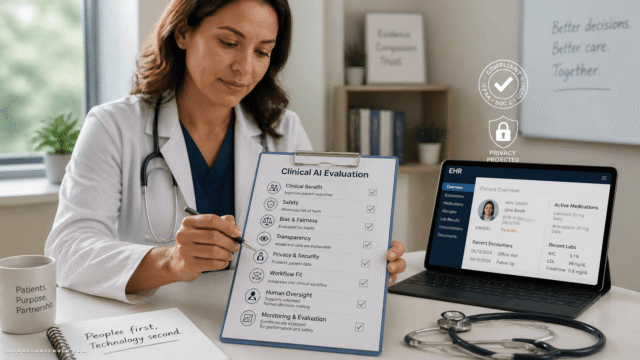
The questions worth asking before adopting either type of solution:
- Does it integrate with your existing EHR, or does it create a parallel data environment?
- How is the AI bounded—what can it answer, and what does it do when it can’t?
- Does it add workflow for clinicians, or does it genuinely operate in the background?
- What happens to patient data, and where does it live?
Both Oracle Health and Suvi Health have made deliberate choices on each of these dimensions. Whether those choices fit your infrastructure and patient population is the real evaluation question.
The broader takeaway: patient-facing AI is no longer a nice-to-have feature. It’s becoming a core component of care coordination strategy—and the tools that get the guardrails right will have a significant advantage over those that don’t.





Comments (0) No comments yet
Want to join this discussion? Login or Register.
No comments yet. Be the first to share your thoughts!