


What Is Being Built
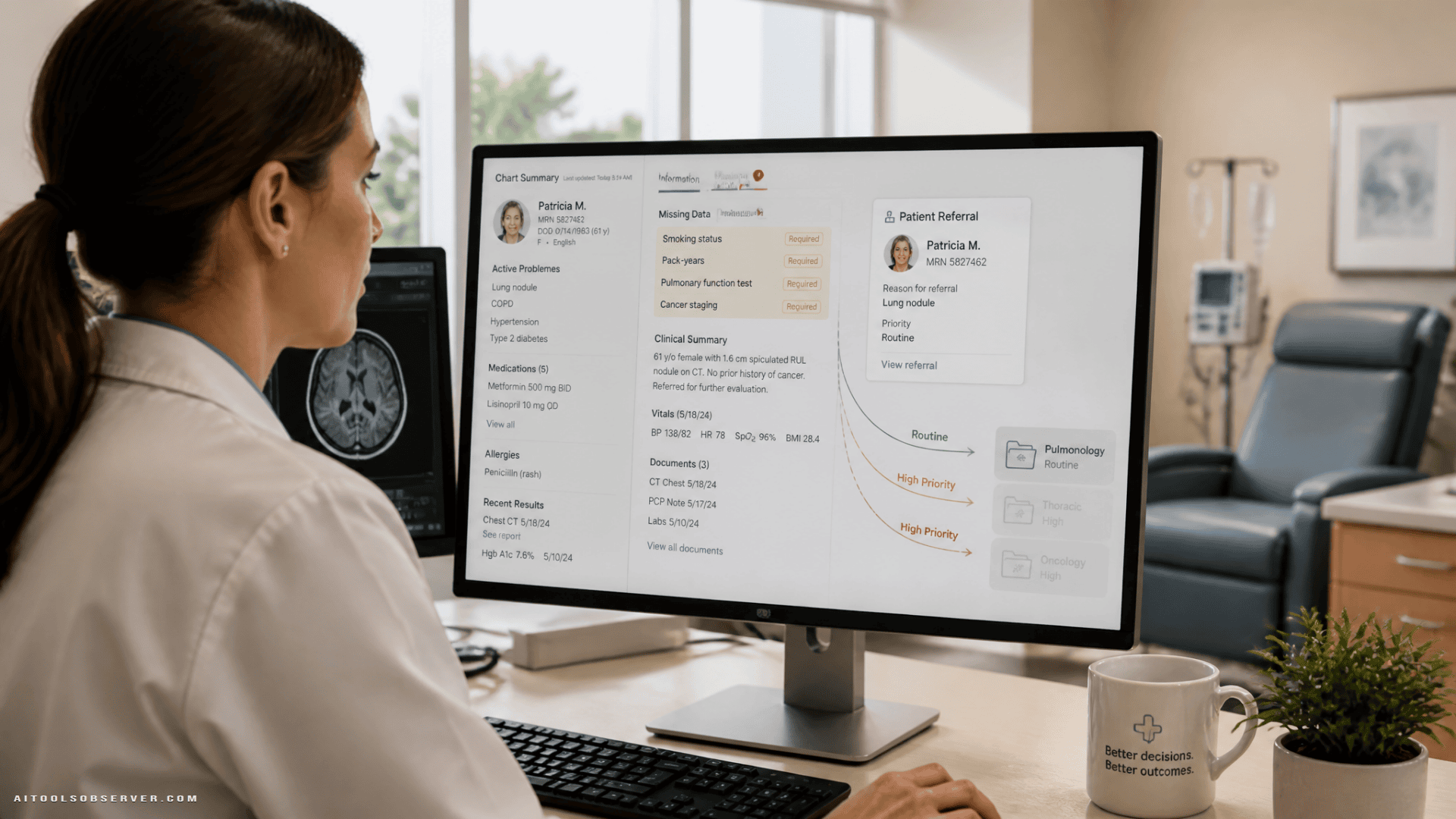
Funded by a $600,000 grant from Eli Lilly and Company, a team at Vanderbilt Health is developing an AI triage agent embedded directly inside the electronic health record (EHR). The 18-month project targets the referral handoff from primary care or geriatrics to neurology — the point in the care pathway where delays most commonly accumulate.
The agent is designed to do three things at the moment a clinician enters a referral for cognitive concern:
- Summarize the relevant chart information automatically
- Flag missing data that typically slows specialist evaluation
- Recommend routing — priority or standard — based on case characteristics
Clinicians retain full control. Every recommendation can be accepted, edited, or overridden.
Why This Workflow, Why Now
Newly approved monoclonal antibody therapies have created a new clinical urgency. These drugs are approved for early-stage, amyloid-positive Alzheimer’s patients, which means the window for intervention is narrow. The diagnosis-to-infusion pathway — spanning specialist evaluation, brain imaging, and insurance authorization — was not designed with that urgency in mind.
The Vanderbilt team will first reconstruct care timelines from a cohort of more than 5,300 Vanderbilt Health patients, using AI to identify precisely where delays accumulate and why. That diagnostic phase informs the agent’s design before any deployment begins. In that sense, the work also touches the healthcare discovery‑delivery gap.
The Team and Scope
The project is led by principal investigator You Chen, PhD, Associate Professor of Biomedical Informatics, alongside co-principal investigators Amalia Peterson, MD (Neurology) and Sean Huang, MD (Medicine and Biomedical Informatics). The multidisciplinary structure — combining informatics, neurology, and geriatrics — reflects the complexity of the care pathway the tool is meant to serve.
Success will be measured by a concrete metric: reduction in time from diagnosis to first infusion.
Designed for Transferability
One detail worth noting for health system operators and AI tool evaluators: the project is explicitly designed to be transferable to other health systems. This is not a bespoke internal tool built for Vanderbilt’s specific infrastructure. The architecture and methodology are intended to generalize.
What Could Come Next
The project proposal outlines two additional AI agents that could follow:
- An agent to analyze MRI images and generate Alzheimer’s-related safety reports for radiologist review
- An agent to compile therapy authorization packets and track the insurance authorization process end-to-end
These are not confirmed deliverables of the current grant, but they indicate the team’s intent to address the full diagnosis-to-infusion workflow systematically rather than in isolation.
The Practical Takeaway
This project is a concrete example of how AI is being applied to a specific, measurable bottleneck in clinical care — not as a general-purpose assistant, but as a structured workflow tool with defined inputs, outputs, and success criteria. For anyone tracking healthcare AI tools, the design pattern here — chart summarization plus missing-data detection plus priority routing, embedded at a decision point — is worth watching as a replicable model for other high-stakes referral pathways. It also fits a broader pattern of AI-supported clinical triage.





Comments (0) No comments yet
Want to join this discussion? Login or Register.
No comments yet. Be the first to share your thoughts!