



What AI Scribes Do
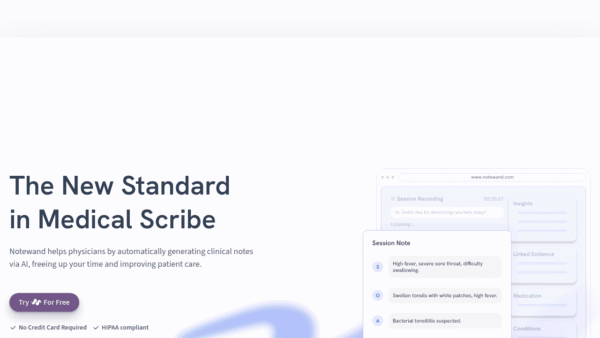
AI scribes work like a digital assistant in the consultation room. They listen to the conversation between doctor and patient, then use generative AI to produce structured clinical notes, summaries, and other documentation.
The appeal is obvious. Less time typing means more time facing the patient. But the gap between what these tools promise and what they deliver in practice is worth examining closely.
The Time Savings Are Real — But Modest
A large multi-site study published in JAMA in April 2026 found that clinicians using AI scribes saved around 16 minutes per day on documentation — roughly a 10% reduction. For primary care clinicians specifically, that figure nearly doubled to about 27 minutes per day.
That’s meaningful, but it’s not transformative. If you’re expecting to reclaim hours, the evidence doesn’t support that expectation.
Previous studies have pointed in the same direction: modest but potentially significant improvements in clinical workflow, particularly for high-volume GP practices where documentation pressure is constant.
Where the Time Savings Can Disappear
AI scribes are not error-free. They can misinterpret clinical language, omit important details, and occasionally generate content that wasn’t said at all — a problem known as hallucination.
There’s also the issue of note bloat. AI-generated notes tend to be longer, which can actually obscure critical clinical information rather than surface it.
The JAMA study authors noted that time saved on initial documentation can shift to time spent reviewing, correcting, and verifying AI-generated records. That’s a real tradeoff GPs need to factor in.
Notably, the study also found that AI scribe use did not significantly reduce time spent on documentation outside of working hours — one of the more persistent pain points for clinicians.
The Burnout Angle Is Worth Taking Seriously
Even modest time savings may have an outsized effect on how doctors feel about their work.
Previous research has linked AI scribe use to reduced clinician burnout and improved wellbeing scores. The JAMA authors suggested this may be less about raw minutes saved and more about perception — the sense that administrative burden has shifted, even slightly, can influence satisfaction.
As the study authors put it, clinicians may view the reallocation of time from documentation as valuable in itself, independent of the actual time recovered.
That’s a softer benefit, but for a profession with serious burnout rates, it’s not a trivial one.
Patients Are Cautiously Positive — With Conditions
The RACGP notes that AI scribes can improve the doctor-patient experience by allowing GPs to maintain eye contact and focus during consultations rather than typing notes.
But patient trust is conditional. A recent Australian study found that patients were comfortable with AI-generated consultation summaries — but only if they were confident the doctor had reviewed and approved the output.
The researchers concluded that maintaining appropriate human oversight is important for fostering consumer trust, and that AI should support rather than replace clinician judgement. That framing matters when introducing AI tools to patients.
Your Professional Obligations Under AHPRA
Using an AI scribe isn’t just a workflow decision — it’s a professional one. The Australian Health Practitioner Regulation Agency (AHPRA) and the National Boards have issued guidance on responsible AI use in healthcare.
The core principles AHPRA expects practitioners to consider are:
- Accountability — you remain responsible for the care delivered and the records created
- Understanding — you need to know how the tool works and where it can fail
- Transparency — patients should know AI is being used
- Informed consent — obtaining consent is a professional obligation, not optional
Doctors using AI tools are still bound by the Medical Board’s Code of Conduct. The tool doesn’t change the standard of care expected.
It’s also worth noting that in some Australian states, recording a conversation without consent is a criminal offence — making a clear consent process in your clinical workflow a legal necessity, not just best practice.
Questions around consent continue to shape how ambient AI is introduced in care settings.
A Practical Checklist for GPs Using AI Scribes
If you’re using an AI scribe or considering one, this checklist covers the key bases:
- Do your due diligence on the tool — understand how patient data is stored, who can access it, and whether it meets Australian privacy requirements
- Obtain patient consent before recording or processing any consultation, and document that consent
- Explain clearly to patients why you’re using the tool and how you’ll maintain oversight
- Review every AI-generated output before it enters the clinical record — don’t assume accuracy
- Develop internal policies for AI use and ensure all staff understand them
- Update your privacy policy to disclose AI use and how patient information is protected
- Regularly reassess whether the tool is delivering value in your specific practice context
The Regulation Gap Is Real
Most AI scribes are not regulated by the Therapeutic Goods Administration (TGA). The TGA only covers AI tools classified as medical devices — typically those designed to assist in clinical decision-making. Most documentation tools don’t meet that threshold.
That means the responsibility for vetting these tools falls largely on the individual practitioner. AHPRA guidance and RACGP resources exist to help, but there’s no centralised approval process for AI scribes the way there is for pharmaceuticals or diagnostic equipment.
The Bottom Line
AI scribes can save GPs time — roughly 16 to 27 minutes per day based on current evidence. That’s not nothing, especially when compounded across a busy week. The wellbeing benefits may extend beyond the raw minutes.
But the tools are imperfect. They require active oversight, not passive trust. And using them comes with real professional obligations around consent, transparency, and accuracy that can’t be delegated to the software.
The GPs getting the most out of AI scribes appear to be those who treat them as a drafting assistant rather than a documentation replacement — reviewing outputs critically, maintaining patient trust through transparency, and building clear processes around how the tools fit into their workflow.
If you’re evaluating AI scribes for your practice, start with the evidence, not the marketing.












Comments (0) No comments yet
Want to join this discussion? Login or Register.
No comments yet. Be the first to share your thoughts!