


What Problem Does Cosmos 3 Actually Solve?

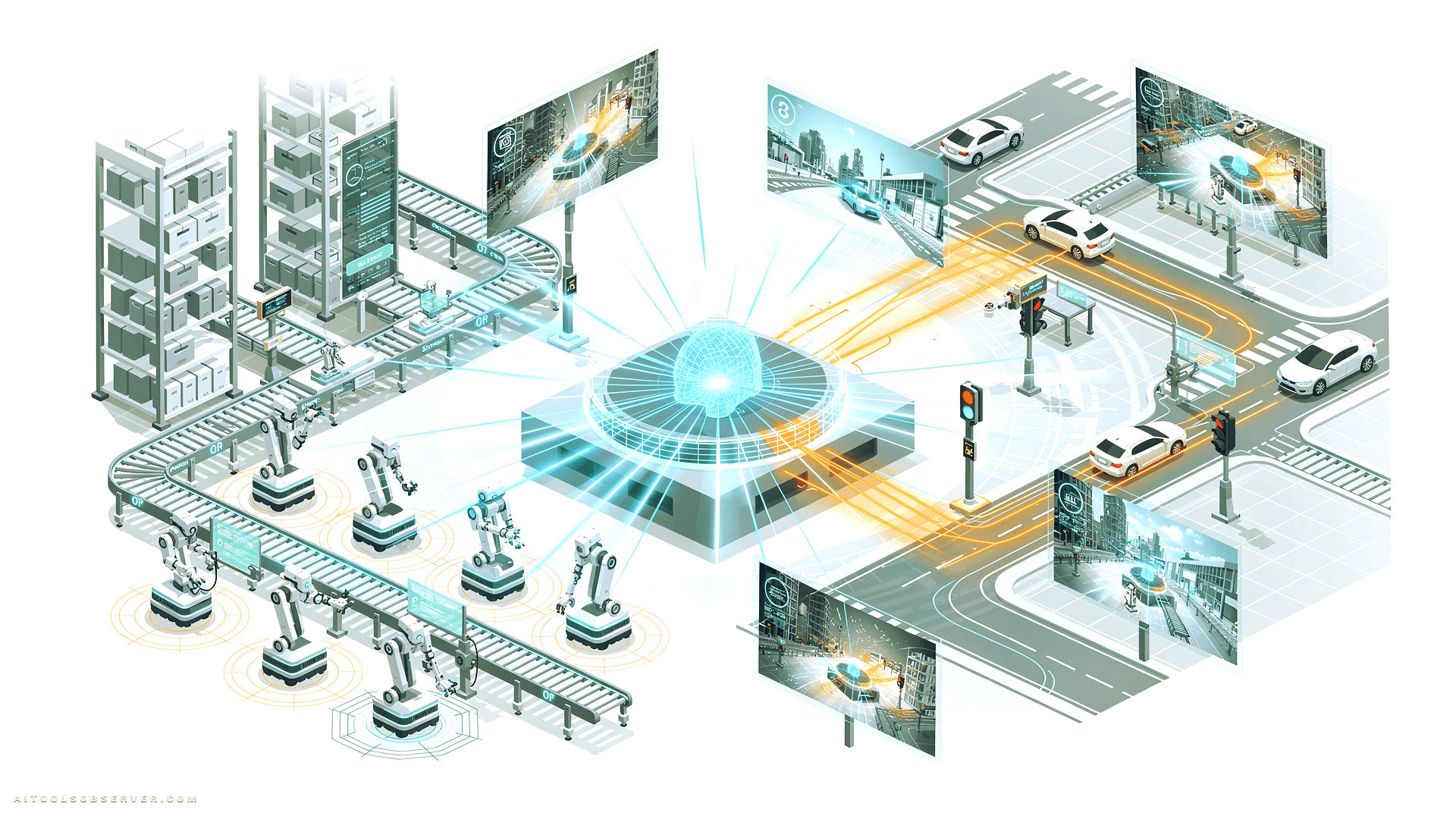
Previous physical AI workflows were fragmented. You’d run one model to understand a scene, another to generate future frames, and a third to predict actions — then stitch the outputs together and hope nothing broke.
Cosmos 3 collapses that pipeline. One model handles the reasoning and the generation, which means fewer moving parts, less orchestration overhead, and a more coherent understanding of physical context across tasks.
The Architecture: Two Towers, One Brain

Cosmos 3 uses a Mixture-of-Transformers (MOT) architecture built around two specialized towers that work in concert.
The Reasoner Tower
This is the vision-language model (VLM) side — the part that thinks. It processes multimodal inputs like images, video, and text using an autoregressive architecture to understand motion, object interactions, and physical context. It can run independently when you only need reasoning.
The Generator Tower
This is the diffusion-based side — the part that creates. It generates physics-aware video and action sequences conditioned on what the Reasoner already understood. The Generator never runs alone; it always activates both towers to ensure generated outputs stay grounded in physical reality.
The result: a model that reasons before it generates, rather than guessing its way through physics.
Two Model Sizes, Two Deployment Contexts

Cosmos 3 Nano — 16B parameters, built for efficient inference. Designed to run on workstation-grade hardware like the NVIDIA RTX PRO 6000. If you need real-time robotics inference without a datacenter, this is your entry point.
Cosmos 3 Super — 64B parameters, built for maximum quality. Targets NVIDIA Hopper and Blackwell GPUs in datacenter environments. Best suited for large-scale synthetic data generation and advanced physical reasoning workloads where benchmark scores matter most.
Pick Nano to move fast. Pick Super when the output quality is the product.
What Can It Actually Do?

Cosmos 3 supports a surprisingly wide range of input-output combinations through its unified architecture.
| Input | Output | Use Case |
|---|---|---|
| Text | Image | Physically plausible image generation |
| Text + Video | Video | Rare edge case data generation |
| Text + Image | Video | World model for prediction |
| Text + Image + Video | Text | VLM reasoning |
| Action + Video + Text | Video | Action-conditioned world model |
| Video + Text | Video + Action | Policy model for robot learning |
The last row is particularly interesting. A model that takes video and text and returns both video and action sequences is essentially a trainable robot policy — one grounded in real-world physics rather than simulation abstractions.
Six Open Datasets for Physical AI

NVIDIA is open-sourcing six synthetic data generation (SDG) datasets alongside the model. These aren’t toy datasets — they’re purpose-built for post-training Cosmos 3 and other physical AI models.
- Embodied Robot Scenes — manipulation tasks and robot interactions
- Physical Interaction Scenes — object contact, force, and dynamics
- Spatial Reasoning — 3D layout and positional understanding
- Digital Human Scenes — human motion and behavior
- Autonomous Driving Scenarios — edge cases and traffic conditions
- Warehouse Operations Scenes — safety monitoring and logistics
Each dataset targets a domain where real-world data is expensive, dangerous, or simply rare to collect. Synthetic data generation at this fidelity starts to look less like a shortcut and more like a strategy.
How Benchmarks Are Handled: Meet HUE

Automated leaderboards are hitting a ceiling. When top models score within fractions of a percent of each other, the rankings stop being useful.
NVIDIA’s response is the Cosmos Human Evaluation (HUE) framework — a shift from subjective grading to objective fact verification. Each generated video is decomposed into atomic yes/no questions across four dimensions: semantic alignment, physical laws, geometric reasoning, and visual integrity.
Questions are generated by a VLM pipeline, refined by human experts, and released as open source. It’s a more honest quality signal, and it’s designed to stay meaningful as models keep improving.
Where Cosmos 3 Currently Leads
- VANTAGE-Bench — real-world fixed-camera footage across warehouses, transportation, and smart spaces
- PAI-Bench — unified physical AI evaluation across video understanding and generation
- R-Bench — robotic video generation quality and task completion
- Physics-IQ — whether generative models actually understand physics, not just look realistic
- RoboLab — task-generalist robot policy evaluation
- Artificial Analysis — leading open-source model on Text-to-Image and Image-to-Video leaderboards
Cosmos 3 Super leads at the 32B tier on VANTAGE-Bench. Cosmos 3 Nano leads at the 8B tier. Both positions matter depending on your deployment constraints.
Training Recipes: The Open Part That Actually Matters

Model weights alone don’t make a release truly open. Cosmos 3 ships with full post-training code, configs, and workflows — so you can adapt the model to your own data, not just run it as-is.
Supervised Fine-Tuning (SFT)
Adapt Cosmos 3 to custom video datasets or domain-specific workflows across robotics, autonomous driving, and warehouse automation. The recipes are on GitHub and designed to be practical, not academic.
Action Post-Training

This is where Cosmos 3 gets genuinely interesting for robotics teams. Action post-training covers three workflows:
- Forward dynamics — generate future observations conditioned on robot actions
- Inverse dynamics — infer the actions behind observed demonstrations
- Policy generation — predict action sequences from current observations and task prompts
These workflows make Cosmos 3 a credible foundation for world action modeling and policy learning — not just a video generator with a robot skin.
Deploying with NVIDIA NIM Microservices

For teams who want production-ready inference without tuning serving infrastructure, Cosmos 3 is available as NVIDIA NIM microservices.
The Cosmos 3 Reasoner NIM is available now. The Generator NIM is coming. NIM packages the model with optimized runtimes and is the recommended path for inference workflows — the GitHub repo is better suited for post-training.
Three Inference Optimizations Worth Knowing
Quantization — Cosmos 3 NIM supports BF16, FP8, and NVFP4 checkpoints. NVFP4 reduces precision to 4-bit floating point, delivering up to 2x inference speedup.
vLLM — The Reasoner NIM serving stack is built on vLLM, using continuous batching, paged attention, and tensor parallelism for higher throughput. Cosmos 3 Nano is ready to run with vLLM-omni and NVIDIA Dynamo.
Efficient Video Sampling (EVS) — Reduces video tokens fed into the VLM during inference by keeping only the most unique chunks per frame. Smaller GPUs benefit most from this technique.
Getting Started
Pull the Cosmos 3 Nano or Super checkpoints from Hugging Face. For inference, spin up the Reasoner NIM with an NGC API key. For post-training, head to GitHub for the full recipe library.
The Nano model is designed to run on workstation-grade hardware, which means the barrier to experimentation is lower than most frontier model releases.
The Bigger Picture

Physical AI has a data problem. Real-world robot demonstrations are slow to collect. Edge cases in autonomous driving are rare by definition. Warehouse incidents are exactly the kind of thing you don’t want to wait around for.
Cosmos 3 addresses this by making high-fidelity synthetic data generation accessible, open, and physically grounded. The unified architecture isn’t just an engineering convenience — it’s a statement that reasoning and generation should inform each other, not operate in separate silos.
Whether that translates into production-ready robotics depends on your domain, your data, and how much you’re willing to invest in post-training. But as open foundations for physical AI go, this one arrives with unusually few excuses not to try it.













Comments (5)
Want to join this discussion? Login or Register.
Great overview of how AI-powered smart warehouses are transforming logistics and supply chains. The article does a good job explaining both the opportunities and challenges, making a complex topic accessible to readers interested in automation and the future of warehousing.