


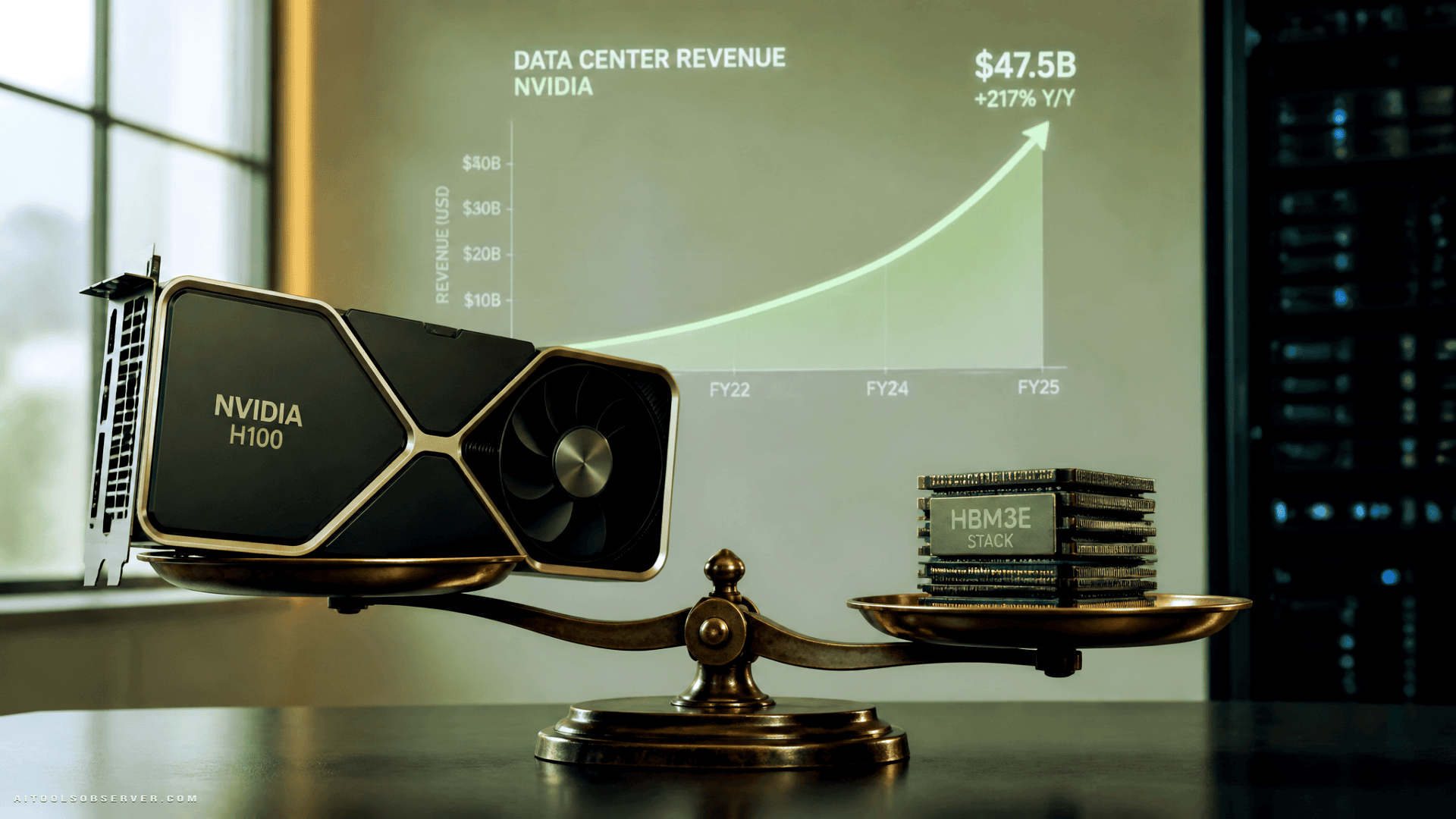
The Revenue Picture: Near-Doubling, Again
Analyst estimates compiled by LSEG point to Nvidia’s Q2 revenue nearly doubling from $46.7 billion a year earlier. For Q3, Wall Street expects guidance of roughly $104.2 billion in revenue — an 83% year-over-year jump — with some estimates reaching as high as $112.2 billion.
That kind of sustained growth, almost four years after the ChatGPT moment that kicked off the AI infrastructure boom, is unusual for any company at this scale. The demand signal from hyperscalers remains strong, even if the sustainability of that spending is increasingly questioned.
Gross Margin: Healthy, But Under Pressure
Nvidia is expected to report a gross margin around 75%, consistent with Q1. That sounds solid, but there are real pressures underneath the surface.
Memory costs are rising sharply. Nvidia has been building inventory ahead of the Vera Rubin rollout, which means front-loaded spending. And widely reported price hikes on AI chips could cut both ways — helping revenue but potentially softening demand at the margin.
The 75% figure, if it holds, signals that Nvidia is managing these pressures well for now. But it’s a number worth watching closely in the guidance commentary.
The HBM Memory Shortage Is a Real Risk
This is arguably the most underappreciated story in the Nvidia earnings narrative right now.
Nvidia’s chips require high-bandwidth memory (HBM), and its complete systems also consume large quantities of standard server DRAM. That demand is contributing to a global memory shortage that is pushing prices sharply higher. Server DRAM prices reportedly rose 64% in the second half of last year, with further increases projected into 2026.
Nvidia CFO Colette Kress has acknowledged the company is “not immune to supply challenges.” In Q1, Nvidia spent $145 billion to secure component supply — a significant commitment that reflects both confidence in demand and the reality that supply is constrained.
For AI tool builders and infrastructure buyers, this matters. Memory cost inflation flows downstream into GPU pricing, cloud compute costs, and ultimately the economics of running AI workloads.
Vera Rubin: The Product Cycle Everyone Is Watching
Nvidia is in the middle of a major product transition. Vera Rubin AI systems — the successor generation to Blackwell — have started shipping to early customers including Microsoft and OpenAI.
Investors want to know two things: how fast the ramp is going, and whether there are supply or yield issues. Jensen Huang has previously projected $1 trillion in cumulative sales through 2027 from Blackwell and Vera Rubin combined. That’s an ambitious target, and Q2 results will offer the first real data points on whether Vera Rubin is tracking toward it.
Any commentary on shipment volumes, customer feedback, or supply constraints will move the stock.
The Customer Cash Flow Problem
Here’s a tension that doesn’t get enough attention: Nvidia’s biggest customers are burning cash.
Amazon, Alphabet, Tesla, and SpaceX all reported negative free cash flow in Q2. Meta’s cash generation reportedly fell by roughly 90%. These hyperscalers are collectively spending hundreds of billions on AI infrastructure annually, with Goldman Sachs projecting that figure could reach $1.2 trillion by 2027.
They’re funding this through equity raises, debt, and financial partnerships — essentially betting that AI demand will justify the capital outlay. That bet may well pay off, but it introduces a systemic risk: if any major hyperscaler pulls back on capex, Nvidia’s order book feels it quickly.
Nvidia’s New Financing Play
Nvidia isn’t just selling chips anymore. Jensen Huang announced a program with six major financial firms pledging up to $500 billion in financing, with Nvidia offering residual value backstops on certain AI infrastructure projects.
The thesis is that AI chips are becoming a financeable asset class — similar to how aircraft or real estate can be financed against future value. Nvidia’s strong cash flow and balance sheet make this credible in the near term.
Morgan Stanley initiated credit coverage of Nvidia and described the model as supportable, while noting that the long-term tail risk remains “too early-stage, opaque, and sizable” to fully quantify. That’s a measured way of saying: interesting strategy, but the risk profile isn’t fully visible yet.
Competition Is Closer Than It Was
Nvidia’s dominance in AI chips is real, but it’s no longer uncontested. AMD is pushing harder into the data center GPU market. Google is deploying its own TPUs at scale. Other hyperscalers are investing in custom silicon to reduce Nvidia dependency.
None of this threatens Nvidia’s position in the next two quarters. But through 2026 and 2027, the competitive landscape will look meaningfully different than it does today. Earnings calls are where you start to hear the early signals — watch for how Huang frames the competitive question.
The broader push into AI cloud services is one sign that the market structure around compute is already evolving.
What This Means for AI Tool Builders and Buyers
If you’re building on AI infrastructure or evaluating AI tools that depend on GPU compute, a few practical takeaways from this earnings cycle:
- Memory cost inflation is real and ongoing. Expect it to show up in cloud GPU pricing and inference costs over the next 12–18 months.
- The Vera Rubin ramp will shape availability of next-gen compute. Early access is going to Microsoft and OpenAI first — broader availability will follow, but timing matters for planning.
- Hyperscaler capex commitments are a leading indicator. If the big spenders start pulling back, AI compute availability and pricing will shift faster than most expect.
- Nvidia’s financing moves signal a maturing market. When chips become a financeable asset class, it changes how AI infrastructure gets built and who can afford to build it.
The Q2 numbers will almost certainly be large. The more important story is what the guidance, margin commentary, and Vera Rubin ramp signal about the next 12 months of AI infrastructure economics.













Comments (0) No comments yet
Want to join this discussion? Login or Register.
No comments yet. Be the first to share your thoughts!