


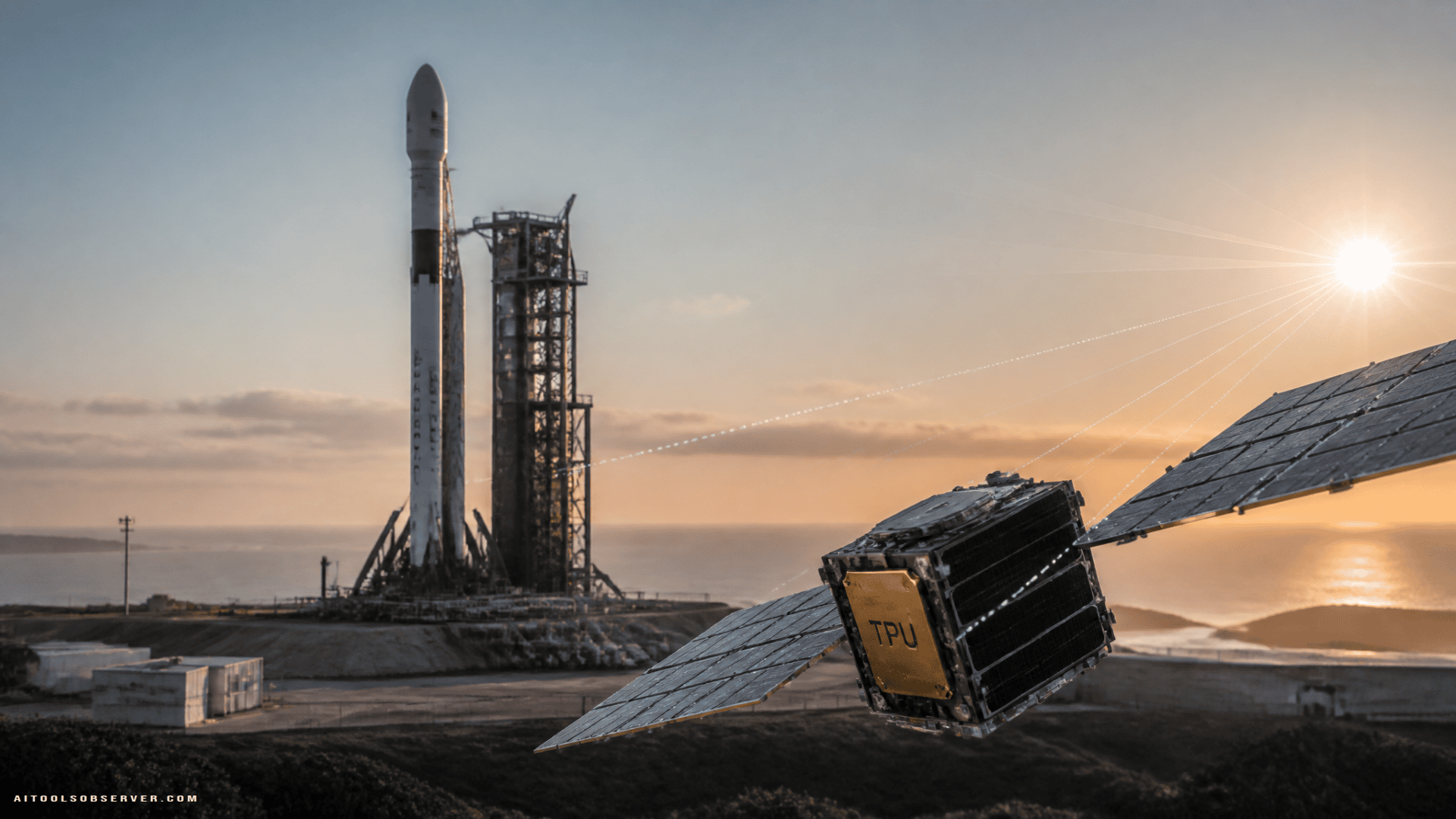
What Project Suncatcher Actually Is
Alphabet first disclosed Project Suncatcher in November 2025, describing it as a moonshot initiative to develop solar-powered AI computing infrastructure that operates continuously in orbit. The core premise is straightforward: satellites in low Earth orbit can access near-constant sunlight, generating up to eight times more solar energy than equivalent ground-based systems.
The longer-term ambition is to link multiple satellite constellations together, enabling them to handle larger AI workloads collectively while in orbit. Alphabet has framed this as “exploring whether space could one day host scalable machine learning infrastructure”—careful language that signals genuine uncertainty about feasibility.
Before Thursday’s launch, Google had only tested its TPUs running AI workloads in space in a ground facility at the University of California, Davis. How those chips perform under the thermal extremes, radiation exposure, and vacuum conditions of low Earth orbit remains an open question.
The SpaceX–Alphabet Relationship
The two companies are closely intertwined. Alphabet holds a stake in SpaceX currently valued at over $82 billion, following SpaceX’s record IPO in June. That financial relationship exists alongside direct competition between their respective AI divisions—an arrangement that is increasingly common in the current AI infrastructure landscape.
SpaceX has its own orbital data center ambitions. The company has announced plans to build satellite-based supercomputers equipped with GPUs and solar arrays, with the latter to be produced in partnership with Tesla. SpaceX COO Gwynne Shotwell indicated at a September event that the company aims to deploy “supercompute in space” in 2027.
Why This Is Harder Than It Sounds
Industry experts are measured about the timeline and viability of space-based data centers. Several structural challenges remain unsolved:
- Launch capacity constraints — rocket launches remain expensive and limited in throughput, making large-scale orbital infrastructure difficult to scale quickly.
- Thermal management — orbital environments involve extreme temperature swings that standard data center cooling systems are not designed to handle.
- Radiation hardening — chips must be able to withstand radiation levels that would degrade standard commercial silicon.
- Orbital debris — growing clutter in low Earth orbit poses collision and operational risks.
These are not minor engineering footnotes. They represent the difference between a compelling demonstration and a commercially viable infrastructure layer.
What to Watch From Here
The Transporter-18 mission is a data-gathering exercise, not a product launch. The results will tell Alphabet whether its TPUs can sustain AI workloads in orbit at all—a prerequisite for everything that follows.
For anyone tracking AI infrastructure trends, this is worth monitoring closely. If orbital compute proves viable, it introduces a fundamentally different cost and energy model for training and inference at scale. If it doesn’t, the ground-based data center buildout—land constraints, power demands, and community opposition included—remains the only game in town for the foreseeable future.
The practical takeaway: space-based AI infrastructure is moving from theoretical to testable. Thursday’s launch doesn’t validate the concept, but it does begin the process of finding out whether the concept can survive contact with reality.











Comments (0) No comments yet
Want to join this discussion? Login or Register.
No comments yet. Be the first to share your thoughts!