


What Actually Happened Up There

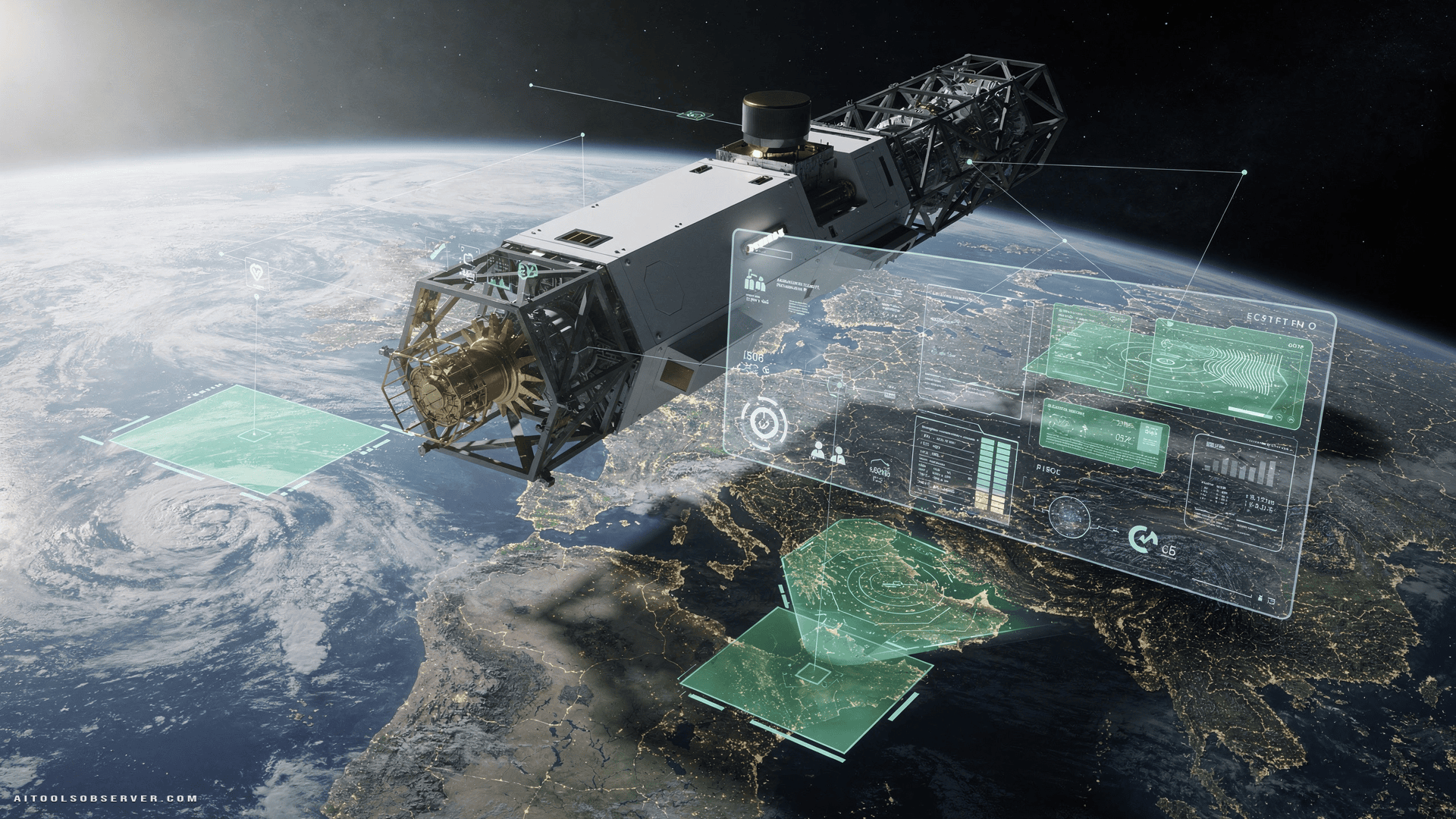
Loft’s YAM-9 satellite, launched in fall 2025, was purpose-built as a pathfinder for orbital AI. It carries an Nvidia Jetson Orin AGX GPU — one of the most capable chips currently flying in space — and served as the testbed for this demonstration.
NASA JPL’s Juan Delfa Victoria led development of NAVI-Orbital, a software package designed to run Gemma 3 on that hardware. Gemma 3 is an off-the-shelf model, but deploying it in orbit required serious engineering work: stripping down libraries, cutting memory overhead, and making the whole stack lean enough to survive the constraints of space compute.
The result was the first confirmed deployment of a vision-language model (VLM) on orbit.
Why VLMs in Space Are a Big Deal

Vision-language models combine image analysis with natural-language understanding. On the ground, that means you can ask a model to describe what it sees in a photo. In orbit, it means you can instruct a satellite to monitor a specific location, identify specific objects, and report back — without a human operator reviewing every frame.
That’s a fundamental change in how Earth observation works.
Traditional satellites collect enormous volumes of raw imagery and beam it to the ground, where analysts sort through it. The bottleneck is bandwidth, storage, and human attention. On-orbit AI collapses that pipeline. The satellite becomes the analyst.
As Loft’s CEO put it: the goal is to enable a user to say “monitor this border for me” and have the satellite respond intelligently — an interactive, always-on sensor rather than a passive camera.
Loft’s Business Model Is Built for This
Loft Orbital operates as infrastructure-as-a-service for space. They build, launch, and operate satellites on behalf of third-party customers — a model closer to AWS than to Boeing. One recent deal saw them deploy six satellites for EarthDaily, which handles data analysis and commercialization.
YAM-9 is the proof-of-concept node in what Loft wants to grow into a real-time Earth monitoring constellation. Lasserre estimates it would take 50 to 100 satellites like YAM-9 to achieve continuous global coverage. Loft currently operates 12.
Nvidia Jetson Orin Is Becoming the Space GPU Standard
The Jetson Orin AGX is emerging as the default compute platform for orbital AI workloads. Planet Labs also flies satellites with Jetson Orin processors — currently for simpler object detection tasks, but a spokesperson confirmed that research into VLMs and more advanced AI applications is underway.
The chip’s combination of power efficiency and GPU performance makes it viable for the tight power and thermal budgets of small satellites. As more operators standardize on it, the ecosystem of orbital AI software will grow faster.
Who Else Is Moving in This Direction
The Loft/JPL demonstration is the first reported VLM deployment on orbit. It almost certainly isn’t the only one.
Kepler Communications operates the largest cluster of GPUs currently in space. When asked about VLM deployments, the company declined to confirm specifics due to NDA agreements with partners — but noted there have been “several undisclosed use cases” of their compute environment since those spacecraft launched in January 2026.
That’s a telling non-answer. The technology is moving faster than the press releases.
Planet Labs is openly researching the space. Kepler is quietly deploying it. Loft just published the proof of concept. The pattern here is familiar: one public demonstration, several private experiments already underway, and a wave of followers about to announce their own versions.
From Satellites to Astronaut Assistants
The NAVI-Orbital project didn’t start with Earth observation. It started with a thought experiment about astronauts on the Moon.
Delfa Victoria and JPL researcher Taran Cyriac John were thinking about what a useful AI assistant would look like for someone in a pressurized suit on a lunar surface — someone who can’t type, can’t easily navigate a UI, and needs to interact with complex systems through voice and vision.
The answer they landed on was a conversational AI that could see what the astronaut sees and respond intelligently. NAVI-Space was the result. NAVI-Orbital is its satellite-facing sibling.
That origin story matters because it signals the longer arc here. On-orbit VLMs aren’t just a data compression trick. They’re the foundation for a new class of autonomous space systems — ones that can reason about their environment, respond to natural-language instructions, and operate with far less ground-based oversight.
What This Means for the AI Tools Ecosystem
On-orbit AI is a niche today. It won’t be for long.
The lessons being learned right now — about power management, memory optimization, model compression, and real-time inference in constrained environments — will directly inform how AI is deployed in other edge environments. Industrial sensors, remote infrastructure monitoring, autonomous vehicles, and disaster response systems all face similar constraints.
The companies building tooling for orbital AI today are writing the playbook for edge AI deployment more broadly.
For AI tool builders and enterprise adopters, the signal is clear: the frontier of AI deployment is moving away from the data center and toward the edge — and in some cases, 400 miles above it.
The Practical Takeaway
If you’re tracking where AI is going, watch the satellite industry closely over the next 18 months.
The Loft/JPL demonstration proved the concept. Planet Labs and Kepler are already in motion. The next phase is productization — turning one-off demonstrations into repeatable, commercially available capabilities that enterprises can actually buy.
Real-time Earth monitoring via natural-language queries. Autonomous border and infrastructure surveillance. AI-assisted scientific observation from orbit. These aren’t roadmap items anymore. They’re engineering problems being solved right now, on hardware already in space.
The satellite just learned to find things on its own. The question worth asking isn’t whether this is impressive — it clearly is. The question is what you’ll do when this capability becomes a commodity service you can subscribe to.
That day is closer than most people think.















Comments (0) No comments yet
Want to join this discussion? Login or Register.
No comments yet. Be the first to share your thoughts!