


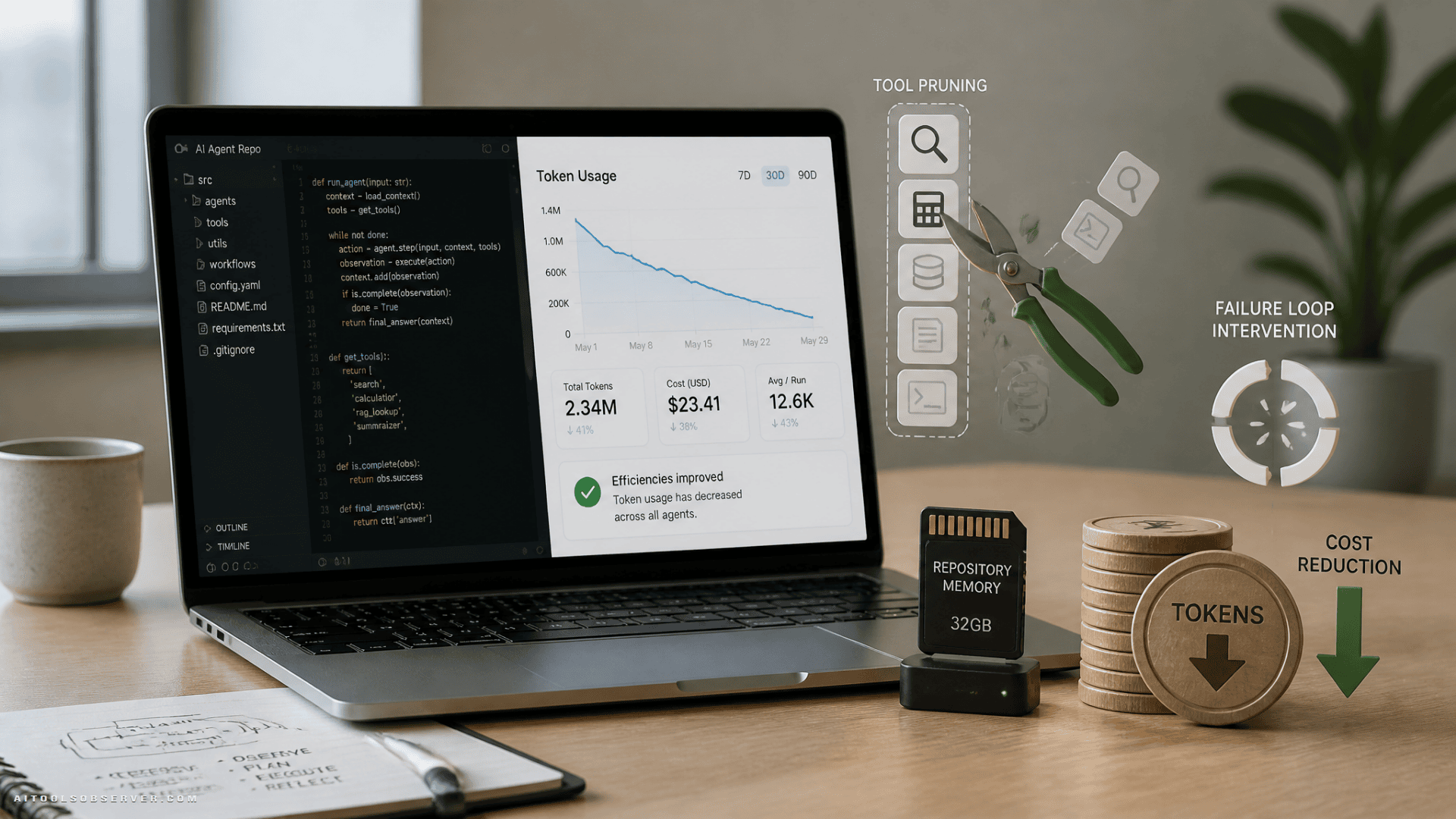
The Core Problem: Agents That Never Remember
Most cost-reduction efforts for AI agents focus on individual tasks. But developers work in the same repositories day after day. Without cross-session memory, an agent will:
- Rediscover how to run tests every single session
- Load tool descriptions it never actually uses
- Get stuck in failure loops, burning tokens on the same dead end
The research team profiled Claude Code on 60 tasks from SWE-Bench and found that after a repository accumulated at least five completed tasks, 30% of tool calls repeated an action from an earlier session in that same repository. Meanwhile, out of 23 tool descriptions loaded on every turn, 16 were never called. And the 17% of tasks that failed accounted for 32% of total spending.
That’s a lot of waste with a straightforward fix: give the agent a memory.
How TokenEconomizer Actually Works
TokenEconomizer doesn’t modify the underlying agent or its model. It works as a plugin that reads completed session logs and updates what it knows about the repository. That knowledge then flows back into the agent through three mechanisms.
Micro-Skills
These are one-line notes that capture repository-specific patterns — things like how to run tests or where configuration files live. TokenEconomizer only adds a note to the agent’s starting context after several sessions have confirmed the pattern. If later evidence contradicts it, the note gets retired. This keeps the system from confidently passing along bad information.
Tool Pruning
Based on session history, TokenEconomizer removes tool descriptions the agent is unlikely to need in a given repository. Core tools — running commands, editing files — are always kept. Removed tools can be restored if the agent needs them. This trims the token load on every turn without breaking functionality.
Failure-Loop Intervention
When an agent keeps hitting the same error, TokenEconomizer uses a judge model to assess whether it’s genuinely stuck or still making progress. If it’s stuck, the agent gets a short nudge suggesting a different approach. If it’s still stuck after that, the developer gets an alert. The plugin doesn’t silently kill the work — it escalates.
All three mechanisms update after every finished session, and the savings reported in the research already account for the cost of TokenEconomizer’s own model calls.
The Numbers Across Five Agent-Model Combinations
The evaluation covered 277 SWE-Bench tasks across six repositories, using five different AI coding agent and model combinations. TokenEconomizer started each repository with zero prior history.
Mean cost reduction per task:
- Claude Code Sonnet 5: 23.6%
- Claude Code Opus 4.8: 24.7%
- Codex GPT-5.6 Terra: 30.9%
- Codex GPT-5.6 Sol: 26.1%
- Copilot CLI Sonnet 5: 18.4%
Pass@1 — the standard measure of whether the agent actually fixed the bug — rose in four of the five combinations. Costs fell in every single repository tested.
One important comparison: lowering the model’s reasoning effort produced similar or larger cost savings, but came with substantial performance degradation. TokenEconomizer achieves comparable savings without that tradeoff.
How Fast Do Savings Kick In?
Early tasks in a new repository can actually cost slightly more while TokenEconomizer is learning. But cumulative costs fell below the default in every repository by the sixth task. The more sessions it observes, the more efficient it gets.
The gains also extended beyond bug fixing. On sequential web development tasks (Web-Bench), costs dropped 16.0–21.2%. On security auditing — where every task involves a new repository — costs still fell 6.4–19.6%, even with minimal accumulated history.
What This Means for Teams Using AI Coding Agents
If your team runs AI coding agents regularly against the same codebases, the cost profile here is worth paying attention to. The plugin is open-source, requires no API key of its own, and keeps learned session data on the developer’s machine rather than sending it to an external service.
It’s also designed to be additive — you don’t have to swap out your existing agent or model. You layer it on top.
The research positions this as an early step toward agents that don’t just learn what to do, but learn how to spend computation more effectively over time. That’s a meaningful distinction. Right now, most agents are stateless by default. TokenEconomizer makes the case that stateful efficiency — learning from experience in a specific codebase — is both achievable and measurable.
The Practical Takeaway
If you’re evaluating ways to reduce AI coding agent costs without sacrificing output quality, TokenEconomizer is one of the more credible options to surface recently. The benchmarks are grounded in real bug-fixing tasks, the savings are consistent across repositories and agent types, and the mechanism is transparent enough to reason about.
It won’t eliminate token costs. But cutting 18–31% without touching performance is a meaningful lever — especially as agentic coding workflows scale up across larger engineering teams.
The code is available publicly, and the research paper provides the full methodology for teams that want to dig deeper before adopting it.












Comments (0) No comments yet
Want to join this discussion? Login or Register.
No comments yet. Be the first to share your thoughts!