


What changed
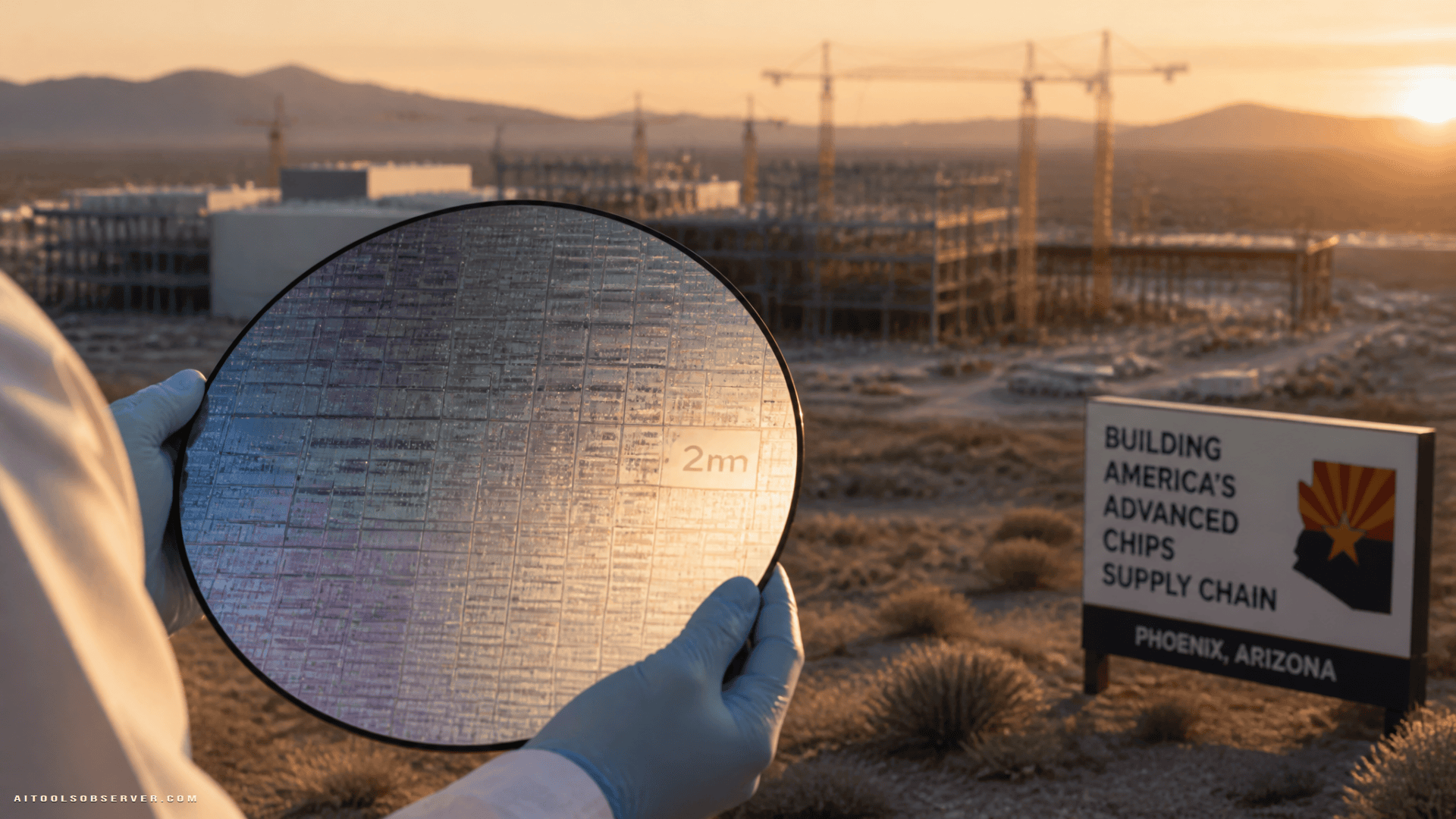
TSMC says it is accelerating its Arizona expansion as AI chip demand keeps climbing. The company’s comments frame the move as a response to a multi-year customer demand trend, not a one-quarter scramble.
The notable part is the mix:
- Arizona capacity is being built out faster
- 2nm is positioned as an important revenue driver
- U.S. investment is expanding beyond wafer fabs into advanced packaging
- TSMC is still reshaping existing capacity, including moving from 5nm toward 3nm where demand supports it
That combination matters because AI chips do not appear out of thin air. They need leading-edge manufacturing, then packaging, then an ecosystem around both. Silicon is only the beginning; the assembly line after the assembly line is where things get interesting.
Why 2nm is the headline
Smaller process nodes generally allow more transistors to fit onto a chip, which can support better performance and efficiency. In AI, that tends to translate into one big question: how much useful compute can you squeeze into real-world power and thermal limits?
That is why 2nm gets attention. Not because “tiny number good,” but because AI demand keeps rewarding chips that deliver more work per watt and more capability per package.
For AI companies, this has practical downstream effects:
- Model training economics can improve if hardware gets more efficient
- Inference infrastructure can become denser
- Device makers can keep pushing more AI compute into limited power envelopes
- Cloud providers get another lever for margin and capacity planning
No magic here. Just expensive physics doing expensive physics things.
Why Arizona matters beyond TSMC
A U.S. fab is not just a building with very clean floors. It is also a supply chain anchor.
When TSMC says Arizona expansion will include both front-end wafer fabs and back-end advanced packaging, that broadens the conversation. AI hardware capacity is not only about making wafers. Packaging has become a strategic choke point too, especially for advanced AI chips that rely on high-performance integration.
That means Arizona’s importance is not merely “more chipmaking in America.” It is closer to:
- More geographic diversification
- Better resilience for U.S.-aligned AI infrastructure demand
- A stronger local semiconductor ecosystem over time
- Potentially shorter or less fragile supply paths for some customers
If you build wafers in one place, package in another, and ship through a third, every handoff becomes a stress test. Pulling more of that ecosystem into the U.S. does not erase risk, but it can redistribute it.
The cost problem is real
There is a catch, because of course there is. TSMC’s CFO said U.S. fab construction costs are significantly higher than in Taiwan.
That matters for two reasons. First, more domestic capacity does not automatically mean cheaper chips. Second, scaling overseas operations can create margin pressure before the ecosystem matures.
So the tradeoff looks something like this:
- Higher build cost now
- Better geographic diversification later
- Potentially stronger local ecosystem over time
- But no promise that economics instantly become prettier
For AI buyers, the main lesson is simple: supply chain resilience and low cost do not always arrive in the same box.
What this suggests about AI demand
TSMC’s messaging is one of the clearest tells in the market. When a leading manufacturer accelerates capacity, highlights 2nm as a revenue driver, and keeps investing heavily in advanced nodes and packaging, it suggests customers are signaling sustained demand.
That does not just point to “more AI.” It points to a more specific pattern:
1. AI demand is moving from bursty to structural
Companies appear to be planning around multi-year compute needs. That changes how suppliers invest, where they build, and how aggressively they secure capacity.
2. Leading-edge chips remain strategic
Not every AI workload needs the latest node. But the highest-demand, highest-performance systems still pull the ecosystem toward the front edge.
3. Packaging is no longer a side quest
For advanced AI systems, packaging capacity can matter almost as much as wafer capacity. Anyone reading semiconductor news and skipping the packaging section is skipping the plot.
What founders and AI tool buyers should pay attention to
Most readers are not ordering wafers from TSMC. Fair. But this still matters if you use, build, or budget around AI.
Here is the practical lens:
If you build AI products
Watch infrastructure costs and model serving economics. More advanced chip supply can improve availability over time, but leading-edge transitions are rarely smooth or cheap at first.
If you depend on cloud AI providers
This is a medium-term signal about where future capacity may come from. More geographically diversified chip production can help with resilience, though it does not guarantee instant relief on pricing or access.
If you evaluate AI vendors
Ask where their infrastructure assumptions come from. Vendors with plans tied entirely to endless cheap compute may look less convincing than those designed for cost volatility, hardware constraints, and supply uncertainty.
If you care about risk
The comments about diversified sourcing and safety stocks are a reminder that semiconductor operations are being run with disruption in mind. That is not paranoia. That is the job description now.
The geopolitical angle, without the drama cosplay
One reason Arizona gets attention is obvious: semiconductor concentration has long been a strategic concern. More U.S. manufacturing and packaging capacity can reduce some exposure to regional disruptions, export policy pressure, and long supply chains.
But this is not a clean handoff from one geography to another. Taiwan remains central to advanced semiconductor manufacturing, and the global AI supply chain will stay interdependent for a long time.
So the smarter read is not “Arizona replaces everything.” It is “Arizona adds options.” In supply chains, options are underrated until suddenly they are the only thing anyone wants.
What to watch next
The useful signals from here are not flashy headlines. They are operational ones:
- How quickly Arizona capacity scales
- How much advanced packaging gets built alongside wafer capacity
- Whether 2nm demand continues to strengthen
- How customers balance 2nm, 3nm, and older nodes across different AI workloads
- Whether higher U.S. costs get offset by ecosystem and resilience gains
Those details will say more about the real AI hardware market than a dozen earnings-call buzzwords.
The takeaway
TSMC’s Arizona push is a supply chain story wearing an AI badge. The 2nm angle matters, but the bigger signal is that leading-edge manufacturing, advanced packaging, and U.S. capacity are being treated as core infrastructure for the next phase of AI demand.
If you build with AI, buy AI tools, or rely on AI vendors, the practical takeaway is simple: pay more attention to where compute comes from. The smartest AI strategy is not just model choice. It is model choice plus supply chain realism.













Comments (0) No comments yet
Want to join this discussion? Login or Register.
No comments yet. Be the first to share your thoughts!