


What the USDA Is Asking For
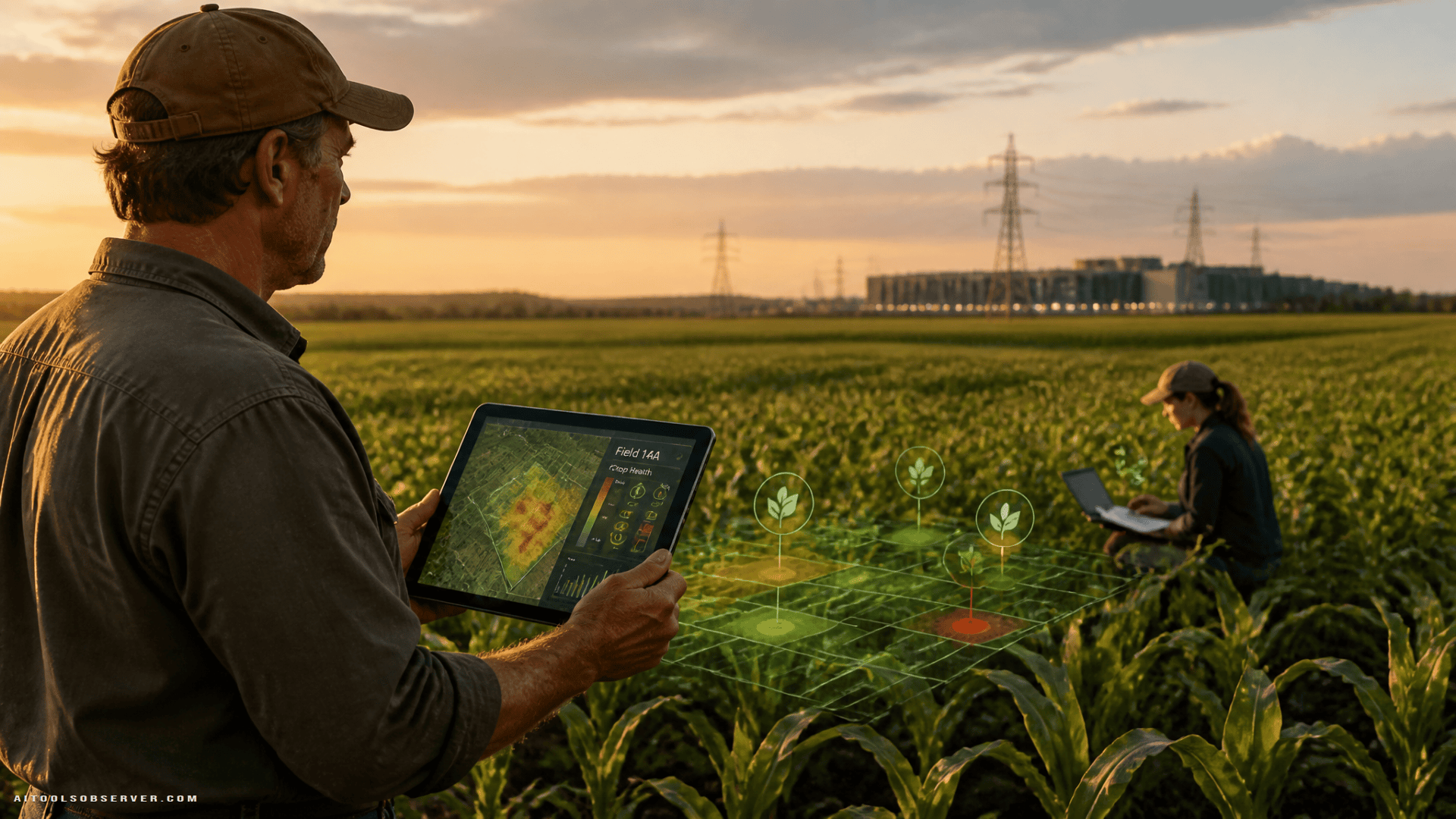
The USDA’s call centers on building AI tools that can process large volumes of agricultural data — satellite imagery, field sensor readings, climate patterns — and translate them into actionable insights for farmers. The goal is to support the development of crops that can better withstand stress from weather, pests, and shifting growing conditions.
This is not a speculative research agenda. Precision agriculture tools already exist that analyze field data at scale. The USDA initiative appears to be pushing toward broader deployment and more targeted development, particularly around crop resilience as a specific outcome.
How Farmers and Researchers Are Responding
Virgil Shockley, a farmer with decades of experience in Worcester County, Maryland, sees AI-assisted crop resilience as an inevitable direction. He frames it in terms of food security: the U.S. has long positioned itself as a global agricultural innovator, and AI is the next step in that trajectory.
Dr. Alfadhl Alkhaled, an assistant professor in precision agriculture at the University of Maryland Eastern Shore, has researched AI applications in satellite imagery and field data analysis. His read on the USDA initiative is straightforwardly positive — with a clear emphasis on practical utility.
“Ultimately, these advances have the potential to support the development of more resilient and productive crops and provide better decision-support tools for farmers.”
The phrase “decision-support tools” is worth noting. It signals a realistic framing: AI as an aid to farmer judgment, not a replacement for it.
The Infrastructure Tradeoff Nobody Should Skip
Shockley raises a concern that tends to get buried in agtech coverage: the energy and water demands of the data centers that make AI possible.
His position is not anti-development. It is about accountability in how that development happens — specifically, whether the entities building data centers take responsibility for generating the energy they consume, rather than simply drawing from an already-strained grid.
This is a legitimate systems-level concern. AI tools for agriculture require substantial compute infrastructure. That infrastructure has real costs — in electricity, in water for cooling, and in grid load. For farming communities that are already sensitive to utility costs and resource availability, these are not abstract policy questions.
What This Means for the AI Tools Ecosystem
For developers and vendors working in agtech, the USDA’s initiative signals a clearer institutional appetite for AI tools that deliver on specific agricultural outcomes — crop resilience, yield prediction, field-level decision support.
A few practical implications stand out:
- Satellite imagery analysis and field data integration are explicitly relevant use cases, not edge cases.
- Tools that translate complex data into farmer-readable insights will have more traction than those optimized purely for research environments.
- Infrastructure efficiency — compute cost, energy footprint — is increasingly part of the value proposition, not just a technical footnote.
The Useful Takeaway
The USDA’s call is an early signal, not a finished program. But it confirms that AI in agriculture is moving from experimental to institutional. For anyone building or evaluating agtech tools, the relevant question is not whether AI belongs in farming — it is whether specific tools can deliver measurable resilience outcomes while remaining deployable within the real constraints farmers and rural infrastructure actually face.











Comments (0) No comments yet
Want to join this discussion? Login or Register.
No comments yet. Be the first to share your thoughts!