


The Numbers Were Strong. The Bar Was Higher.
AMD beat analyst expectations for the quarter. Analysts had projected earnings of $1.62 on revenues of $11.31B. AMD cleared both.
Data center revenue hit $6.72B, up 107% year-over-year, driven by Instinct GPU deployments and EPYC processor demand. Client and Gaming segment revenue rose to $3.8B, up 23% year-over-year. Even the Embedded segment posted a 19% year-over-year gain to $977M.
On paper, that’s a strong quarter across the board.
So Why Did the Stock Drop?
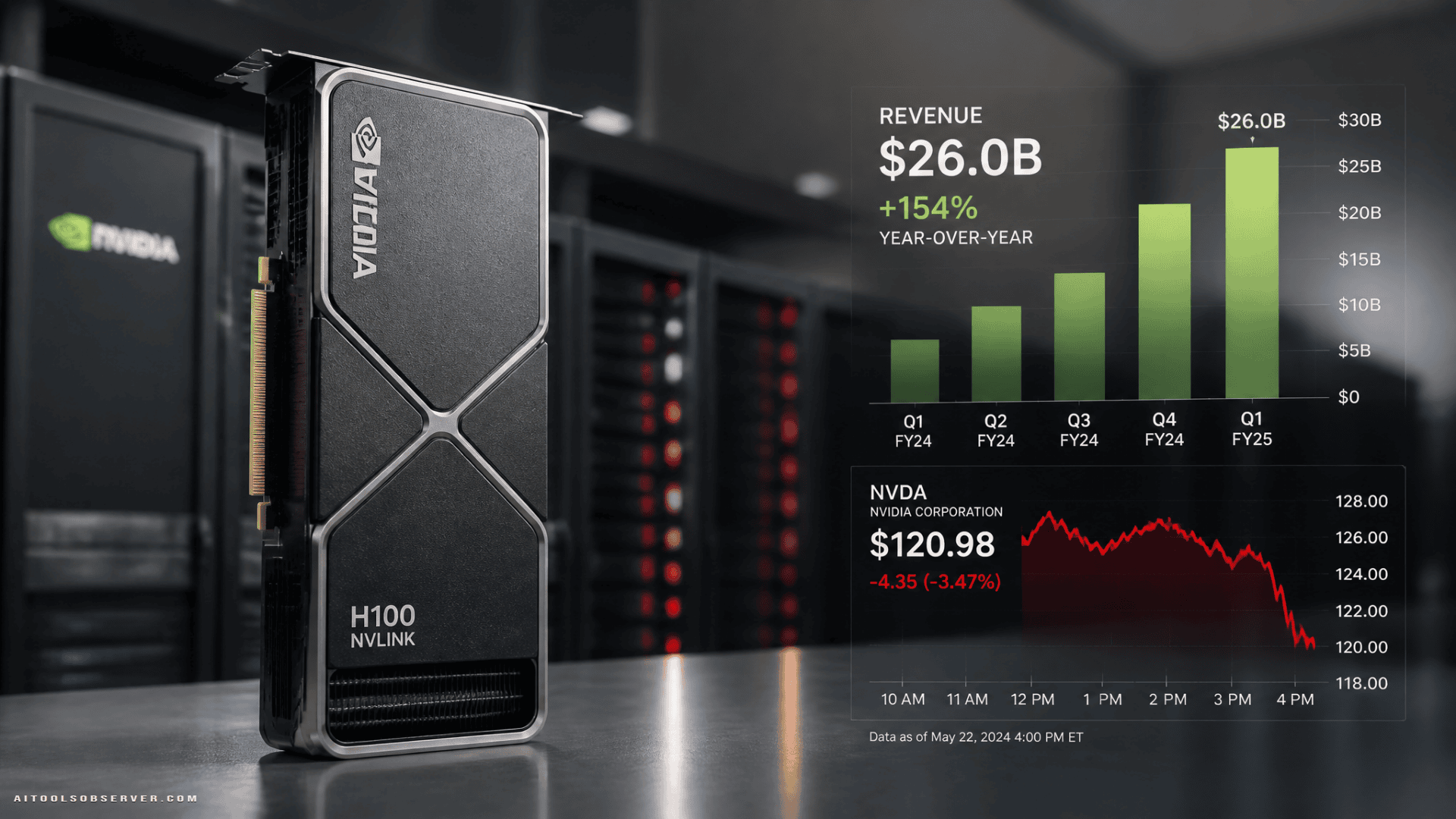
The short answer: AMD is being measured against Nvidia, and that’s a tough comparison.
Jonathan Weber, Investing Group Leader for Cash Flow Club, put it plainly — AMD continues to grow at a slower pace than Nvidia while trading at a significantly higher valuation. When the market prices in aggressive growth expectations and the results, while good, don’t close the gap with the leader, the stock gets punished.
This is a valuation problem, not a business problem. The market wasn’t reacting to bad results. It was reacting to the distance between AMD’s trajectory and what investors had already priced in.
What AMD’s Business Actually Looks Like Right Now
Breaking down the segments gives a clearer picture of where AMD’s momentum is concentrated:
- Data Center: $6.72B, up 107% YoY — the clear growth engine, fueled by AI accelerator and EPYC server processor demand
- Client: $3.06B, up 23% YoY — PC business holding up well
- Gaming: $779M, down 11% YoY — weak semi-custom revenue dragging this segment
- Embedded: $977M, up 19% YoY — recovering steadily
The gaming decline is worth noting, but it’s not the story. The data center and client segments are carrying the company’s growth narrative.
CEO Lisa Su’s Take on the Second Half
Dr. Su framed the quarter as a launchpad, not a ceiling. In her statement, she pointed to accelerating EPYC demand, scaling Instinct deployments, and the early ramp of Helios as reasons for confidence heading into H2 2026.
Her broader point: AI is expanding compute demand across all of AMD’s markets, not just data centers. That’s a useful framing for anyone tracking where AI infrastructure spending is actually flowing.
Q3 Guidance Came in Above Consensus
AMD guided Q3 revenue between $12.7B and $13.3B, with a midpoint of $13B. That’s well above the $12.51B analyst consensus.
Adjusted gross margin is expected to hold at 56% for the quarter.
By any standard measure, that’s confident guidance. The fact that Intel and Nvidia also ticked down slightly in sympathy with AMD’s results suggests the market’s reaction was partly sector-wide caution, not just an AMD-specific verdict.
What This Means for the AI Chip Market
AMD’s Q2 results confirm a few things worth tracking:
AI GPU demand is real and accelerating. A 107% year-over-year jump in data center revenue isn’t a rounding error. Enterprises and cloud providers are actively deploying AMD’s Instinct GPUs at scale.
The Nvidia comparison isn’t going away. As long as Nvidia dominates AI accelerator mindshare, AMD will face a perception gap even when its own numbers are strong. That gap affects how investors price AMD’s growth story.
Valuation matters as much as growth. For anyone evaluating AI infrastructure plays, AMD’s situation is a reminder that strong revenue growth doesn’t automatically justify a premium multiple — especially when a faster-growing competitor exists in the same space.
The Practical Takeaway
If you’re watching the AI chip market to understand where enterprise AI infrastructure is heading, AMD’s Q2 results are actually a positive signal. Data center revenue doubling year-over-year, strong Q3 guidance, and CEO commentary pointing to scaling deployments all suggest AMD is a legitimate second player in the AI accelerator race.
The stock drop isn’t a red flag on AMD’s business. It’s a reminder that in high-expectation markets, beating estimates isn’t enough — you have to beat the narrative too.











Comments (0) No comments yet
Want to join this discussion? Login or Register.
No comments yet. Be the first to share your thoughts!