


What’s reportedly in the works
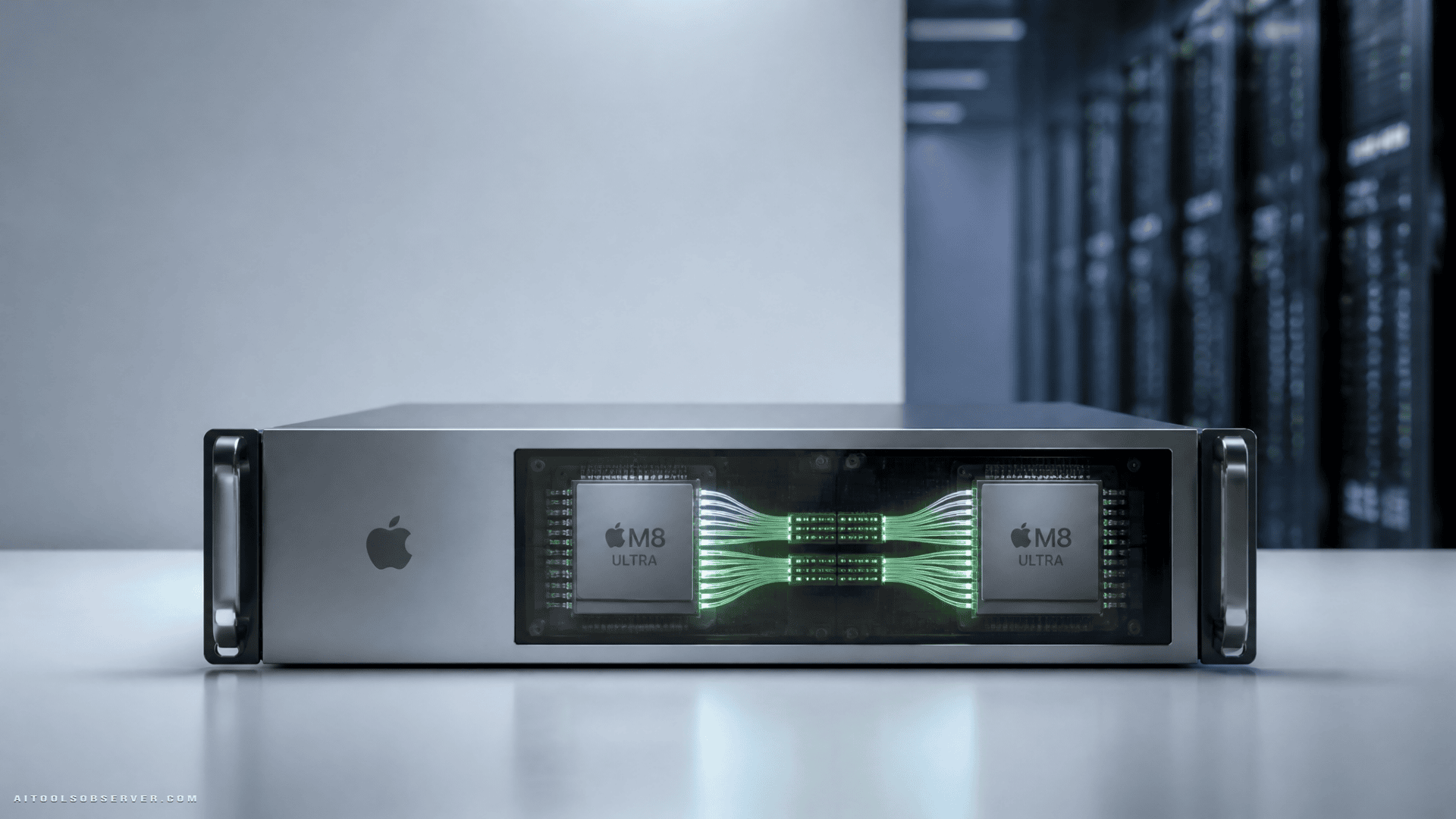
Based on the available description, Apple is developing an AI server that uses the same general family of Apple Silicon found in high-end Mac desktops. The reported product could come in two versions:
- A configuration with two M8 Ultra chips
- A configuration with four M8 Ultra chips
If that happens, it would mark Apple’s first server product in nearly two decades. It would also be a notable shift in how the company positions its in-house chips: not just for personal computing, but for enterprise AI workloads.
There is still a lot of uncertainty here. The project could change significantly, be delayed, or be canceled altogether.
Why Apple would even consider this now
The timing makes sense. Apple hardware has become more attractive to AI developers, especially for certain workloads where power efficiency, compact deployment, and Apple Silicon performance are appealing.
That trend appears to be one reason Apple is exploring a server built from the same chip architecture already gaining traction in the market. When developers start buying desktop-class systems for AI work at scale, the next logical question is whether a rack-friendly version follows.
This is the bigger story: Apple may be responding to real usage patterns instead of trying to create demand from scratch.
The Mac mini and Mac Studio signal is hard to ignore
One of the clearest indicators in the report is the growing use of Mac mini and Mac Studio systems for AI workloads. The description points to AI companies buying large numbers of these machines, while others have reportedly accessed them through cloud rental channels.
That does not mean Macs are replacing mainstream GPU clusters. It does suggest there is a meaningful slice of AI development where Apple hardware is useful enough to justify serious deployment.
For developers, that usually comes down to practical questions:
- Can the system run the models and workflows I care about?
- Is it efficient enough to justify the cost?
- Can I scale deployment without rebuilding everything?
- Does it fit reinforcement learning, inference, testing, or agent workloads better than alternatives?
If enough teams are answering “yes” on Mac hardware, Apple has a reason to productize that demand.
Why Nvidia networking is the most interesting part
The chip story is important, but the networking angle may be even more revealing. Apple is reportedly considering Nvidia data center networking technology, including NVLink Fusion.
If that holds, it would signal something important: Apple may be willing to mix its own compute strategy with outside infrastructure components where it makes sense. That is a practical move, not a branding move.
In AI infrastructure, standalone chip performance is only part of the equation. The hard part is often how systems connect, scale, and move data across multiple processors and nodes. Networking becomes central when workloads expand beyond a single box.
What that could mean in practice
A possible Apple server with Nvidia networking would suggest Apple is not trying to copy the standard hyperscale GPU stack exactly. Instead, it may be looking for a way to make Apple Silicon more viable in enterprise environments where interconnect and scaling matter.
That creates a few implications:
- Apple could focus on its strengths in chip design and system integration
- Nvidia could remain relevant even in a server that does not rely on Nvidia GPUs
- Enterprises might get another architecture option for AI workloads
The caveat is obvious: the Nvidia component is still not guaranteed.
This would be Apple’s first real server return since Xserve
Apple exited the server market long ago, with Xserve retired in 2011. A return in 2029 would not just be a product launch. It would be a strategic reentry into a category Apple left behind.
That is significant because the server market Apple would reenter now looks nothing like the one it left. Back then, enterprise hardware was a different conversation. Today, AI infrastructure spending is shaping roadmaps across chips, memory, networking, and cloud platforms.
So this is not about reviving an old server business. It is about joining a new infrastructure cycle built around AI workloads.
Why this matters for enterprise buyers
If Apple does ship an AI server, enterprise hardware buyers would have another decision to make: when does Apple Silicon make sense in the data center?
That will likely depend on workload fit, not brand loyalty. A future Apple server would need to prove itself on deployment efficiency, software compatibility, orchestration, serviceability, and total cost of ownership.
For buyers, the practical questions would include:
- Is it better for specific AI tasks than standard GPU-heavy setups?
- How well does it integrate into existing infrastructure?
- What software tools and frameworks are supported?
- Can teams manage it at scale like other enterprise systems?
- Does the performance-per-watt justify adoption?
That is the real bar. Enterprise infrastructure is not won by curiosity alone.
The developer angle is just as important
Apple’s clearest opening may be with developers already comfortable building on Mac hardware. If those teams are prototyping, testing, or running AI systems on Mac minis and Mac Studios today, a server-grade version could reduce friction.
That matters because AI adoption often starts with what teams can use quickly, not what looks perfect on paper. Familiar tooling, hardware consistency, and easier experimentation can all influence purchasing decisions.
In other words, Apple may not need to win the whole AI infrastructure market. It may only need to serve the segment already leaning toward its ecosystem.
There’s a supply chain reality behind all of this
One major constraint stands out: memory.
The broader AI infrastructure market is already dealing with memory shortages as companies rush to build out AI data centers. That pressure has affected pricing across consumer electronics and computing hardware, including Apple products.
Any Apple server effort would likely face the same bottleneck. Even if the architecture is compelling, supply chain limits can shape pricing, availability, and rollout timelines.
That matters for two reasons:
- AI hardware demand is no longer just a design problem
- Even strong product plans can be slowed by component scarcity
For enterprise buyers, that means watching not only product announcements, but also the economics behind them.
What this could mean for Apple’s role in AI infrastructure
Apple has often been viewed as adjacent to the AI infrastructure race rather than central to it. A dedicated server would change that perception.
It would suggest Apple wants a more direct role in the hardware layer supporting developer workloads, enterprise AI use cases, and possibly private or hybrid deployments where Apple Silicon offers a differentiated profile.
That does not automatically make Apple a top-tier data center incumbent. It does make Apple more relevant to a conversation it has largely influenced from the edge rather than the core.
What to watch next
The reported timeline is long, so the most useful move right now is to watch the signals around the project rather than treat it as a certainty.
Key signs worth tracking include:
- Continued enterprise adoption of Mac mini and Mac Studio for AI work
- More visible Apple positioning around developer AI workloads
- Any deeper signs of Apple-Nvidia infrastructure collaboration
- Evidence that Apple is preparing software and deployment tooling for server environments
- Ongoing memory supply pressure across AI hardware markets
If those pieces keep lining up, the server story gets more credible.
Bottom line
The reported Apple AI server is interesting not because it promises a dramatic disruption, but because it reflects where real demand may already be forming. Apple hardware appears to be gaining traction in AI development, and a server built around that momentum would be a logical next step.
For founders, developers, and enterprise teams, the takeaway is simple: keep watching Apple as an AI infrastructure player, not just an endpoint hardware company. If your workflows are already leaning on Apple Silicon, this is the kind of market shift that could matter long before 2029 arrives.









Comments (0) No comments yet
Want to join this discussion? Login or Register.
No comments yet. Be the first to share your thoughts!