


The New Actor Inside Your Perimeter
When you deploy an AI tool or agent, you’re not just adding software. You’re introducing an autonomous actor into your infrastructure — one that can query databases, retrieve records, trigger workflows, and move across connected systems, often faster and more broadly than any human operator would think to explicitly authorize.
Traditional perimeter security was never designed to catch this. You’ve hardened the edges. But inside the perimeter, you now have models with broad data access and no runtime control governing what they actually do with it.
The AI supply chain creates a category of blind spot that most security teams haven’t fully mapped yet.
What AI Agents Are Actually Doing
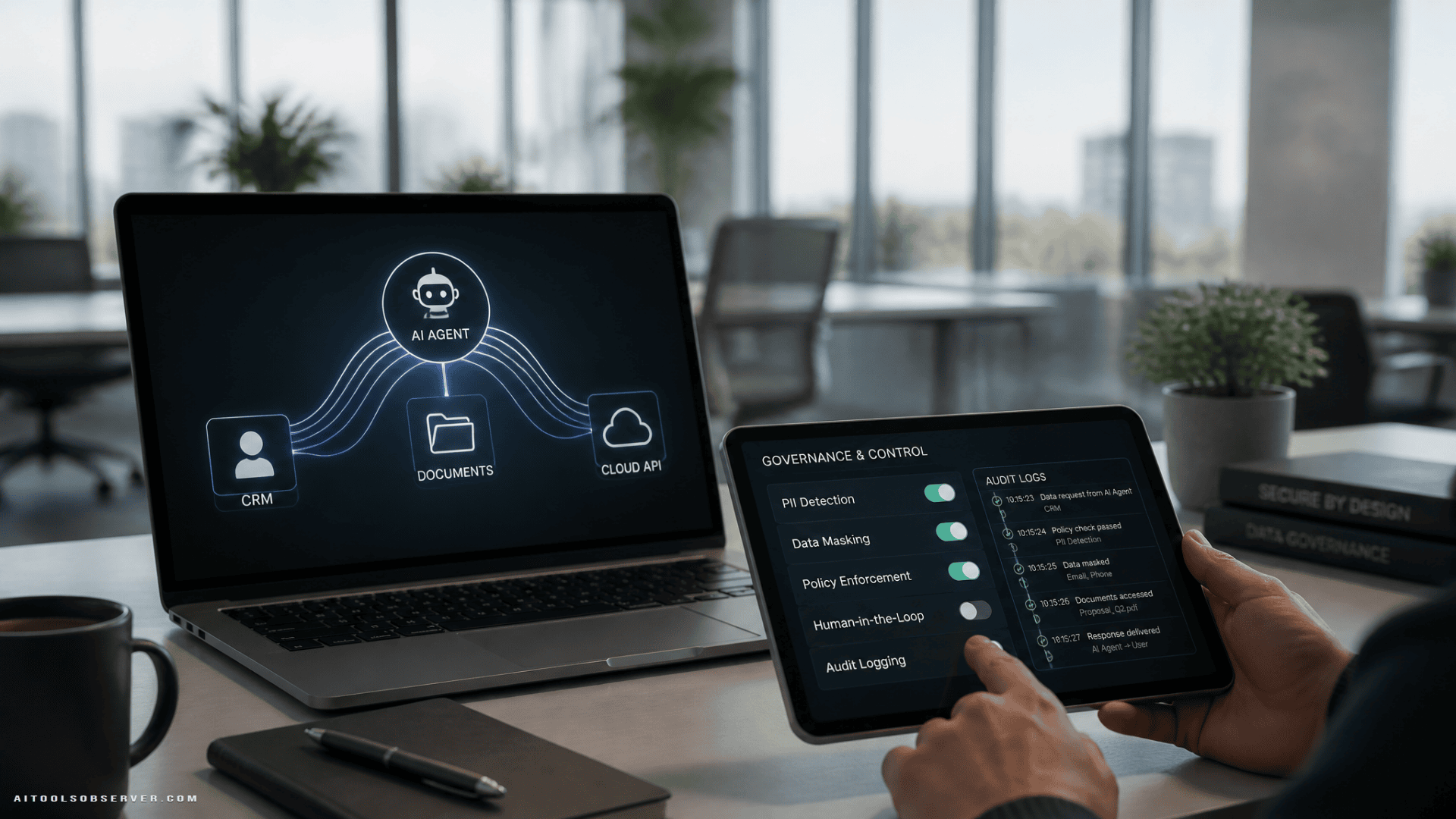
Modern AI agents don’t just respond to prompts. In a single execution cycle, an agent might:
- Pull a record from your CRM
- Retrieve a document from internal storage
- Query an external API
- Synthesize all of it into a response
Each of those steps is a data access event. Combined, they represent aggregation across systems that were never intended to be connected. And because this happens at machine speed and volume, by the time a human notices an anomaly, the data has already moved.
Most organizations are governing model outputs — what the AI says — while remaining entirely blind to what agents do. Those are two very different problems, and only one of them is getting attention.
The Employee Behavior Problem Is Actually an Architecture Problem
When employees use external AI tools without guardrails, company-confidential information often ends up sent to public models over unmonitored networks. That’s not recklessness. Those employees were told to use AI to be more efficient. They’re doing exactly what they were asked to do.
The governance gap is architectural, not behavioral. Blaming users doesn’t fix the exposure. Changing the infrastructure does.
At scale — organizations processing billions of tokens daily — even a one-percent governance gap isn’t a rounding error. It’s a measurable, compounding exposure that grows with every new AI deployment.
Why Post-Exposure Remediation Keeps Failing
Traditional GRC frameworks were built for a world where quarterly reviews and consultant assessments were sufficient. That model worked when decisions moved at human speed.
AI agents make decisions in milliseconds. Anything done wrong gets multiplied fast. Post-exposure remediation at that speed is the equivalent of patching a vulnerability after it’s already been exploited at scale.
The quarterly review cadence doesn’t match the execution cadence. That mismatch is where risk accumulates.
What Runtime Governance Actually Looks Like
The missing layer is inline inspection: governance that sits in the execution path and evaluates every AI action, tool call, and data access request against policy before it executes — not after.
This means a control plane operating in the flow of AI interactions, positioned between applications, models, agents, MCP servers, and enterprise tools. In practice, that looks like:
- Authorization enforcement at the execution layer — every tool call or data access request is evaluated against current policy before data moves
- Bidirectional data inspection — PII and regulated content are screened both going into models and coming back out
- Automatic audit records — every governed interaction produces a log, because regulators increasingly want operational proof that controls functioned, not just documentation that they exist
This isn’t about slowing AI down. It’s about making AI access auditable and bounded in real time.
The Regulated vs. Unregulated Industry Gap
In regulated industries — finance, healthcare, legal — external mandates are already pushing organizations toward execution-layer controls. The forcing function exists.
In unregulated industries, it hasn’t arrived yet. That means companies are accumulating structural exposure without the pressure to address it. The risk is real; the urgency just hasn’t been manufactured by a regulator or a headline yet.
When something significant happens — and the pattern suggests it will — organizations that treated governance as infrastructure will be in a fundamentally different position than those scrambling to retrofit controls after the fact.
That window is closing faster than most security teams realize.
The Practical Takeaway
Stop treating AI security as a post-deployment audit problem. The exposure isn’t happening in the logs you review. It’s happening in the execution cycles you can’t see.
If your current AI governance strategy relies on reviewing outputs and responding to incidents, you’re already behind the architecture. The organizations that get ahead of this will build the control plane first, then scale the AI on top of it — not the other way around.
Runtime governance isn’t a compliance checkbox. It’s the infrastructure layer that makes agentic AI deployable at enterprise scale without accumulating silent, compounding risk.










Comments (0) No comments yet
Want to join this discussion? Login or Register.
No comments yet. Be the first to share your thoughts!