


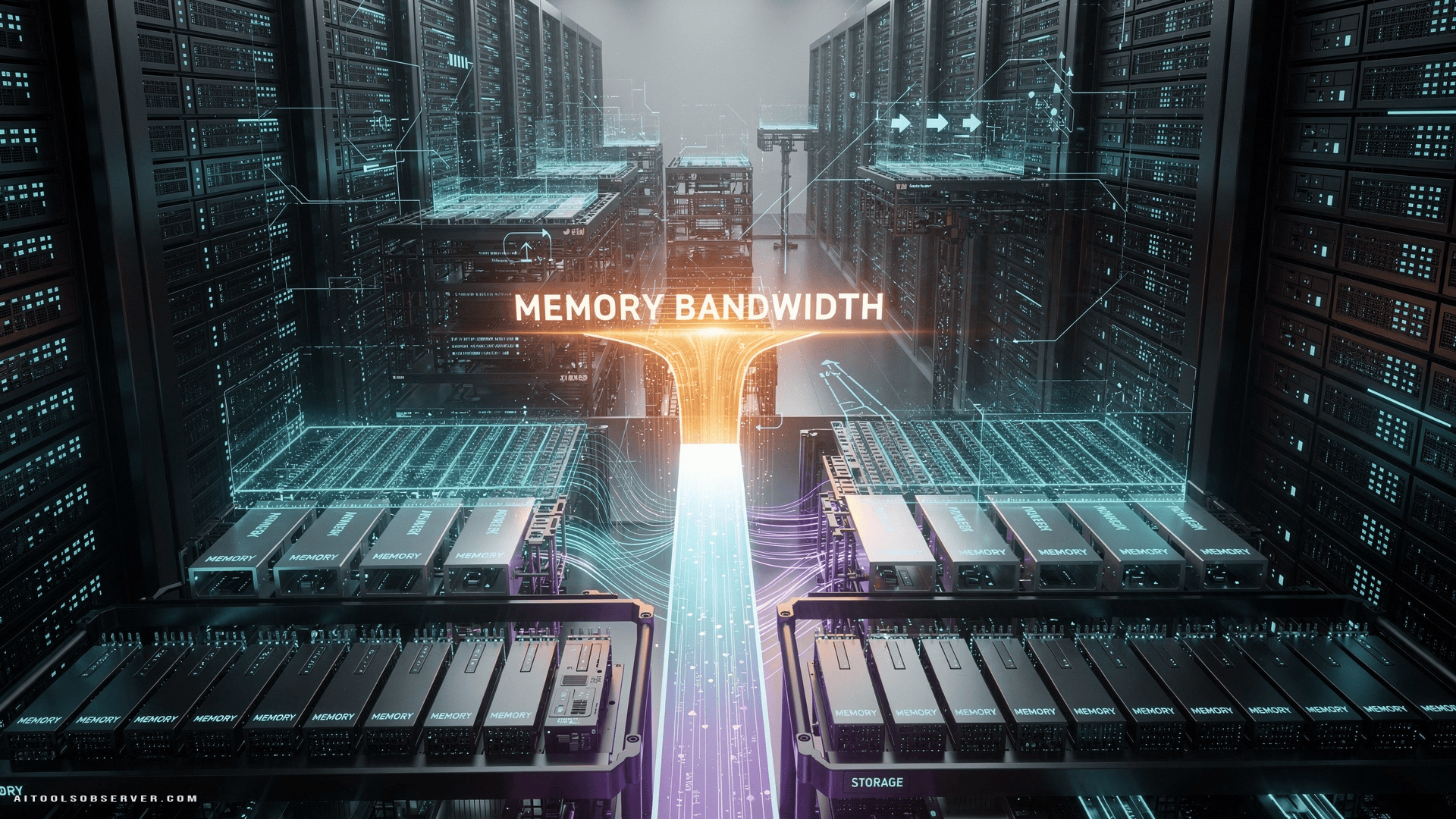
The Part Nobody Planned For

Here’s the basic anatomy of an AI data center: processors, DRAM, storage, all networked together into one massive, humming brain. It’s not conceptually different from your laptop. It’s just… a lot more of everything.
The problem is that “a lot more” turned out to be a dramatic underestimate.
Data centers were built around projections. Those projections, it turns out, were too conservative. The volume of data being consumed, processed, and generated by AI workloads has outpaced what operators planned for — and the market is now scrambling to catch up.
When Demand Outruns Supply, Prices Get Weird

DRAM prices rose roughly 40% year-to-date through early 2026. Over the prior 12 months? Up 240%.
That’s not a typo. That’s what happens when a critical component is undersupplied against explosive, non-negotiable demand.
Micron Technology has been the most visible beneficiary. Revenue grew 74% year over year. Net income more than tripled. Its market cap crossed $1 trillion. The stock climbed over 900% in twelve months — the kind of number that makes people double-check their screens.
But Micron isn’t alone in this.
The Quiet Giants Cashing In

SK Hynix — still not listed on U.S. exchanges, which is why most retail investors haven’t heard of it — makes both memory chips and hard drives. It’s riding the same wave. Its market cap has also crossed into trillion-dollar territory.
Samsung, better known for phones, has a deep presence in both memory and storage markets. Its shares have followed a similar trajectory.
Three companies. Three trillion-dollar valuations. All selling the same fundamental thing: the capacity for AI to remember and store what it’s doing.
That’s a meaningful signal about where value is accumulating in the AI stack right now.
The Analysts Think There’s More Room to Run
Here’s where it gets genuinely surprising.
Despite prices already being at jaw-dropping levels, Citigroup analysts expect DRAM prices to keep climbing through next year. Gartner’s forecast is even more aggressive — projecting 125% price growth across all of 2026 for DRAM, with storage prices following suit.
The reason is almost counterintuitive: enterprise buyers are paying these prices without flinching.
Consumers balk at expensive memory. Hyperscalers and AI infrastructure operators do not. When your business model depends on compute capacity, you pay what the market asks. Micron, Samsung, and SK Hynix are reportedly nearly sold out through next year.
Mordor Intelligence projects the global DRAM market will grow at nearly 15% annually through 2031. That’s not a spike. That’s a structural shift.
What This Means for the AI Tools Ecosystem

For founders and operators building on top of AI infrastructure, this trend has real downstream implications.
Inference costs aren’t going down as fast as hoped. If memory and storage prices keep rising, the cost of running AI workloads stays elevated — which means the economics of AI-powered SaaS products remain under pressure longer than expected.
The hardware layer is where margin lives right now. The application layer is crowded and competitive. The infrastructure layer — chips, memory, storage — is where pricing power actually exists in 2026.
Tool selection matters more when infrastructure is expensive. Choosing AI tools that are efficient with memory and compute isn’t just a technical preference. It’s a cost decision. Bloated, poorly optimized tools will become harder to justify as infrastructure costs remain high.
The Bigger Picture

The GPU was the obvious first act of the AI infrastructure story. Memory and storage are the second act — less glamorous, more fundamental, and apparently more underestimated.
The companies solving this constraint aren’t building flashy demos. They’re selling the capacity for AI to function at scale. And right now, that capacity is scarce.
If the AI ecosystem is a city, Nvidia built the roads. Micron, SK Hynix, and Samsung are building the warehouses. Turns out you can’t run a city without somewhere to put things.
The infrastructure layer is having its moment. It just took a memory shortage to make everyone notice.











Comments (0) No comments yet
Want to join this discussion? Login or Register.
No comments yet. Be the first to share your thoughts!