



Why Audit Workflows Are Particularly Well-Suited for AI
Audit work is document-intensive, data-heavy, and structured around repeatable procedures. These characteristics make it an ideal environment for AI augmentation. The core benefits are not abstract:
- Routine confirmation tasks and document reviews can be automated without sacrificing quality
- Large volumes of financial data can be analyzed faster and with greater consistency
- Risk identification improves when pattern recognition operates across complete datasets rather than samples
- Auditors reclaim time previously consumed by manual extraction and summarization
The strategic implication is significant. When AI handles computational and clerical work, auditors can concentrate on interpretation, professional judgment, and client advisory — the work that genuinely requires human expertise.
More than half of professionals now use publicly available GenAI tools for work purposes. Among those already using GenAI, 82% report doing so at least weekly. The integration is not experimental; it is becoming structural.
A Practical Framework for Getting Started
Getting started does not require a complete technology overhaul. The following four-step framework applies to firms of five people or five hundred.
Step 1: Establish Your Foundation
Before deploying any tool, understand the boundaries. Review your firm’s acceptable use policies, confirm the knowledge cutoff dates of any AI models you plan to use, and map your existing technology stack against data security requirements. Free training resources from major vendors are widely available and worth the investment of a few hours.
Step 2: Identify Your Highest-Cost Time Drains
Survey your team. Ask colleagues which repetitive tasks consume the most time each week. Common answers include board minutes review, lease agreement analysis, routine correspondence drafting, and document summarization. Build a prioritized list before selecting any tool.
Step 3: Test One Use Case in Parallel
Choose a single, well-defined problem. Run an AI-assisted process alongside your traditional approach and compare outputs. Craft precise prompts, ask the model to cite its sources, and validate results with the same professional skepticism you would apply to any audit procedure. Document what works and what does not.
Step 4: Scale What Proves Its Value
Once a process demonstrates consistent, reliable results, formalize it. Create templates, share prompting strategies across the team, and build institutional knowledge that makes adoption sustainable rather than dependent on individual initiative.
Document Analysis: Where AI Delivers Immediate Value

Document analysis is the highest-return entry point for most audit teams. Three applications stand out for their immediate, measurable impact.
Board Minutes Summarization
AI can rapidly extract items of audit significance from board minutes — new debt agreements, related party transactions, significant operational changes, and litigation matters requiring disclosure consideration. What previously took an hour of careful reading can be reduced to a structured summary in minutes.
Lease Agreement and Debt Covenant Review
AI can analyze lease agreements and debt covenants, extracting key terms, conditions, and compliance requirements. This accelerates the assessment of proper accounting treatment and reduces the risk of overlooking embedded provisions.
Revenue Contract Analysis Under ASC 606
For complex revenue arrangements, AI can identify and summarize the five steps of ASC 606, helping auditors assess proper revenue recognition methodology efficiently. This is particularly valuable when contract volumes are high or terms vary significantly across a client’s customer base.
The governing principle remains constant: garbage in, garbage out. The quality of your inputs — both the documents you provide and the precision of your prompts — directly determines the usefulness of the output.
Risk Assessment and Planning: Enhancing Judgment, Not Replacing It
AI excels at pattern recognition and comparative analysis, which are foundational to effective risk assessment. It can analyze client financial ratios, benchmark against industry data, and surface anomalies that warrant closer examination.
This does not replace professional judgment. It sharpens it. When AI handles the computational layer, auditors can focus on interpreting results, calibrating audit scope, and making informed decisions about where to direct procedures. The human remains accountable for every conclusion; AI improves the quality of the information feeding those conclusions.
Evaluating AI Tools: Eight Criteria That Matter
Selecting audit automation software requires structured evaluation. Eight criteria should anchor every assessment:
- Integration options — Does the tool connect with your existing audit management and document systems?
- Accuracy and reliability — Request evidence of accuracy rates and ask about built-in verification mechanisms.
- Security and data privacy — Look for SOC 2 compliance, encryption protocols, and role-based access controls.
- Client technology alignment — Confirm the tool is compatible with client environments where data exchange is required.
- Firm policies and procedures — Verify the tool supports, rather than conflicts with, your internal governance requirements.
- Cost/benefit analysis — Quantify time savings against licensing and implementation costs with realistic assumptions.
- Training requirements — Assess onboarding complexity and ongoing skill development needs.
- Copyright considerations — Understand how the tool handles proprietary content and generated outputs.
A Note on CoCounsel

CoCounsel, Thomson Reuters’ purpose-built AI solution, is worth examining as a reference point for what purpose-built audit AI looks like in practice. It operates against a closed set of credible sources, generates citations, and comes with baseline templates that firms can customize. The closed-source architecture directly addresses data governance concerns that open-model tools raise in professional settings.
Regulatory Standards: What PCAOB and AICPA Now Require
Regulatory frameworks have moved in parallel with adoption. Auditors need to understand what is now expected, not just what is permitted.
The PCAOB’s amendments to AS 1105 and AS 2301 clarify how auditors must evaluate and document technology-assisted analysis to obtain sufficient appropriate evidence. QC 1000 extends this requirement to engagement documentation regardless of whether it was created manually or with AI assistance — the standard of documentation does not change based on the method of production.
The AICPA’s AU-C 500 now explicitly acknowledges that audit procedures on information used as audit evidence may be performed using automated tools and techniques, including data analytics, artificial intelligence, machine learning, remote observation tools, and robotic process automation.
Five foundational principles remain non-negotiable under both frameworks: reperformability, professional skepticism, validity, accuracy, and completeness. AI changes the method; it does not change the standard.
Data Governance and Human Oversight: The Non-Negotiable Layer
Efficiency gains from AI are only sustainable when built on a foundation of strong data governance. Four principles should guide every auditor using AI tools:
- Trust but verify — Validate AI outputs before relying on them as audit evidence
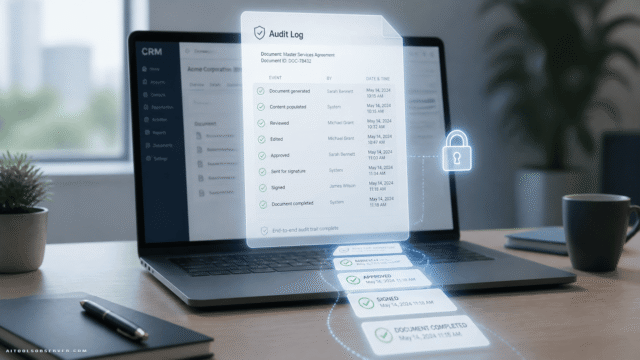
- Document the source — Record what tool was used, what inputs were provided, and how outputs were verified
- Account for bias and inaccuracies — AI models can reflect training data limitations; professional judgment must remain active
- Protect client confidentiality — Never input sensitive client data into tools that lack appropriate security controls
These are not bureaucratic constraints. They are the conditions under which AI-assisted audit work meets professional and legal requirements.
Agentic AI: The Next Horizon
The current wave of GenAI adoption is a precursor to something more consequential. Agentic AI — systems capable of executing complex, multi-step workflows with minimal human intervention — is moving from concept to deployment.
The numbers indicate how quickly this is approaching: 15% of organizations already use agentic AI tools, 53% are in the planning or consideration phase, and 77% expect it to be central to their workflow by 2030. For audit firms, this means systems that could eventually manage end-to-end confirmation processes, monitor continuous controls, and flag exceptions in real time — not just assist with individual tasks.
The firms investing in governance frameworks, data quality, and AI literacy today are building the infrastructure that agentic AI will require tomorrow.
Smaller Firms Have a Structural Advantage
A common misconception is that AI adoption is primarily a large-firm story. The opposite is often true. Smaller firms have fewer stakeholders, shorter decision cycles, and greater organizational agility. They can test, validate, and scale a new process in weeks rather than quarters.
AI can streamline document analysis, assist with research, summarize agreements, and review board minutes — all tasks that consume disproportionate time in lean teams. The return on investment per person is often higher in smaller practices precisely because each hour reclaimed has greater marginal value.
The Standard Has Risen
AI in audit workflows is no longer a competitive differentiator reserved for the largest firms. It is becoming the baseline expectation for professional practice. The auditors and firms that adopt it thoughtfully — with clear frameworks, rigorous controls, and a commitment to professional standards — will not just work more efficiently. They will deliver more strategic value, identify risk more reliably, and serve clients at a level that manual-only workflows cannot match.
The tools are accessible. The regulatory frameworks are in place. The remaining variable is the quality of implementation. That is where the real work — and the real opportunity — now sits.








Comments (0) No comments yet
Want to join this discussion? Login or Register.
No comments yet. Be the first to share your thoughts!