


What Is an AI Medical Scribe?
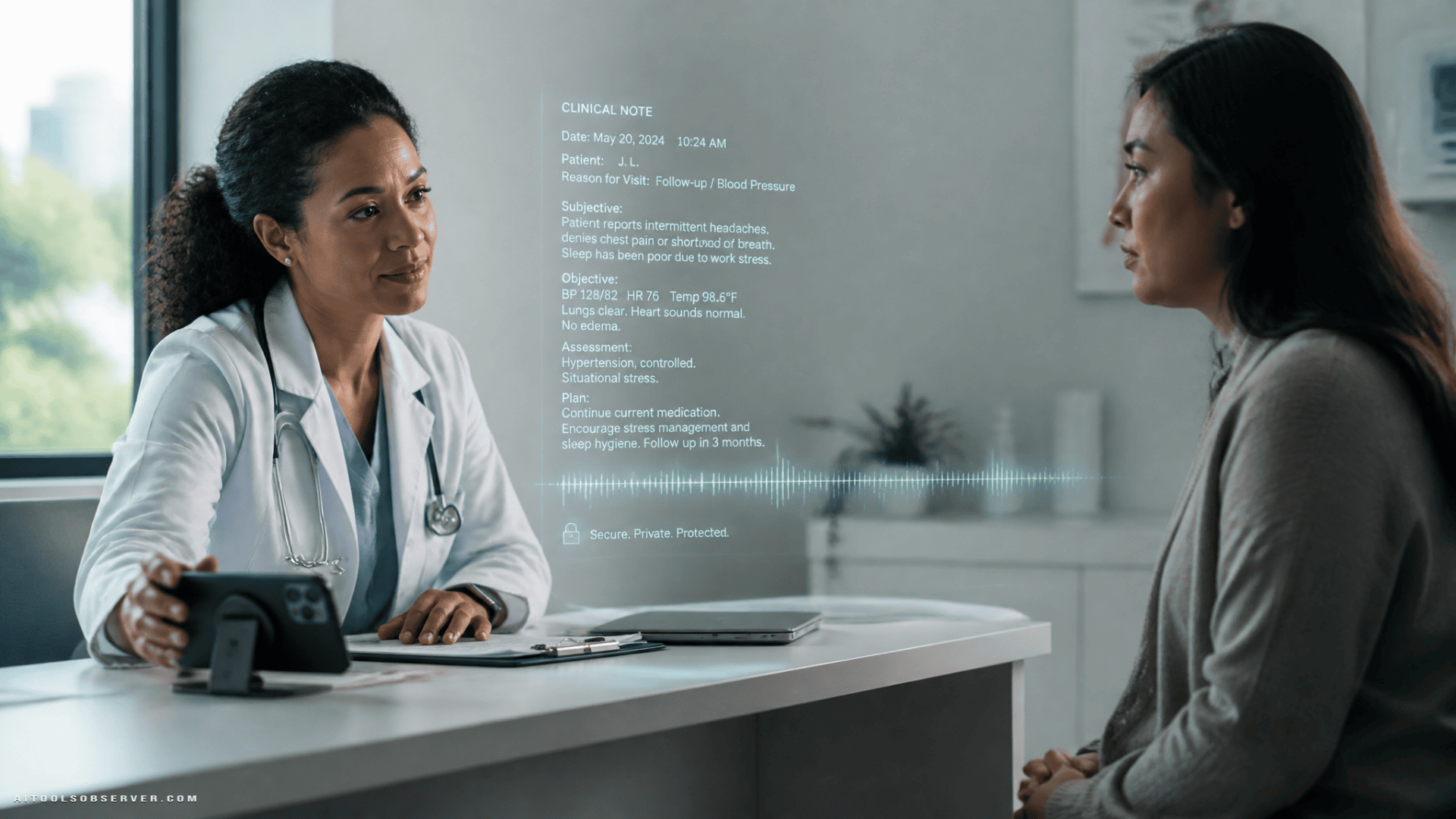
An AI medical scribe is software that listens to a doctor-patient conversation, transcribes it, and then uses a large language model — similar to the technology behind ChatGPT, but trained for clinical use — to generate a structured medical note.
The note typically captures what the patient reported, physical exam findings, and the doctor’s clinical reasoning. It follows standard formats specific to the specialty and visit type.
The goal is straightforward: reduce the documentation burden on physicians so they can focus on the patient in front of them rather than typing into a computer screen.
How It Actually Works in Practice
Most AI medical scribe tools run as smartphone apps. A physician places the phone on a desk, starts recording, and the software handles the rest.
The system uses automatic speech recognition to distinguish between voices — doctor, patient, and sometimes a family member in the room. When the visit ends, the audio is uploaded to a cloud server, transcribed, and converted into a draft clinical note. The doctor reviews it, edits as needed, and signs off before it enters the medical record.
Some scribes are embedded directly into electronic health record (EHR) systems. Others are standalone apps a physician downloads independently. The range of products on the market is wide, from enterprise-level integrations to free consumer apps.
Why Doctors Are Using Them
The appeal is real. Physicians spend a significant portion of their workday on documentation — time that comes at the expense of patient interaction.
When a doctor isn’t typing notes during a visit, they can make eye contact, listen more carefully, and engage more fully. That shift in attention can meaningfully change how a patient experiences the appointment.
There’s also a practical efficiency argument. Faster note generation means less time on administrative tasks after hours — a major driver of physician burnout.
The Privacy Question: What Happens to Your Data?
This is where most patients have legitimate concerns, and the answer is more nuanced than a simple “it’s fine.”
HIPAA Compliance Is the Baseline, Not a Guarantee
Reputable AI scribe products are designed to be HIPAA-compliant, meaning they follow the federal standards set by the Health Insurance Portability and Accountability Act. This includes encrypting data, controlling access, and maintaining liability if a breach occurs.
Recordings are typically not stored on the physician’s device. They’re uploaded to a compliant cloud environment, used to generate the note, and then deleted after a set period.
But HIPAA compliance is a legal floor, not a ceiling. It tells you the company has agreed to certain standards — it doesn’t guarantee those standards are perfectly implemented or that breaches won’t happen.
The “Digital Gold” Problem
Here’s a tension worth understanding. Some researchers describe these recordings as valuable data for studying physician-patient communication at scale — analyzing hundreds of thousands of real conversations to understand what actually works in clinical practice.
For now, recordings from routine appointments are generally not used for research unless a patient has been enrolled in a study. But the potential is there, and the policies around it are still evolving.
Can You Opt Out?
Yes — at least from the scribe itself. If you’re uncomfortable, you can tell your doctor before the visit starts. A good physician will simply take notes the traditional way. There’s no obligation to consent.
Opting out of AI in healthcare more broadly, however, is effectively impossible. Machine learning is already embedded in billing systems, clinical risk calculators, early warning tools, and patient communication platforms. If you’re receiving medical care, AI is almost certainly involved somewhere in the process.
Where AI Scribes Can Fail
This is the part that doesn’t get enough attention.
Accuracy Errors Are Real and Consequential
Errors in AI scribes are real. Common errors include misidentifying a patient’s gender or age, misattributing statements, or missing clinical nuance entirely.
One particularly dangerous failure mode: confusing “I do” with “I do not.” In a medical context, the difference between “the patient does have chest pain” and “the patient does not have chest pain” is not a minor editing issue. It’s a potential patient safety event.
Complex clinical situations — a patient in denial about a serious diagnosis, a conversation with emotional or psychological layers — are especially difficult for AI to capture accurately. The software produces a clean, structured note. The messy reality of the conversation often doesn’t survive the translation.
Error Propagation Through the Record
There’s a compounding risk that clinical informatics specialists have flagged. An overburdened physician doesn’t have time to carefully review every AI-generated note. An inaccurate note enters the medical record. Another AI system — used for risk assessment or clinical decision support — reads that note and acts on the wrong information. The error spreads.
This isn’t hypothetical. Errors in electronic health records are already common. AI scribes have the potential to accelerate that problem if review processes aren’t rigorous.
Who Is Liable?
The physician. Full stop.
Most AI scribe software requires doctors to sign user agreements confirming they are responsible for everything in the medical record, regardless of how the note was generated. The AI is a drafting tool. The doctor is the author.
That accountability structure is appropriate — but it only works if physicians actually review and edit the notes carefully before signing.
Health Equity Concerns
Many AI scribe tools are built primarily for English-speaking patients. That’s a meaningful limitation in diverse clinical settings.
The technology’s benefits — more eye contact, more attentive listening, better patient comfort — may not reach patients who speak other languages. And patients who are already distrustful of data collection, for any number of historically grounded reasons, may be less likely to consent, potentially affecting the quality of their care.
These aren’t edge cases. They’re structural issues that the healthcare AI industry hasn’t fully addressed.
What Patients Should Actually Do
You have more agency here than you might think. A few practical steps:
- Ask before the visit starts. If you see a phone or recording device, ask what it’s for and how the data is handled.
- Read any consent forms carefully. If you’re asked to sign something related to AI documentation, take a moment to understand what you’re agreeing to.
- Opt out if you’re uncomfortable. You’re entitled to say no. A physician who respects patient autonomy will accommodate that without issue.
- Ask about data retention. How long is the recording kept? Who has access to it? These are reasonable questions.
- Review your medical records. In the US, you have the right to access your records. If something looks inaccurate, you can request a correction.
The Bottom Line
AI medical scribes offer a genuine benefit: they can help physicians be more present with their patients. That’s not nothing. Attention is one of the most valuable things a doctor can offer.
But the technology comes with real tradeoffs — accuracy risks that can affect patient safety, privacy considerations that go beyond a HIPAA checkbox, and equity gaps that haven’t been solved. The physician is still responsible for every word in your medical record, which means the quality of their review matters as much as the quality of the AI.
The most important thing you can do as a patient is ask questions before you consent — not after you’ve left the office and started wondering what you agreed to.








Comments (0) No comments yet
Want to join this discussion? Login or Register.
No comments yet. Be the first to share your thoughts!