


Why model deprecation is not an edge case
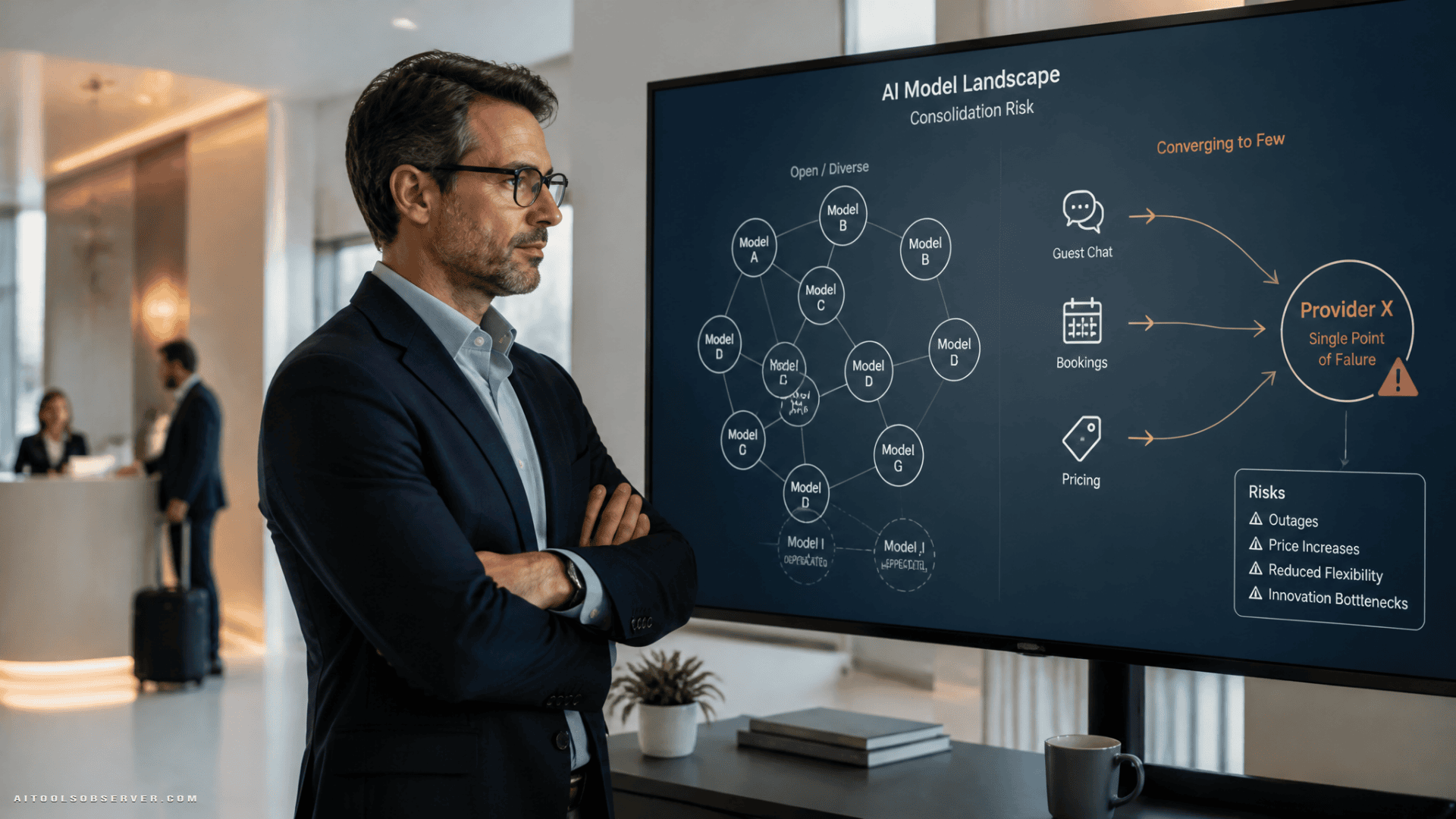
Model deprecation is becoming part of the normal lifecycle of AI platforms. Providers retire versions, consolidate product lines, and redirect customers toward new models with different characteristics.
For hotels, the issue is not merely technical replacement. A new model can behave differently in ways that matter operationally:
- it may classify requests differently
- it may produce different guest-facing language
- it may apply instructions less consistently
- it may introduce different latency or cost patterns
- it may handle multilingual or edge-case scenarios differently
That means a model swap is not the same as a standard backend patch. It is closer to replacing a decision-making component inside multiple live workflows.
Where the operational impact shows up first
In hospitality, AI is increasingly embedded in processes that touch either guests or revenue. That is why a model change can move quickly from technical issue to business issue.
Common exposure points include:
- guest communications and service triage
- reservation assistance and inquiry handling
- revenue and pricing support
- internal knowledge retrieval for staff
- categorization of requests, incidents, or feedback
- agent-like workflows with approval or action logic
If several of these systems depend on the same provider, one external change can create a broad but uneven disruption. Some workflows may degrade silently before anyone recognizes the pattern.
What a real AI continuity plan looks like
Business continuity for AI should be treated as an architecture problem, not just a vendor management problem. The goal is not to eliminate AI use. The goal is to reduce the blast radius when providers change models, pricing, access, or direction.
A practical continuity plan usually includes five elements.
1. Dependency mapping
Start by identifying where AI is actually present in the stack.
This sounds obvious, but embedded AI often disappears into product labels such as assistant, copilot, automation, or smart replies. CIOs need a live inventory of systems that use AI, the workflows they support, and the providers underneath them where that information is available.
Useful questions include:
- Which hotel operations depend on AI outputs?
- Which vendors use external foundation models?
- Which business processes would degrade if a model changed tomorrow?
- Where do multiple tools rely on the same provider?
Without this map, concentration risk remains mostly invisible.
2. Architectural abstraction
Applications should not be tightly coupled to one model provider if that can be avoided. An abstraction layer between application logic and model endpoints makes future switching less painful.
The principle is straightforward: your hotel systems should call a controlled internal interface, and that interface should handle model routing, versioning, and fallback policy. Technologies such as the Model Context Protocol point in this direction by separating application behavior from provider-specific implementation details.
The benefit is practical. If a provider retires a model, the change becomes a routing and validation exercise rather than a full rebuild.
3. Multi-model design
Not every task requires the same model. In fact, using one model for everything is often the riskiest and least efficient approach.
A more resilient pattern is to assign models by workload:
- smaller models for tagging, classification, or extraction
- stronger reasoning models for complex support or policy interpretation
- locally controlled models for sensitive data or residency constraints
- secondary providers for tested fallback paths
This improves resilience and often sharpens cost control. It also limits operational exposure if one provider changes terms or quality unexpectedly.
4. Portable governance
The long-term value in hotel AI operations is not the model itself. It is the business logic around the model.
That includes:
- approval workflows
- escalation conditions
- authority limits
- brand and tone constraints
- pricing or policy guardrails
- prompt libraries
- evaluation criteria
- exception handling procedures
These assets should exist independently of any one provider. If governance lives inside a vendor-specific implementation, portability becomes expensive and slow. If governance is maintained as a separate layer, the organization can test and adopt new models without rebuilding trust from scratch.
5. Tested fallback paths
A fallback model is only useful if it has been tested against real tasks and real governance rules. Simply naming a backup provider in a slide deck does not reduce risk.
A useful fallback design includes:
- a secondary provider or model path
- regression tests against representative hotel workflows
- clear thresholds for failover
- ownership for activation decisions
- post-switch monitoring for output drift
The key point is continuity of behavior, not just continuity of service.
Treat prompts and guardrails as operational assets
Many teams still treat prompts as disposable configuration. That is a mistake, especially in hospitality where consistency, compliance, and service tone matter.
Your prompts, control logic, escalation rules, and authority ceilings are operational assets. They should be versioned, reviewed, and tested like code. That usually means storing them in a managed repository, documenting changes, and validating outputs through a repeatable pipeline.
Why this matters: if a primary model is deprecated, the organization cannot preserve the old model itself. What it can preserve is the operating layer built around it.
That operating layer is what allows a new model to behave acceptably within known boundaries.
Portability is harder than it sounds
Good abstraction helps, but it does not remove the portability problem. Prompts tuned for one model may produce materially different results on another.
This is where many migration plans become too optimistic. A system may be technically portable while remaining behaviorally unstable.
Examples of portability friction include:
- one model follows structured instructions more reliably than another
- one provider is more verbose or more cautious in guest-facing responses
- multilingual handling varies across models
- classification thresholds shift enough to alter downstream routing
These issues are rarely caught by architecture diagrams alone. They are surfaced through regression testing across realistic scenarios.
For hotel CIOs, the practical lesson is simple: portability is not a claim. It is a tested property.
Vendor lock-in now includes model behavior
Traditional lock-in in hospitality software focused on data schemas, interfaces, migration cost, and implementation effort. AI adds a new form of lock-in: behavioral dependence.
A team may believe it is using a replaceable model API while actually depending on provider-specific quirks that have become embedded in prompts, workflow assumptions, and evaluation logic.
This is why vendor due diligence needs to go deeper than feature lists. Hotels should push vendors for clarity on:
- which model providers underpin the product
- how model updates are introduced and communicated
- whether fallback providers exist
- how outputs are regression-tested after model changes
- what happens if pricing, licensing, or access terms change
- whether governance rules can be exported or recreated elsewhere
A vendor does not need to expose every internal detail. But the hotel does need enough transparency to assess operational risk.
Questions hotel CIOs should ask now
For many organizations, the first useful step is not a redesign. It is a sharper set of governance and architecture questions.
Consider asking:
- Which guest-facing workflows depend on external AI models today?
- Where do we have single-provider concentration without realizing it?
- Do we control the governance layer, or does a vendor control it for us?
- Can we switch providers without rewriting prompts and decision logic from scratch?
- Have we tested our fallback path on real scenarios?
- Do we know which processes would fail quietly rather than visibly?
These questions tend to reveal whether AI resilience is real or assumed.
The architecture pattern that reduces risk
The strongest position for a hotel operator is usually one where the AI layer sits above core systems rather than being deeply baked into them.
In that setup:
- core operational systems remain stable
- AI acts as a controlled decision or interaction layer
- governance is enforced outside the model
- model choice becomes more modular
- failover becomes operationally manageable
This does not make migrations effortless. But it does prevent every model change from becoming a business continuity event.
What to do in the next 90 days
Hotel CIOs do not need to solve the entire problem at once. They do need to stop treating model dependency as an abstract future concern.
A sensible near-term plan is:
- inventory all AI-enabled systems and critical workflows
- identify shared provider dependencies across vendors
- classify which workflows are guest-critical or revenue-critical
- document where prompts, guardrails, and approval logic live
- define a fallback design for the highest-risk use cases
- require vendors to explain their model change and continuity process
- begin regression testing on at least one alternate model path
That work is not glamorous, but it is where resilience begins.
The useful takeaway
AI in hotels is not risky because models change. It is risky when operations depend on changing models without portability, fallback, or governance independence.
The practical objective for CIOs is clear: make model replacement a controlled transition instead of a disruptive surprise. If your prompts, business rules, and operational guardrails can survive a provider change, your AI strategy is becoming architecture. If they cannot, your hotel already has a single point of failure.











Comments (0) No comments yet
Want to join this discussion? Login or Register.
No comments yet. Be the first to share your thoughts!