


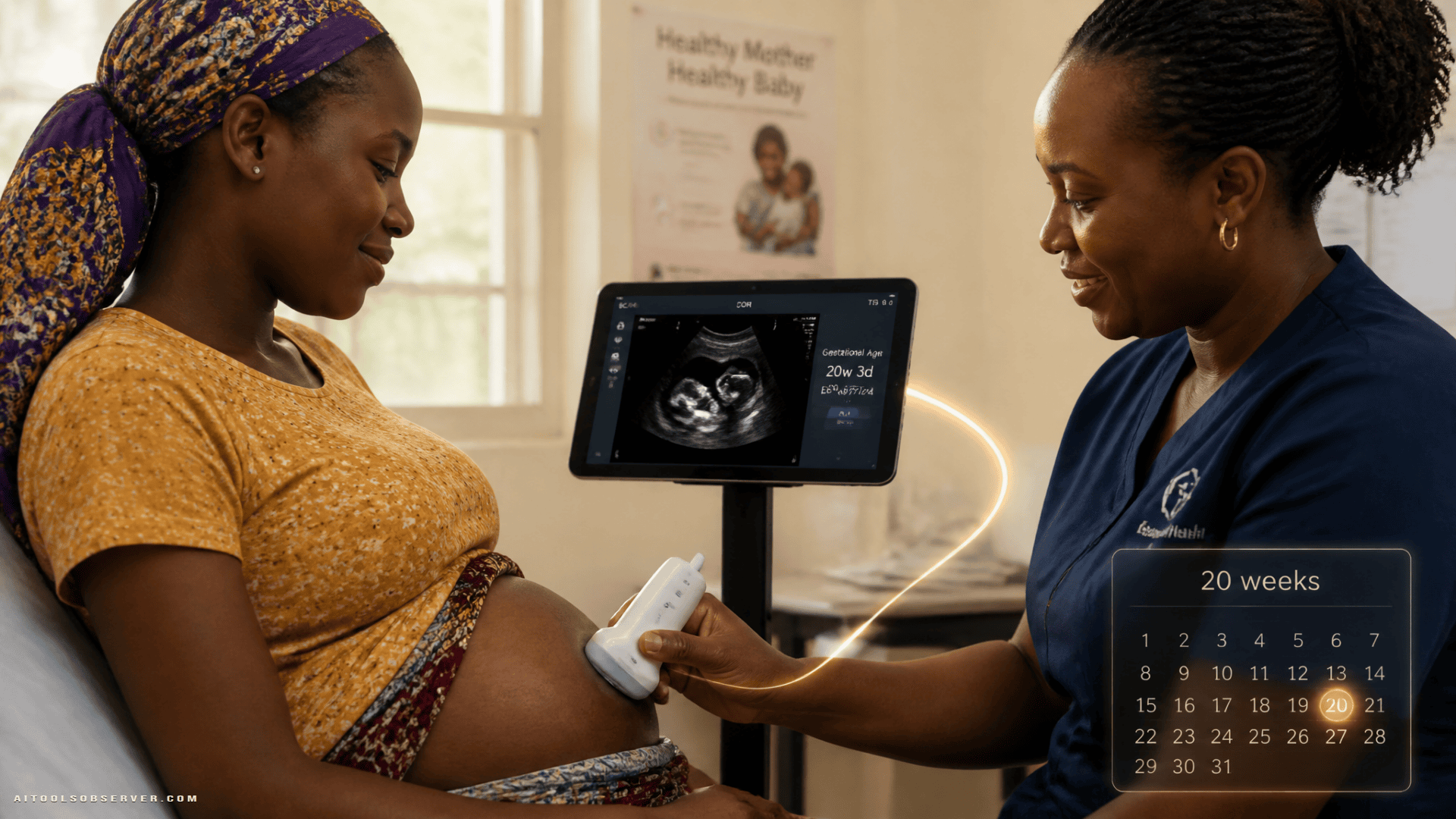
The problem it solves
Gestational age is not paperwork. It shapes real clinical decisions, including how care teams watch for preterm birth, post-term pregnancy, and other higher-risk situations.
Traditional ultrasound is recommended in prenatal care, but it comes with two practical bottlenecks:
- skilled sonographers
- costly equipment
Low-resource clinics often have neither in steady supply. So the real issue is not whether ultrasound is useful. It is whether ultrasound can show up where patients actually are.
What the AI system does differently
The approach here uses portable ultrasound plus AI analysis of blind sweep scans.
Blind sweep ultrasonography is a more structured acquisition method. Instead of requiring an expert to interpret images in real time while scanning, the operator performs protocol-based sweeps, and the AI estimates gestational age from that scan data.
That shift matters because it changes the workflow:
- less dependence on specialist interpretation during scanning
- more potential for use by novice operators
- better fit for clinics with limited staffing and equipment
In plain English: fewer “we need the expert in the room right now” moments.
What the reported results suggest
Based on the available description, researchers evaluated the system across multiple clinical settings, including sites in Chicago and Nairobi, and across different hardware conditions.
The key takeaway is simple: the model appears to have generalized well outside its original training setup. Reported mean absolute error was about 4.2 days, which was described as noninferior to the clinical standard. Performance was also similar across the two main evaluation settings.
That matters because clinical AI often looks smart in one environment and confused in another. Here, the description suggests stronger portability than many healthcare models manage.
Why this is a strong AI use case
This is not AI searching for a problem. The problem is old, expensive, and stubborn.
A useful healthcare AI use case usually checks four boxes:
1. The task is narrow
Estimate gestational age from ultrasound sweeps. Clear input, clear output.
2. The workflow is repeatable
Protocolized sweeps create a more standardized capture process, which gives AI a fighting chance.
3. The expertise gap is real
Skilled sonographers are valuable and not evenly distributed. AI has room to help.
4. The decision has practical value
Gestational age informs prenatal planning and interventions. This is not a vanity metric.
When those four line up, AI stops being a demo and starts looking like a service layer.
The operational lesson: training still matters
One of the more useful details in the description is not the model score. It is the sweep rejection rate.
The Nairobi setting reportedly had a lower rejection rate than Chicago, and the authors noted that more formal hands-on training may have improved scan acquisition quality. That is a good reminder that “AI-assisted” does not mean “humans optional.”
The smarter framing is:
- AI can reduce specialist dependency
- AI does not remove the need for good process
- lightweight training can still have outsized impact
In healthcare, the workflow usually beats the model. Or at least bullies it.
What founders and healthcare teams can learn from this
Even if you are not building for obstetrics, this is a strong template for applied clinical AI.
Design for constrained environments
If your product only works with premium hardware, stable bandwidth, and highly trained staff, it is not scalable in many care settings.
Standardize inputs
Blind sweep protocols are a quiet advantage. AI performs better when data capture is consistent enough to trust.
Fine-tune sparingly, not endlessly
The description suggests a relatively small amount of additional tuning helped adapt the model to new hardware and population differences. That is a practical deployment lesson: local adaptation may be necessary, but it should not require rebuilding the system from scratch.
Measure workflow quality, not just model quality
Rejected scans, operator training, and device differences matter. Clinical performance lives downstream from operations.
How this compares with broader AI tool adoption
Many AI tools promise efficiency by replacing expertise. This use case is better framed as redistributing expertise.
That distinction is important.
The system appears positioned to help novice operators perform a clinically useful task in places where specialist access is limited. That is different from saying AI can fully replace trained sonographers everywhere. It can extend capacity, widen access, and standardize one important part of prenatal assessment.
That is a much more believable, and more useful, story.
Tradeoffs to keep in view
Good use cases still come with caveats.
- Accuracy in one clinical task does not equal full prenatal diagnostic coverage.
- Different clinics can have different staffing, patient populations, and device setups.
- Operator training remains part of the outcome.
- Deployment in real care settings requires trust, process, and oversight, not just software.
So yes, this looks promising. No, it does not mean every ultrasound workflow is now solved by a portable probe and a model.
Where this could matter most
The clearest impact is in clinics where conventional prenatal ultrasonography is difficult to scale.
That includes settings where:
- sonographers are scarce
- imaging equipment budgets are tight
- prenatal screening demand exceeds specialist capacity
- patients would otherwise go without timely gestational dating
In those environments, AI is not competing with an excellent existing workflow. It may be filling a gap where the alternative is delay, distance, or no scan at all.
The practical takeaway
If you want a good example of AI applied well, look for this pattern: a high-value clinical task, a standardized data collection method, low-cost hardware, and a workflow that helps nonexperts do useful work safely.
This portable ultrasound use case fits that pattern unusually well. The lesson is bigger than maternal health: when AI is built around access, not just accuracy, it starts solving the problem people actually have.









Comments (0) No comments yet
Want to join this discussion? Login or Register.
No comments yet. Be the first to share your thoughts!