



The Product Behind the Statistic

Before you generalize the 65%, you need to understand what produced it.
On June 23, Anthropic launched Claude Tag in public beta — a persistent AI teammate that lives inside Slack. It replaces the older Claude in Slack app with something closer to an actual colleague. You summon it with @Claude, every member of a channel talks to the same instance, and it holds context across conversations over time.
With ambient mode on, it surfaces relevant information unprompted, follows up on threads that have gone quiet, and works asynchronously across hours or days. It’s available now to Claude Enterprise and Team customers, with a 30-day migration window from the old app.
The 65% figure comes from Anthropic running this exact tool on itself. Its product team uses an internal version of Claude Tag. Support and data-analysis work routes through the same system. It’s the cleanest live demonstration of agentic AI anyone has put on the table — which is precisely why the number deserves a second look before it gets copy-pasted into a broader narrative.
Why This Number Doesn’t Generalize
Anthropic is the single best-positioned organization on earth to produce that statistic.
It builds the model. Its engineers are among the most capable AI users anywhere. Its codebase is the one Claude has the deepest exposure to. A frontier lab running its own frontier model on its own code is the ceiling of what’s possible today — not a baseline any average company should expect to match.
The actual baseline looks very different. MIT’s Project NANDA found that 95% of enterprise generative-AI pilots deliver no measurable P&L impact, with only about 5% extracting real value. The diagnosis isn’t the technology. It’s data readiness and workflow integration — the unglamorous work of wiring a model into the systems where a company actually operates.
Most enterprises are still stuck on that step. The distance between Anthropic’s 65% and the median company’s results is the real story, and the headline number steps right over it.
The Design Choice That Tells You Everything

Here’s where the product says more than the statistic does.
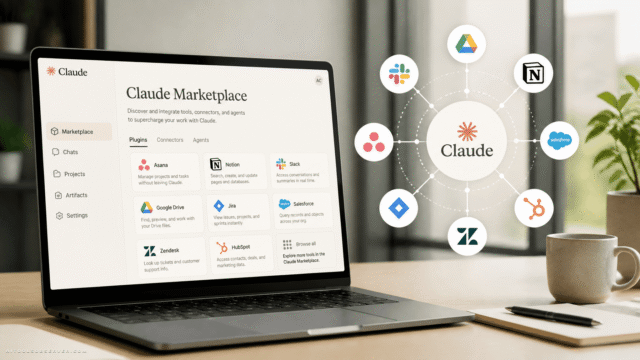
Anthropic didn’t build Claude Tag as a standalone destination that pulls work out of existing tools. It built the agent to live inside Slack — where the conversations, decisions, and accumulated context already sit. The agent is only as good as its access to that context, so Anthropic brought the agent to the data rather than asking the data to move to the agent.
That single design choice is the entire argument about who captures value in the agent era.
A model maker that believed the model was the moat would try to own the surface and keep users inside its own walls. Instead, the most advanced lab in the field is plugging into someone else’s system of record — because that’s where the proprietary context lives. The lesson generalizes cleanly: value accrues to whoever owns the data the agent needs, and the agent gets carried to it.
What the “SaaSpocalypse” Bears Have Backwards
The dominant market read since early 2026 has been that AI agents automate the seats and hollow out enterprise software. Claude Tag is fresh evidence pointing the other way.
An agent that must embed in the system of record to be useful makes the owner of that record more valuable, not less. The agent can’t function without it.
The companies positioned best by this dynamic are the ones already holding a company’s working data:
- Workflow platforms like ServiceNow, whose configuration database has become a system of record across much of the Fortune 500
- Microsoft, with its productivity and cloud layers embedded in nearly every large enterprise
- Oracle, running back offices on databases that agents will need to query
A startup trying to replace these systems starts without the data or the switching costs that make the incumbent useful to an agent in the first place. That’s a structural disadvantage, not a temporary one.
Pricing Evolves, It Doesn’t Collapse
Seat-based licensing gives way to billing on deployed agents and the outcomes they produce. As agent count climbs, revenue can climb with it — the opposite of the hollowing-out thesis.
It’s the same misread the market made when it declared Google Search finished the moment ChatGPT arrived. The incumbent that owns the data tends to absorb the new layer rather than be erased by it.
The Question Worth Actually Asking
The investable question isn’t how much of Anthropic’s own code Claude writes. That number will keep climbing, and it will keep getting misread as a verdict on enterprise software.
The sharper question is whether agentic tools like Claude Tag can cross the gap from frontier labs to ordinary companies still parked in pilots — and who captures the value when they do.
The product points to a clear answer: whoever owns the data the agent needs to be useful.
That holds regardless of which model wins the next benchmark race. The agent arrives as a guest in the system of record, not as its successor. The 65% is a milestone for Anthropic. The signal for everyone else is the address Claude Tag shipped to — and what it says about where AI value actually lands.






Comments (0) No comments yet
Want to join this discussion? Login or Register.
No comments yet. Be the first to share your thoughts!