


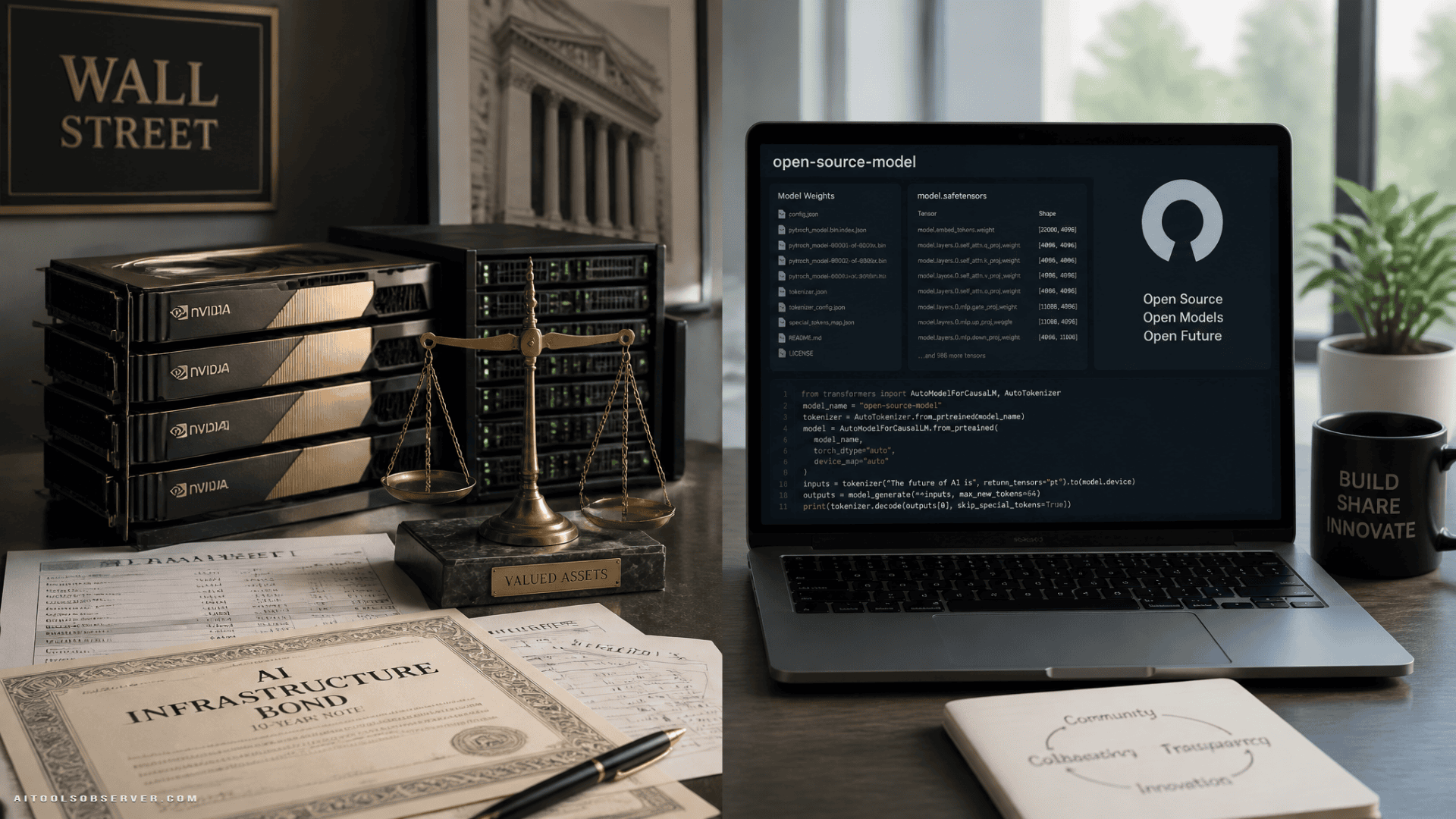
Nvidia Turns GPUs Into a Wall Street Asset Class
The core idea behind Nvidia’s $500 billion push is structural: instead of requiring hyperscalers, frontier AI labs, and enterprises to purchase hardware directly from their own balance sheets, institutional capital — credit facilities, insurance funds, and private investment — underwrites the acquisition of GPUs and data center infrastructure.
This is a significant reframing. AI chips have historically been capital expenditures. Nvidia, working alongside six asset firms, is positioning them as financeable assets — closer in treatment to aircraft or commercial real estate than to software licenses.
The practical implication is that organizations that previously lacked the capital to build serious AI infrastructure could access it through structured financing rather than outright purchase. That expands the addressable market for Nvidia hardware considerably.
What This Means for AI Buyers
For enterprises evaluating AI infrastructure, this development is worth watching closely:
- Access without upfront capital: Financing structures could lower the barrier to deploying large-scale GPU clusters.
- New counterparties: Institutional lenders entering the AI hardware space introduces new due diligence requirements and contract structures that buyers will need to understand.
- Nvidia’s strategic position: By facilitating financing rather than just selling chips, Nvidia deepens its relationship with end users and reduces friction in the sales cycle.
The risk, as with any asset-backed financing model, lies in valuation assumptions. GPUs depreciate. Model architectures shift. Whether institutional capital prices that obsolescence risk accurately remains to be seen.
Meta Opens Its Most Powerful Models — and Targets Laptops
Meta’s announcement runs in a different direction: rather than monetizing access, the company is releasing the weights for Muse Spark 1.2, its most capable current model, making it freely downloadable and usable by the public. Releasing weights means developers can inspect, fine-tune, and deploy the model without routing requests through Meta’s infrastructure.
Alongside that, Meta is introducing the Muse Glimmer family — a set of open source models specifically designed to run on laptops. This is a deliberate move toward on-device inference, reducing dependence on cloud APIs and enabling use cases where latency, privacy, or connectivity constraints make server-side inference impractical.
The Competitive Logic
Meta’s open-source strategy is not purely altruistic. By releasing powerful models freely, the company applies pressure on OpenAI and Anthropic — both of which operate closed, API-gated model access. Developers who build on open weights are less likely to migrate to proprietary alternatives, and the ecosystem that forms around Meta’s models generates indirect value even without direct monetization.
For teams currently evaluating which model provider to build on, the Muse Glimmer family introduces a credible option for local deployment. The tradeoff is support, reliability guarantees, and the operational overhead of self-hosting — factors that matter differently depending on team size and use case.
The Broader Picture
These two developments sit against a backdrop of genuine macroeconomic tension. Oil prices are climbing, the U.S. Strategic Petroleum Reserve is at its lowest level since 1983, and geopolitical uncertainty is affecting energy markets. That context matters for AI infrastructure: data centers are energy-intensive, and energy cost volatility affects the economics of large-scale compute.
The AI infrastructure buildout is not slowing down — but the financing structures, model access models, and hardware economics are all becoming more complex. Staying oriented to those shifts is increasingly part of making sound AI tool and platform decisions.
The practical takeaway: If you are evaluating AI infrastructure options, Nvidia’s financing initiative suggests that capital access may become less of a constraint than it has been — but the terms and counterparties will matter. If you are choosing between hosted and self-hosted model options, Meta’s Muse Glimmer release is worth benchmarking against your latency and privacy requirements before defaulting to a cloud API.







Comments (0) No comments yet
Want to join this discussion? Login or Register.
No comments yet. Be the first to share your thoughts!