


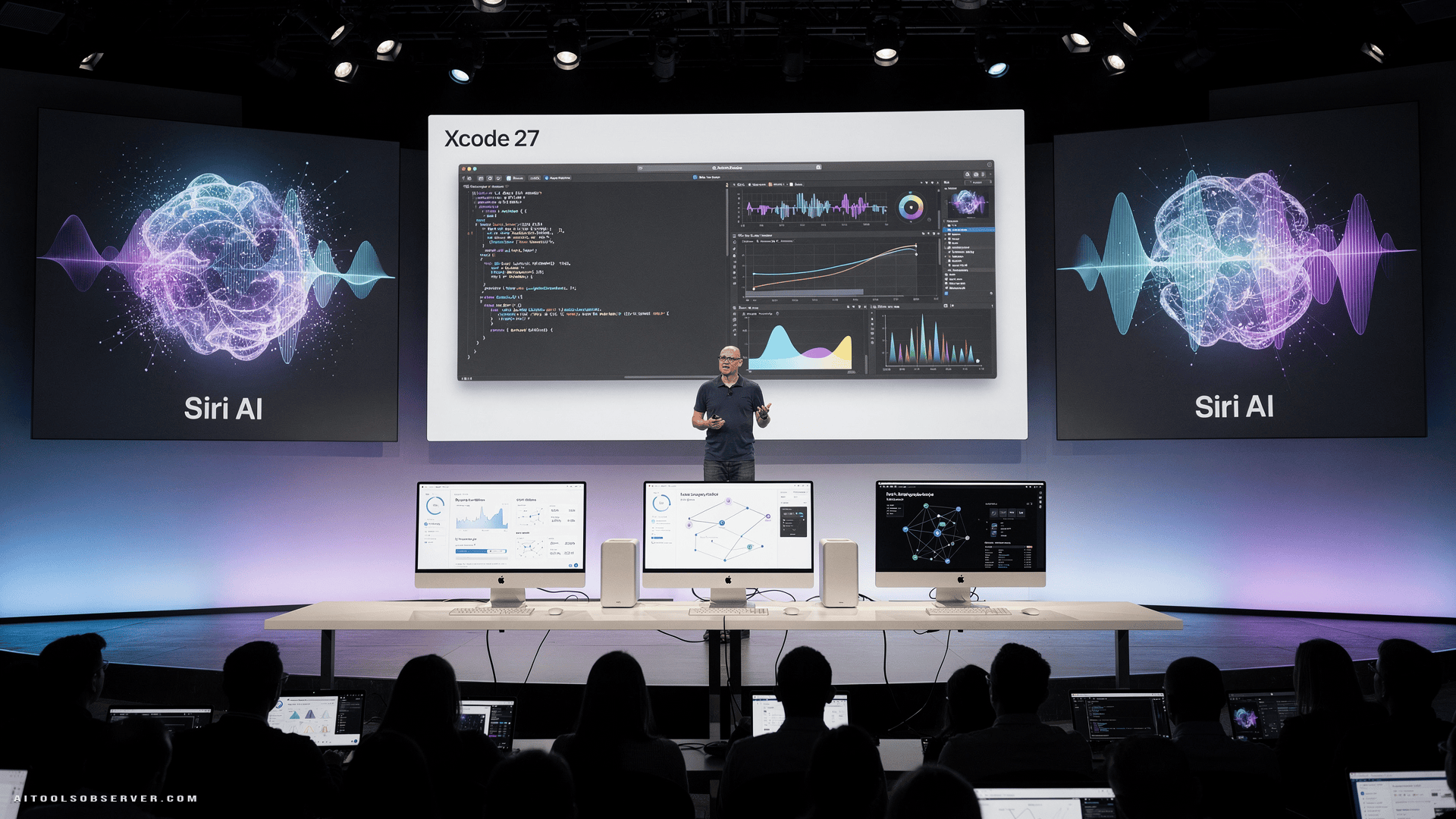
What the Presentation Actually Covers
The 90-minute runtime is dense but well-structured. Apple moves through several distinct layers of its AI developer ecosystem, each building on the last. The session is not a marketing reel — it is a technical walkthrough with live demos, framework explanations, and integration patterns that developers can act on immediately.
For non-developers, it still rewards attention. The demos reveal what third-party apps will realistically be able to do once developers adopt these frameworks at scale.
Xcode 27: From Prompt to Deployed App in 20 Minutes

The most immediately striking segment is a 20-minute live demo in which a complete iOS app is built from a single natural-language prompt. The result is a WWDC badge tracker application featuring 3D animations, holographic visual effects, and integrated Visual Intelligence capabilities.
What makes this demo technically credible rather than merely theatrical is the process Xcode 27 follows before writing a single line of code. The IDE asks clarifying questions, maps out the project architecture, and surfaces follow-up considerations — behavior that mirrors how a senior engineer would approach scoping a new feature.
Why This Matters for Developers
This is not autocomplete at scale. Xcode 27 is demonstrating intent-to-architecture reasoning, which is a qualitatively different capability from token-by-token code suggestion. The implications for solo developers and small teams are significant: the gap between idea and working prototype compresses substantially.
Siri AI Integration: A New Surface for App Developers
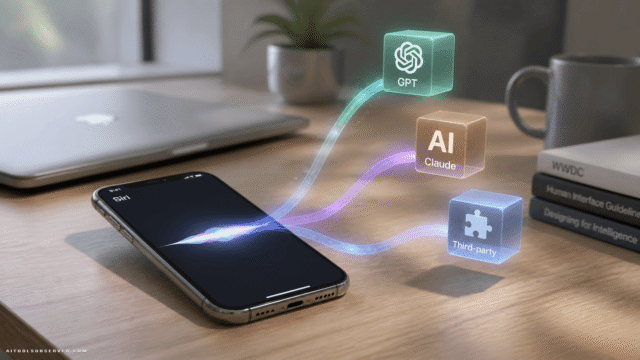
The session dedicates meaningful time to how third-party apps can integrate with the new Siri AI layer. Apple is opening Siri as a programmable surface, allowing developers to expose app functionality through natural-language interfaces without rebuilding their core logic.
This positions Siri less as a consumer assistant and more as an orchestration layer — one that developers can hook into through structured APIs. The practical outcome is that users will be able to interact with third-party apps through Siri in ways that feel native rather than bolted on.
The Framework Stack: Foundation Models, Core AI, and MLX

Apple introduced three interconnected frameworks that form the backbone of its on-device AI strategy.
Apple Foundation Models provides access to Apple’s own language models directly from app code. Core AI sits beneath it as a lower-level abstraction layer, handling model execution, memory management, and hardware acceleration. MLX — Apple’s machine learning framework for Apple Silicon — has been upgraded and now integrates cleanly with both layers.
Third-Party Model Support
Critically, the framework stack does not lock developers into Apple’s own models. The session explicitly demonstrates how third-party models integrate with Core AI and MLX, giving developers flexibility without sacrificing the performance optimizations Apple Silicon provides.
This is a deliberate architectural decision. Apple is building infrastructure that works whether the model is Apple’s or not — a pragmatic stance that acknowledges the diversity of the current LLM landscape.
The Headline Demo: Kimi 2.6 at 1 Trillion Parameters, Running Locally
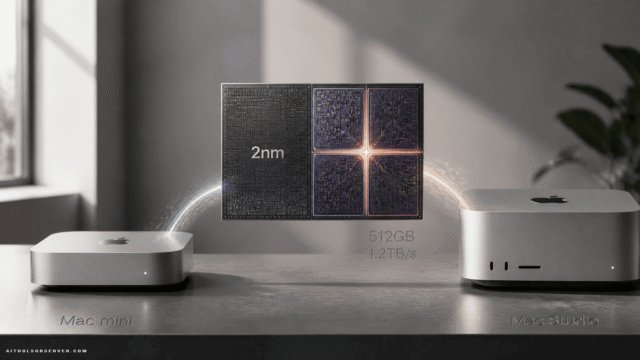
The session closes with its most technically impressive segment. Apple demonstrates the Kimi 2.6 model — a 1-trillion-parameter large language model — running locally in LM Studio across four Mac Studios connected via RDMA-over-Thunderbolt.
RDMA (Remote Direct Memory Access) over Thunderbolt is a technology Apple introduced with macOS Tahoe 26.2. It enables extremely low-latency, high-bandwidth memory access across physically separate machines, effectively allowing multiple Mac Studios to behave as a single unified inference system.
What This Benchmark Signals
Running a 1T-parameter model locally — without cloud infrastructure, without API calls, without data leaving the premises — is not a proof of concept. It is a production-viable architecture for organizations with serious privacy requirements or latency constraints.
The choice of Kimi 2.6 as the demonstration model is also notable. It signals that Apple’s hardware and framework stack is capable of hosting frontier-scale models, not just the compact on-device models Apple typically ships by default.
RDMA-over-Thunderbolt: The Enabling Technology
The RDMA-over-Thunderbolt implementation deserves specific attention. Traditional multi-machine inference setups require either expensive networking infrastructure or accept significant latency penalties. Thunderbolt’s bandwidth characteristics, combined with RDMA’s ability to bypass CPU overhead during memory transfers, create a local cluster architecture that is both accessible and performant.
For AI practitioners evaluating on-premise deployment options, this changes the calculus meaningfully. A cluster of Mac Studios is now a legitimate inference environment for very large models.
What Developers Should Take Away
Apple is not positioning itself as an AI model company. It is positioning itself as the most capable AI infrastructure layer for its own hardware ecosystem. The frameworks announced at WWDC26 — Foundation Models, Core AI, MLX — are designed to make Apple Silicon the default choice for on-device AI workloads, regardless of which model a developer chooses to run.
Xcode 27 lowers the barrier to building AI-native apps. Siri integration opens new interaction surfaces. And the Kimi 2.6 demo establishes that the hardware ceiling for local inference is now genuinely high.
The Broader Signal for the AI Tools Ecosystem
For anyone tracking the AI tools landscape, WWDC26 marks a clear inflection point in Apple’s developer strategy. The company is no longer playing catch-up on AI features — it is building a coherent, layered platform that competes directly with cloud-based AI development environments on the dimension that matters most to privacy-conscious and latency-sensitive users: local execution.
The full session is available on the Apple Developer YouTube channel. For developers building on Apple platforms, it is required viewing. For everyone else, it is the clearest signal yet of where on-device AI is heading.









Comments (0) No comments yet
Want to join this discussion? Login or Register.
No comments yet. Be the first to share your thoughts!