


What Got Leaked and Where It Came From
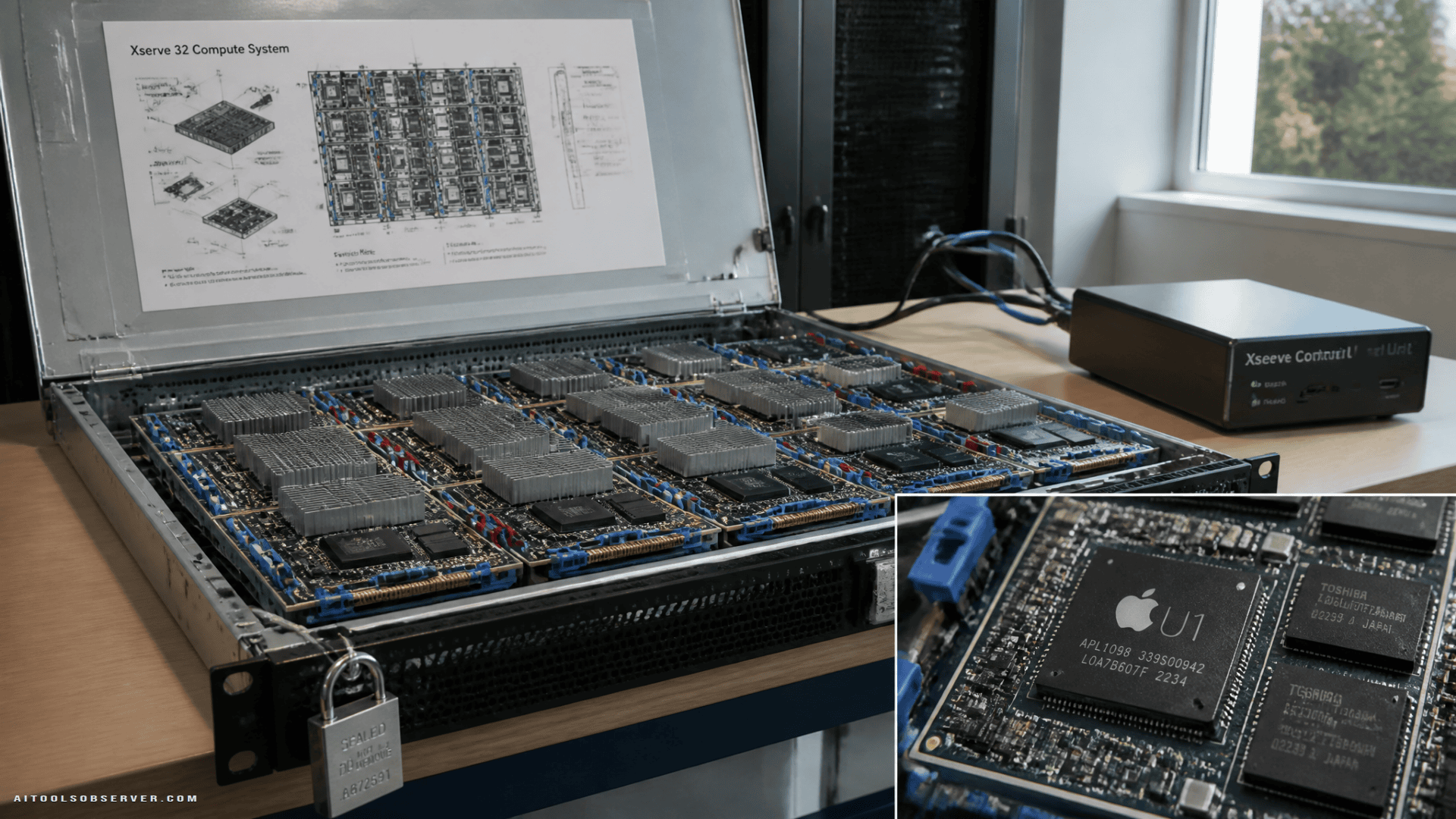
The images were shared on X by the account @hsuchingpo, a leaker with a documented history of Apple hardware and prototype leaks. The post was captioned simply “Apple M5 Server,” with the leaker noting the hardware is “most likely” Apple’s Private Cloud Compute system.
That’s an important qualifier — nothing here is officially confirmed by Apple. But the hardware details visible in the images are specific enough to draw some meaningful conclusions.
What the Hardware Actually Looks Like
The leaked images show a rack-mountable chassis designed to hold up to 32 compute boards. Each board sits on a carrier bar and connects to a backplane through gold edge connectors. Blue and red ejector latches allow for quick removal — a standard feature in enterprise server design built for fast maintenance.
A few details stand out:
- Heatsinks run down the center of each column, with fans positioned at both ends — a layout clearly optimized for airflow at scale.
- A service diagram is taped inside the lid, mapping numbered board positions alongside Apple part numbers. That’s a practical field-service touch, not something you’d see in a prototype.
- One close-up shows a chip package with an Apple logo printed directly on it, visible after thermal paste was wiped away. Two NAND flash chips sit nearby on the same board.
The Apple logo on the chip package appears to confirm what many already suspected: these servers run Apple’s own silicon, not off-the-shelf components from Intel or AMD.
The Control Dependency Is the Most Interesting Detail
Here’s where it gets genuinely interesting from an infrastructure standpoint. According to the leaker, the server cannot manage its own workload independently.
In follow-up replies, they explained that the hardware requires a Mac Studio to function as a software control unit. Beyond that, activation requires both a physical control machine and a control account — meaning no one outside Apple can spin these up.
That’s a significant architectural choice. It suggests Apple has deliberately built a closed activation loop into the hardware itself, not just the software. For a system designed around private, secure AI processing, that kind of hardware-level access control makes sense — but it also means this infrastructure is entirely Apple-dependent by design.
Why Private Cloud Compute Matters for Apple Intelligence
Private Cloud Compute is Apple’s answer to a real tension in AI: users want powerful AI features, but they don’t want their data sitting on someone else’s servers indefinitely.
PCC is designed to offload demanding Apple Intelligence requests from a device to the cloud without storing or sharing user data. Apple has made strong claims about the privacy architecture of PCC, including the ability for security researchers to inspect the system.
The leaked hardware — if accurate — shows that Apple is building dedicated, custom silicon infrastructure to back those claims. This isn’t repurposed cloud capacity. It appears to be purpose-built hardware with Apple silicon at the core.
Domestic Production and the Bigger Picture
Apple has stated it produces AI servers at a facility in Houston, Texas, as part of a broader U.S. investment commitment. That domestic production angle matters for a few reasons: supply chain control, regulatory positioning, and the ability to maintain tighter oversight over hardware that handles sensitive user data.
For enterprise buyers and AI tool evaluators, this signals that Apple is treating AI infrastructure as a core competency — not something to outsource, even as broader conversations around AI data centers continue to grow.
What This Means If You’re Watching the AI Tools Space
A few practical takeaways from what the leak reveals:
- Apple Intelligence is backed by serious custom hardware, not generic cloud infrastructure. That has real implications for performance, privacy, and Apple’s ability to differentiate its AI features.
- The closed activation model limits third-party access by design. If you’re building on or around Apple Intelligence, you’re working within Apple’s controlled environment — full stop.
- The 32-board chassis design suggests scalability is a priority. Apple appears to be building for density and fast serviceability, not just a proof-of-concept deployment.
The leak doesn’t answer every question about Apple’s AI infrastructure roadmap. But it does confirm that Apple is investing heavily in purpose-built, Apple silicon-powered hardware for its cloud AI layer — and that the privacy architecture goes deeper than software alone.
That’s worth keeping in mind as Apple Intelligence continues to expand across devices and use cases.










Comments (0) No comments yet
Want to join this discussion? Login or Register.
No comments yet. Be the first to share your thoughts!