


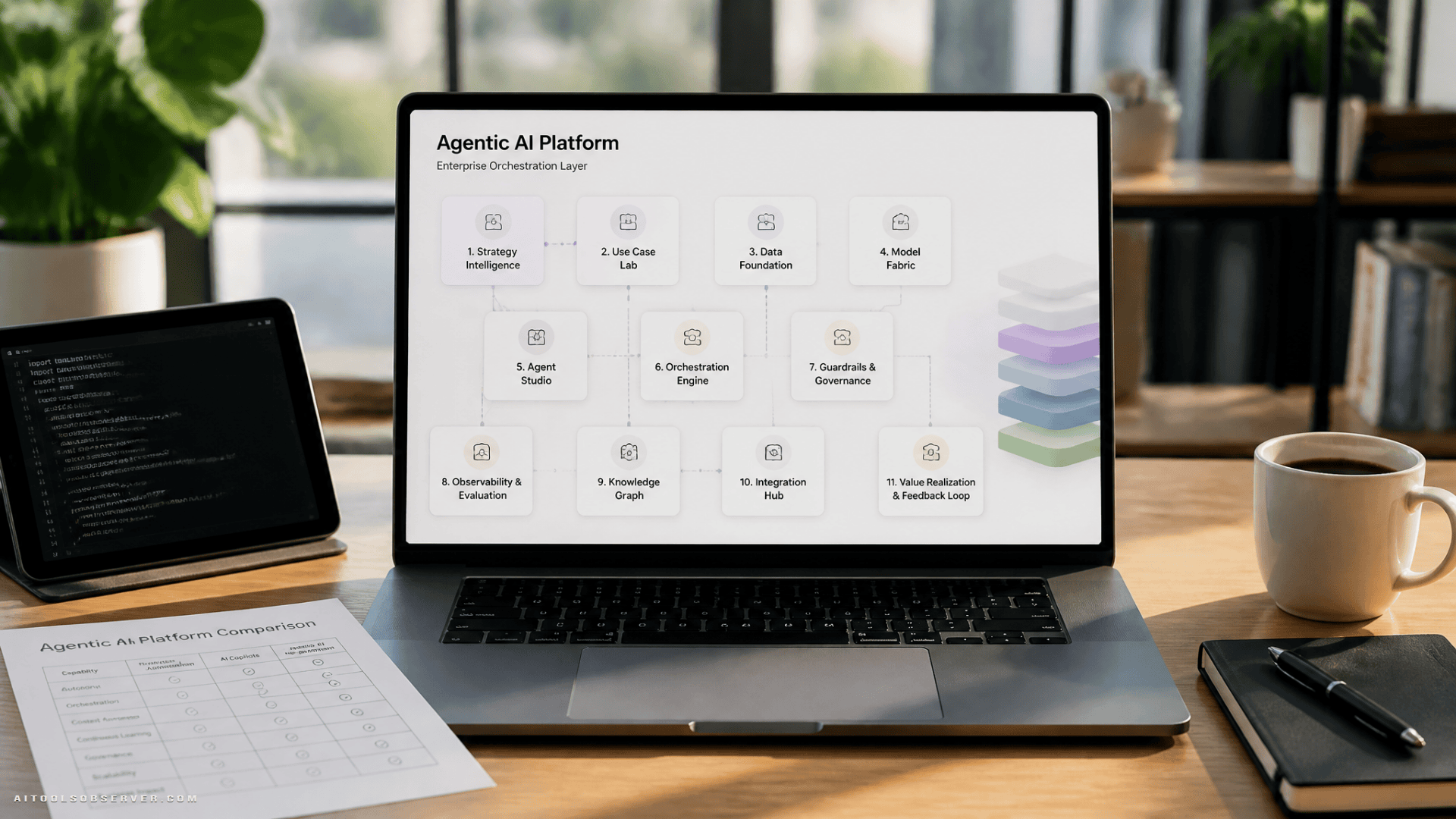
What Makes a Platform “Agentic”
Before comparing tools, it helps to be precise about what separates agentic AI from standard AI integration. An agentic system typically combines:
- A reasoning model that can plan and decompose tasks
- Tool access — APIs, databases, browsers, code execution
- Memory or state management across steps
- Some form of orchestration to sequence actions
- Optionally, multi-agent coordination where specialized agents hand off work
Not every platform on this list covers all five. Some are full stacks; others are focused layers. That distinction matters when you’re deciding what to build versus what to buy.
1. OpenAI (ChatGPT)
OpenAI has moved ChatGPT well beyond its original chatbot framing. The platform now supports agentic behaviors including web browsing, code writing and debugging, deep research tasks, and tool use through its native Model Context Protocol support. Its SDK gives developers a structured way to build agents on top of OpenAI models.
The distribution advantage is significant — ChatGPT’s user base means many enterprise employees are already familiar with the interface. For teams that want to extend that familiarity into automated workflows, OpenAI’s agentic layer is a natural starting point.
Best fit: Teams already in the OpenAI ecosystem who want to extend toward autonomous task execution without switching infrastructure.
2. Anthropic (Claude / Claude Code)
Anthropic’s Claude models are well-regarded for careful reasoning and instruction-following, which matters in agentic contexts where errors compound across steps. Claude Code extends this into software development workflows — writing, reviewing, and reasoning about code as part of longer automated pipelines.
Claude also supports Model Context Protocol, which allows external agents to connect to it as a reasoning layer. This positions Anthropic less as a closed platform and more as a composable component in larger agentic stacks.
Best fit: Enterprises and developers who prioritize reasoning quality and want a model that integrates cleanly into multi-agent architectures.
3. Microsoft (Copilot Studio + Azure AI Agent Service)
Microsoft’s agentic strategy is built on distribution. With more than 450 million paid commercial seats across Microsoft 365, Teams, and Dynamics 365, the company doesn’t need to win on novelty — it needs to make agents useful inside tools people already use daily.
Copilot Studio lets business users build and customize AI agents without deep engineering involvement. Azure AI Agent Service handles the more complex, developer-facing side of deploying agents at scale. Together, they cover both the low-code and pro-code ends of enterprise automation.
Best fit: Organizations already running on Microsoft infrastructure who want to automate workflows within their existing stack rather than introduce new vendors.
4. Salesforce (Agentforce)
Agentforce embeds AI agents directly into Salesforce’s CRM platform. Agents can qualify leads, resolve support cases, update records, and trigger complex workflows — all within the environment where sales and service teams already operate.
The key advantage here is context. Because Agentforce runs inside Salesforce, it has direct access to customer data, pipeline history, and business rules without requiring custom integrations. The tradeoff is that it’s tightly scoped to Salesforce’s ecosystem.
Best fit: Sales and service organizations that run their operations on Salesforce and want agents that act on CRM data without additional integration work.
5. Amazon Web Services (Amazon Bedrock)
Amazon Bedrock provides a unified platform for building AI agents on top of foundation models from Amazon, Anthropic, Meta, and other providers. Running on AWS — which powers a substantial share of enterprise cloud infrastructure — Bedrock lets companies deploy agentic applications without managing model development themselves.
The platform’s strength is flexibility. Teams can swap foundation models, connect agents to enterprise data sources, and scale on infrastructure they likely already use. It’s positioned as a neutral layer rather than a prescriptive solution.
Best fit: Engineering teams building custom agentic applications on AWS who want model flexibility and enterprise-grade infrastructure without vendor lock-in to a single AI provider.
6. Google Cloud (Vertex AI Agent Builder)
Google Cloud’s Vertex AI Agent Builder lets companies construct agents using Gemini-powered foundation models, with native connections to Google’s enterprise search capabilities and business data. The platform pairs Google’s AI research output with its global cloud infrastructure.
For organizations already in the Google Cloud ecosystem, the integration with enterprise search is a meaningful differentiator — agents can reason over internal knowledge bases and structured business data in a relatively unified environment.
Best fit: Google Cloud customers who want to build agents with strong search and retrieval capabilities tied to internal enterprise data.
7. LangChain (LangGraph + LangSmith)
LangChain has become something close to a standard toolkit for developers building custom AI agents. Its core libraries connect AI models to databases, APIs, and business software. LangGraph adds orchestration for stateful, long-running agents. LangSmith handles testing, debugging, and production monitoring.
With more than 1 billion downloads across its Python and JavaScript libraries, LangChain’s ecosystem is large and well-documented. It’s a framework, not a managed service — which means more control but also more responsibility for the teams using it. It also sits naturally within broader developer tools workflows.
Best fit: Developer teams building custom agentic workflows who want composable, open infrastructure and are comfortable owning the orchestration layer.
8. UiPath
UiPath combines AI agents with robotic process automation, which gives it a specific advantage: it can operate across both modern SaaS applications and legacy systems that don’t expose clean APIs. With more than 10,000 customers including a significant portion of the Fortune 500, the platform has deep roots in enterprise process automation.
The shift toward agentic AI allows UiPath to move beyond rule-based automation toward systems that can reason through exceptions and handle unstructured inputs — the kind of messy, real-world operations that traditional RPA struggled with.
Best fit: Enterprises with complex, mixed-system environments — including legacy infrastructure — that need automation to span both old and new software stacks.
9. Relevance AI
Relevance AI offers a visual, drag-and-drop canvas for building multi-agent systems without requiring an engineering queue. Its native support for multi-agent task delegation, model-agnostic flexibility, and built-in human-in-the-loop approval workflows make it a practical choice for organizations that want to move quickly without deep technical resources.
The platform is positioned between single-bot builders (too limited) and developer frameworks (too complex for business teams). That middle ground is increasingly valuable as non-engineering teams take ownership of automation initiatives.
Best fit: Business teams and operations leads who need to build and manage AI agent workflows without depending on engineering resources for every iteration.
10. Webflow (Webflow AEO + MCP Integration)
Webflow’s entry into agentic AI is domain-specific: it’s focused on web design and content management. Its Webflow AEO tool can generate site elements, create pages from natural language prompts, and automate content workflows. Its Model Context Protocol server integration allows external agents like Claude and ChatGPT to connect directly to Webflow’s design systems and CMS.
This is a narrower use case than most platforms on this list, but it’s a well-defined one. For marketing teams and agencies managing high-volume web content, the ability to connect AI agents directly to a CMS is practically useful.
Best fit: Marketing teams, agencies, and content operations that use Webflow and want to automate site and content workflows through AI agents.
11. Vellum
Vellum addresses a problem that often gets overlooked until it’s expensive: how do you know your AI agent is still working correctly after you’ve deployed it? The platform gives engineering teams a dedicated environment to backtest agents, track prompt changes, run evaluations, flag quality regressions, and monitor production behavior.
As agentic systems become more complex and more consequential, the ability to test and observe them systematically becomes critical. Vellum is positioned as the quality assurance layer for AI applications rather than a platform for building agents from scratch.
Best fit: Engineering teams shipping AI agents into production who need structured evaluation, regression testing, and monitoring to maintain reliability over time.
How to Think About the Stack
These 11 platforms don’t all compete directly. A useful way to organize them is by layer:
Foundation model access: OpenAI, Anthropic, Amazon Bedrock, Google Cloud Vertex AI
Orchestration and developer frameworks: LangChain, Azure AI Agent Service
Business-embedded automation: Microsoft Copilot Studio, Salesforce Agentforce, UiPath
No-code / low-code agent building: Relevance AI, Webflow AEO
Testing and observability: Vellum
Most serious enterprise deployments will use tools from more than one layer. A team might build on LangChain, deploy on AWS Bedrock, monitor with Vellum, and surface outputs through Microsoft Copilot — that’s not redundancy, it’s a deliberate stack.
Practical Guidance Before You Choose
A few questions worth answering before committing to a platform:
- Where does your data live? Platforms like Agentforce and Copilot Studio work best when your data is already in their ecosystem. If it isn’t, integration complexity rises quickly.
- Who will build and maintain the agents? Developer frameworks like LangChain give more control but require engineering ownership. Visual builders like Relevance AI shift that responsibility to business teams.
- How much do errors cost? In high-stakes workflows, observability and human-in-the-loop controls aren’t optional. Platforms that treat these as afterthoughts are a risk.
- Do you need to span legacy systems? If yes, UiPath’s RPA heritage is a genuine differentiator that pure-AI platforms don’t replicate easily.
The agentic AI market is moving fast, but the underlying questions — what problem are you solving, who owns the workflow, and what happens when something goes wrong — remain the same ones that determine whether any automation investment actually delivers.









Comments (0) No comments yet
Want to join this discussion? Login or Register.
No comments yet. Be the first to share your thoughts!