



What CoreWeave Sandboxes Actually Does

CoreWeave describes Sandboxes as an execution layer for dynamic AI workloads. That’s a precise framing. This isn’t a training platform in the traditional sense. It’s the infrastructure layer that sits between a model and the real world — a controlled space where agents can act, learn, and be tested at scale.
The platform targets three specific use cases:
- Reinforcement learning — models that improve through trial, feedback, and iteration
- AI agent tool use — agents that interact with external tools, APIs, and environments
- Model evaluation at scale — running systematic assessments across large, diverse conditions
Each of these requires something static training pipelines can’t provide: a live, interactive environment that responds to what the model does.
The Two Core Value Propositions
CoreWeave is making two concrete promises with Sandboxes, and both are worth examining closely.
Continuous Online Learning

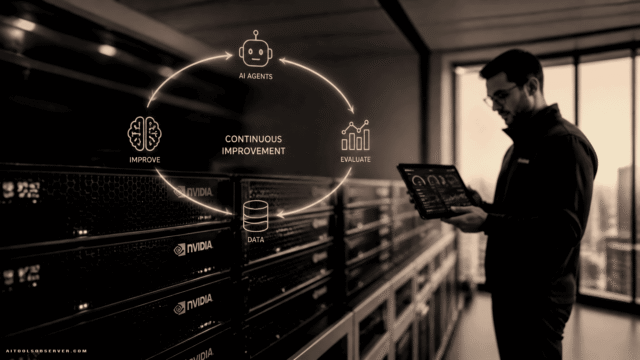
Traditional model training is batch-based. You collect data, train, deploy, and repeat the cycle on a schedule. Continuous online learning flips this. Models keep improving based on how they’re actually used — feedback loops that run in production rather than in a lab.
For teams building agentic AI systems, this is significant. An agent that can learn from its own tool interactions, refine its decision-making, and adapt to new conditions without a full retraining cycle is fundamentally more capable than one that can’t.
Better GPU Utilization and Lower Training Costs

GPU compute is expensive. Idle GPU time is wasted money. CoreWeave argues that Sandboxes improves utilization by keeping GPU resources actively engaged with dynamic workloads rather than sitting between batch jobs.
The downstream effect is reduced training costs — a direct financial argument that resonates with any team running large-scale AI infrastructure.
How Teams Can Deploy Sandboxes

There are two deployment paths available, which gives teams flexibility depending on their infrastructure preferences.
On CoreWeave’s own infrastructure — for teams that want dedicated GPU resources and direct control over their compute environment.
Serverless via Weights & Biases (W&B) — for teams that prefer a managed, software-layer approach. W&B, the widely-used MLOps platform, handles the operational overhead while CoreWeave provides the underlying compute. This path is particularly well-suited for teams already running their ML workflows through W&B.
The W&B integration isn’t incidental. It adds structured tooling for online evaluations and continuous learning workflows — exactly the kind of operational layer that makes Sandboxes practical for production teams rather than just research environments.
The NVIDIA Connection

CoreWeave’s relationship with NVIDIA runs deep, and it directly shapes what Sandboxes can do at the hardware level.
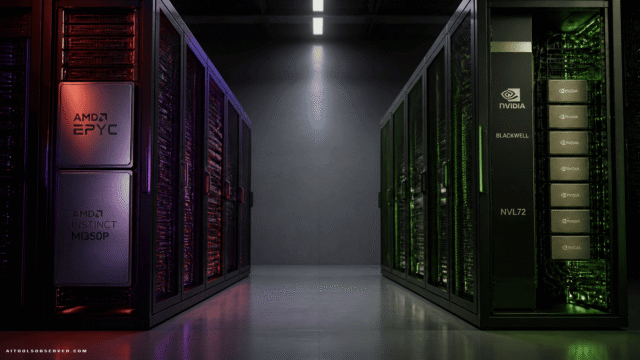
The platform integrates with NVIDIA’s HGX B300, hardware specifically designed for agentic inference workloads. This matters because agentic AI — systems where models take sequences of actions, call tools, and respond to dynamic environments — places different demands on compute than standard inference or batch training.
The HGX B300 is built for those demands. Pairing it with a software layer designed for continuous learning and agent evaluation creates a stack that’s coherent from hardware to workflow.
Why This Matters for AI Teams Right Now

The shift toward agentic AI is accelerating. More teams are building systems where models don’t just answer questions — they take actions, use tools, and operate autonomously across complex tasks. That shift creates infrastructure requirements that most cloud providers haven’t fully addressed.
CoreWeave Sandboxes is a direct response to those requirements. Secure isolation means agents can operate without contaminating production systems or interfering with each other. Scalable evaluation means you can test model behavior across thousands of conditions rather than a handful of curated benchmarks. Continuous learning means the model you deploy in month one is meaningfully better by month three.
For teams choosing their AI tool stack, this is the kind of infrastructure layer that determines whether agentic workflows are practical or perpetually experimental.
CoreWeave’s Trajectory: From Ethereum Mining to AI Cloud

It’s worth knowing where CoreWeave came from, because the pivot is instructive.
The company launched in 2017 as Atlantic Crypto, a GPU mining operation focused on Ethereum. When mining economics deteriorated, the team recognized that their GPU hardware had a far larger addressable market in AI compute. The rebrand to CoreWeave happened in 2019.
Since then, the company has built out data centers across the US and Europe, listed on Nasdaq under the ticker CRWV, and positioned itself as a specialized GPU cloud competing directly with AWS, Google Cloud, and Azure on compute-intensive AI workloads.
The Sandboxes launch is the latest signal that CoreWeave isn’t trying to be a general-purpose cloud. It’s going deep on AI infrastructure — specifically the infrastructure that agentic and continuously-learning systems require.
How to Evaluate Whether Sandboxes Fits Your Workflow

Not every team needs this. If you’re running standard fine-tuning jobs on static datasets and deploying models that don’t need to adapt post-deployment, Sandboxes isn’t your priority.
But if any of these describe your situation, it’s worth a serious look:
- You’re building AI agents that interact with tools, APIs, or external environments
- You’re running reinforcement learning workflows that require interactive, stateful environments
- You need to evaluate models at scale across diverse, dynamic conditions
- You’re looking to reduce GPU costs through better utilization on dynamic workloads
- You’re already using Weights & Biases and want to extend your MLOps stack into continuous learning
The serverless W&B path lowers the barrier to entry significantly. You don’t need to commit to CoreWeave’s full infrastructure stack to start experimenting with the platform’s capabilities.
The Bigger Picture

CoreWeave Sandboxes represents a specific thesis about where AI infrastructure is heading: away from static, batch-oriented training pipelines and toward dynamic, interactive execution layer environments where models learn continuously from real-world use.
That thesis aligns with where the most capable AI systems are being built right now. Agentic AI, reinforcement learning from human feedback, and large-scale model evaluation are all growth areas — and they all need infrastructure that can keep up with dynamic, unpredictable workloads.
The teams that build on the right execution layer today will have a meaningful advantage as these workloads scale. CoreWeave is making a clear bet on what that layer looks like. Whether it’s the right bet depends on your specific workflow — but the underlying direction is hard to argue with.













Comments (0) No comments yet
Want to join this discussion? Login or Register.
No comments yet. Be the first to share your thoughts!