


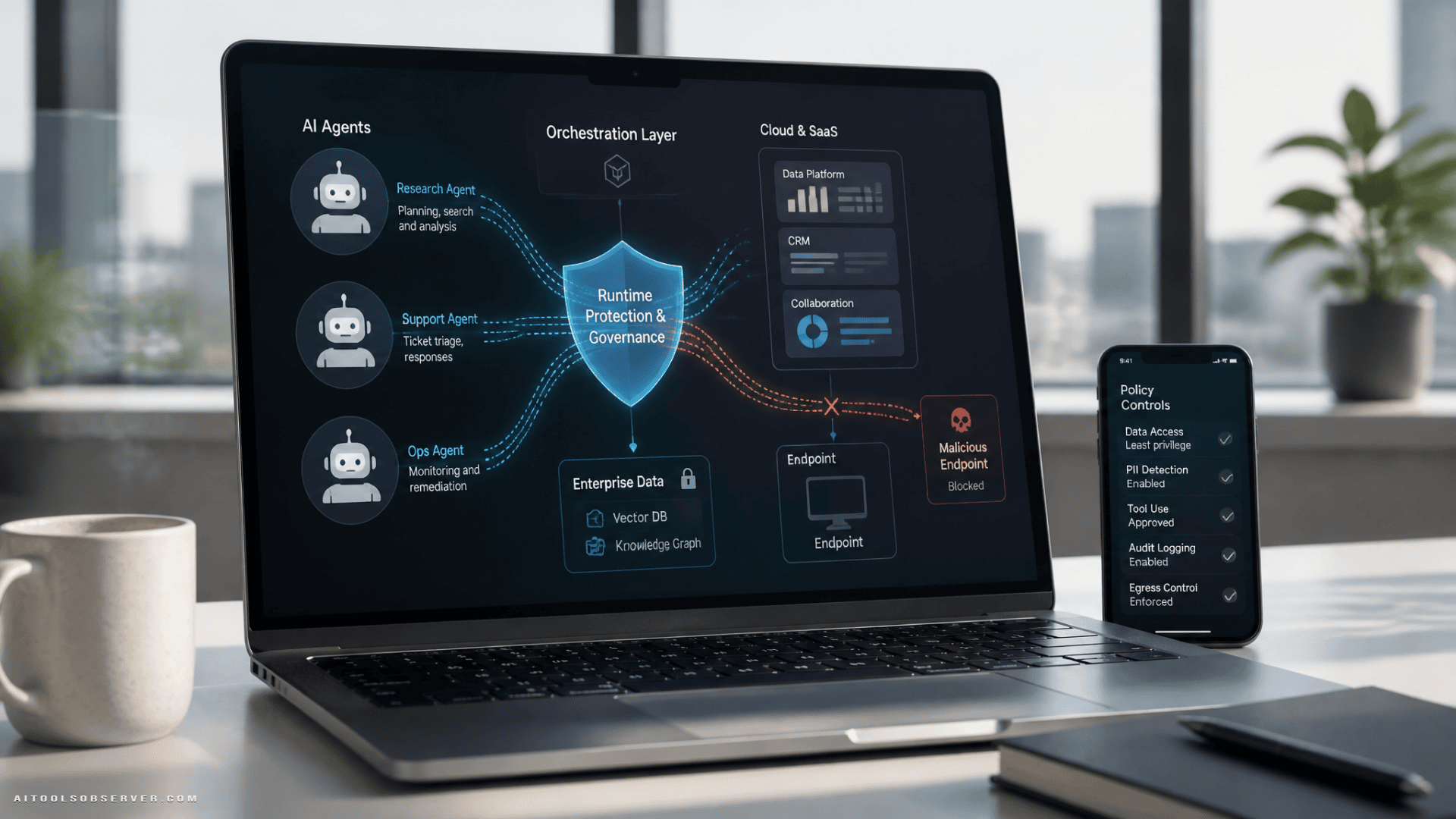
What Cyera launched
Cyera introduced two related products:
- Agent Guardian for securing enterprise AI agents across cloud and SaaS environments
- Cyera Endpoint for extending similar protections to employee devices
Based on the launch description, the focus is not just on visibility. Cyera is pushing toward active governance and runtime enforcement, which matters because many AI agents do more than answer prompts. They can query data, call tools, move files, and interact with business systems.
This is a notable distinction. A chatbot that stays inside a chat window creates one kind of risk. An agent with access to databases, SaaS apps, and local development tools creates another.
Why this launch matters
The timing makes sense. More companies are moving from AI experiments to operational AI agents that can take actions on a user’s behalf.
That changes the security model in a few ways:
- Permissions can be inherited from human users
- Agents may access multiple systems in one workflow
- Actions can happen quickly and at scale
- Some tools run locally on employee devices, outside standard network monitoring
- Security teams may not even know which agents are already in use
Cyera’s framing around non-human identities is useful here. The issue is not only that organizations have more identities to manage. It is that these identities can execute tasks directly, often across fragmented environments.
What Agent Guardian is designed to do
Cyera says Agent Guardian is built around four core functions:
- Discovery
- Governance
- Runtime protection
- Validation
In practical terms, that means the product aims to help security teams answer four basic questions:
Cyera also positions Agent Guardian as a validation layer through testing and reporting. That matters because AI governance often sounds good on paper but breaks down when policies meet real workflows.
The launch description suggests the product can help verify that the intended controls are actually being enforced.
1. What agents exist?
Discovery covers AI agents running across cloud services, SaaS platforms, and employee devices. The value here is straightforward: you cannot secure what you cannot see.
This matters especially in enterprises where teams may be using tools through official platforms like Microsoft Copilot Studio or Salesforce Agentforce, while others are experimenting with separate workflows and local AI tools.
2. What can those agents access?
Cyera says the platform maps the data each agent can reach. That is one of the most important pieces for any security or governance team because access paths are where many agent risks begin.
If an agent can connect to customer records, internal docs, source code, or financial data, the organization needs a clear picture of that access before it can set meaningful guardrails.
3. What are agents actually doing at runtime?
This is where the launch gets more interesting. Cyera says it monitors actions between a user prompt and the final system response.
That suggests a focus on the execution chain, not just the input and output. For enterprise buyers, this is usually where the real concern lives. An unsafe result is one problem. An unsafe tool call or unauthorized data transfer during execution is often the bigger one.
4. Are controls working?
Cyera also positions Agent Guardian as a validation layer through testing and reporting. That matters because AI governance often sounds good on paper but breaks down when policies meet real workflows.
The launch description suggests the product can help verify that the intended controls are actually being enforced.
Cyera Endpoint fills an important blind spot
A lot of enterprise AI security discussion centers on cloud apps and centralized deployments. But employee devices are becoming part of the agent surface area too.
Cyera Endpoint is meant to address that. According to the launch details, it extends governance and protection to local AI tools running on laptops and workstations, including developer-oriented products such as Claude Code and Cursor.
This is a practical move.
If a local coding assistant is handling sensitive source code, internal documentation, or infrastructure-related tasks, the security risk does not disappear just because the workflow happens outside a managed SaaS dashboard. In some cases, it becomes harder to detect because it may never pass through the normal corporate network controls.
For security teams, that endpoint angle may be one of the strongest parts of the launch.
How Cyera appears to enforce policy
The launch points to several enforcement paths, including:
- Platform APIs
- AI gateways
- Browser extensions
- Framework hooks
- Remote scans of employee devices
That broad enforcement model reflects how messy enterprise AI adoption has become. Agents are not deployed in one clean place. Some live inside official enterprise platforms, some run in cloud AI environments, and some are effectively embedded in daily work on employee machines.
A product trying to govern this category probably has to meet customers across all of those layers. The tradeoff, of course, is complexity. The wider the coverage, the more important usability and policy consistency become.
Platform coverage is a key part of the pitch
Cyera says the new products are intended to work across several major AI environments, including:
- Microsoft Copilot Studio
- Salesforce Agentforce
- Snowflake Cortex AI
- AWS Bedrock
- Microsoft Foundry
- Vertex AI
That matters because large organizations rarely standardize on one AI stack. They may build custom workflows in one cloud, use packaged agent tools in another platform, and let business units experiment independently.
A single control layer across cloud, SaaS, and endpoints is an appealing message in that context. Buyers do not want to bolt together separate visibility and policy systems for every agent framework their teams happen to adopt.
The compliance angle is worth watching
Cyera says Agent Guardian can produce reporting aligned with frameworks such as the EU AI Act.
That is a smart positioning choice. For many enterprises, AI governance is no longer just a security question. It is also a compliance and auditability question.
The practical need is not just to block risky actions. It is to show:
- Which agents are in use
- What data they can access
- What policies apply to them
- Whether controls are being enforced
- How issues are detected and handled
As more organizations move AI agents into production, reporting and evidence may become as important as detection and blocking.
Who this looks most useful for
This launch appears most relevant for enterprises dealing with one or more of these conditions:
- Rapid AI agent adoption across multiple teams
- Sensitive data spread across cloud and SaaS systems
- Developer use of local AI assistants on endpoints
- Limited visibility into non-human identities
- Pressure to show AI governance and compliance readiness
It may be especially useful for organizations that are already beyond the experimentation stage. Once agents are connected to real data and operational systems, passive monitoring usually stops being enough.
The bigger takeaway for AI tool buyers
Cyera’s launch highlights a shift that many teams are only starting to feel: AI security is moving from model access control to agent behavior control.
That means the main question is no longer just, “Who can use an AI tool?” It is increasingly, “What can this agent do, what data can it touch, and can we stop it in real time if something goes wrong?”
If your organization is adopting agentic AI across cloud apps, SaaS platforms, and employee devices, visibility alone will not be enough for long. The more useful benchmark is whether your stack can discover agents, map permissions, enforce runtime policy, and prove those controls actually work.









Comments (0) No comments yet
Want to join this discussion? Login or Register.
No comments yet. Be the first to share your thoughts!