



What’s Actually Being Built

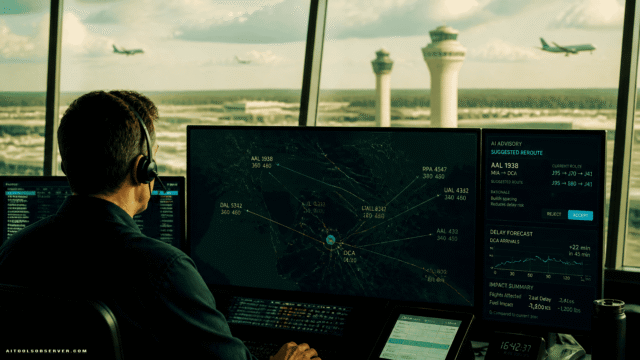
The centerpiece of the deal is the Flow Management Data Services (FMDS) platform — described by the DOT as the “new technological backbone” of the FAA’s Air Traffic Control System Command Center. Think of it as a central nervous system for U.S. airspace: one place where delays are spotted before they cascade, not after.
Inside FMDS, there’s a particularly interesting tool worth watching: SMART — Strategic Management of Airspace, Routes, and Trajectories. It’s an AI layer that lets controllers overlay weather patterns into a single unified visualization. Initial operations are expected by fall 2026, with full deployment within 24 months.
Transportation Secretary Sean Duffy framed it plainly: “We must change how flights are managed.” Radars and radios are getting upgraded too, but the real shift is in the logic layer — how decisions get made at scale.
Why Now? The Safety Pressure Is Real

This announcement didn’t land in a vacuum. It came the same week as a Senate Commerce Subcommittee hearing on aviation safety — and the room was not short on urgency.
The midair collision near Ronald Reagan Washington National Airport last year is still fresh. The NTSB’s final report pointed directly at the absence of ADS-B In — a technology that lets aircraft receive real-time data from other planes, improving collision avoidance and situational awareness. The retrofit cost runs about $50,000 per aircraft, which sounds steep until you weigh the alternative.
Captain Jason Ambrosi of the Air Line Pilots Association put it simply: controllers need accurate weather data and predictions to do their jobs safely. James Viola of the General Aviation Manufacturers Association was more direct — ADS-B In “could have avoided the accident here in D.C. for sure.”
Industry consensus is rare. This is one of those moments.
The Drone Problem Nobody Has Fully Solved
Layered on top of all this is a growing complication: drones.
The FAA stood up a new office earlier this year to manage drone integration as part of a broader reorganization. Rules around location-tracking, detection technologies, and droneport operations are in progress — but not yet finalized. Meanwhile, President Trump’s “drone dominance” executive order, signed last June, has pushed federal agencies to accelerate.
Chris Sununu of Airlines for America didn’t mince words at the hearing: “Whether it’s a commercial airline, a private jet, or UAS, they all present a risk. There can’t be any loopholes.”
The governance questions are still genuinely open. Who controls drone command authority — airports or the federal government? Todd Hauptli of the American Association of Airport Executives acknowledged that airports are split on the answer. That ambiguity, in a congested and increasingly complex airspace, is its own kind of risk.
What This Means for the AI Tools Ecosystem
This contract is a signal worth reading carefully — not just for aviation watchers, but for anyone tracking how AI is being deployed in high-stakes, regulated environments.
A few things stand out:
- Proactive over reactive. FMDS is designed to identify delays before they happen. That’s a meaningful architectural choice — predictive intelligence embedded into operations, not bolted on afterward.
- Visualization as a UX problem. SMART’s weather overlay feature is essentially a data fusion and interface challenge. Getting controllers to trust and act on AI-generated visuals in real time is as much a design problem as a technical one.
- Long contract horizons signal maturity. A 12-year deal isn’t a pilot program. The FAA is committing to a platform relationship, which means Air Space Intelligence will need to evolve alongside the airspace — drones, new entrants, and all.
The Takeaway
The FAA’s $876M move is less about a single AI tool and more about a fundamental shift in how the U.S. manages its airspace — from reactive patchwork to proactive, data-driven coordination.
The technology is ready. The political will appears to be there. The harder work — integrating drones safely, resolving governance gaps, and building controller trust in AI-assisted decisions — is still in progress.
The skies are getting smarter. Whether they get safer fast enough is the real question.







Comments (0) No comments yet
Want to join this discussion? Login or Register.
No comments yet. Be the first to share your thoughts!