


What Mammo Risk Actually Does
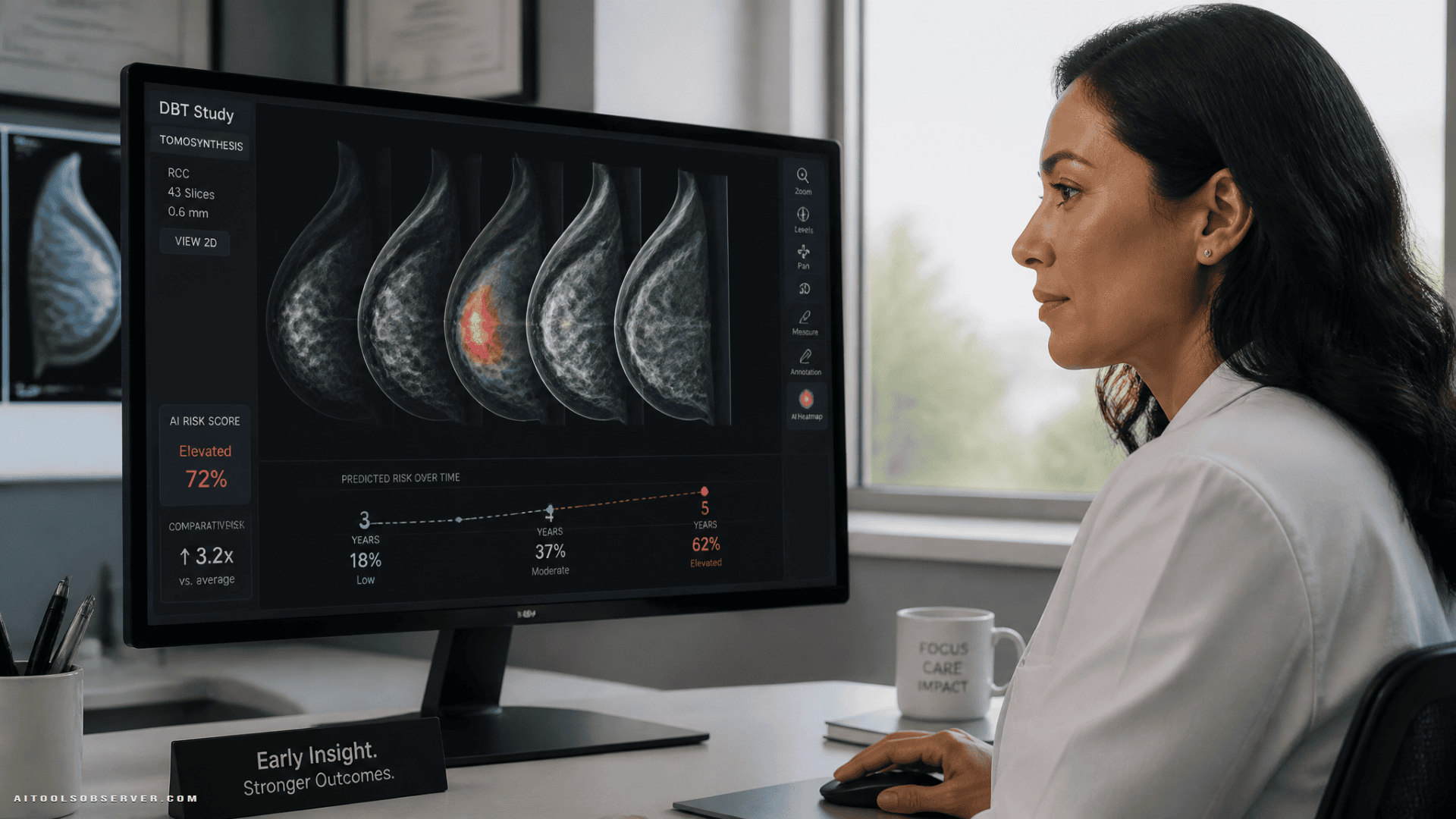
Mammo Risk analyzes completed 3D mammogram images to predict a patient’s risk of developing breast cancer within three, four, or five years. No additional scans are required. The AI works with existing imaging data, which means it can slot into current clinical workflows without adding burden to patients or radiology teams.
The tool also handles combined 3D/2D imaging, giving it flexibility across different facility setups.
DeepHealth trained Mammo Risk on 220,000 studies. An independent validation study covering more than 65,000 mammograms across 10 US clinical sites confirmed it performs consistently across a broad patient population — including Black women and women with dense breasts, two groups where conventional risk models have historically underperformed and where breast cancer outcomes have been worse. This places it squarely in the medical imaging AI category.
Why the 3D Mammography Angle Matters
Standard 2D mammograms produce flat, overlapping images. 3D mammography moves an X-ray arm in an arc around the breast to capture multiple angles, producing clearer, layered views. It’s a more detailed picture — and Mammo Risk is built to extract risk signals from that richer dataset.
This is a step beyond DeepHealth’s earlier tools, which could predict breast cancer risk up to two years ahead. Extending that window to five years gives clinicians and patients more time to act — whether that means more frequent monitoring, preventive interventions, or earlier treatment conversations.
The Equity Dimension
The validation data showing consistent performance across Black women and women with dense breasts isn’t a footnote. These groups have faced a documented gap in risk assessment accuracy with traditional models, contributing to delayed diagnoses and worse outcomes.
A tool that works reliably across diverse populations is a practical requirement for any screening AI that wants to be genuinely useful at scale — not just effective on average.
The Reimbursement Picture
FDA clearance is one hurdle. Payment is another.
The American Medical Association has established a new CPT Category III billing code — X579T — specifically for image-based breast cancer risk assessment. It takes effect on January 1, 2027. The code is a tracking mechanism for new and emerging technologies, not a reimbursement guarantee. Some insurers may choose to cover tools like Mammo Risk while evidence continues to accumulate, but widespread coverage isn’t automatic.
For healthcare systems evaluating adoption, the reimbursement pathway is still developing. That’s worth watching closely over the next 12 to 18 months.
What This Means for the Medical AI Ecosystem
Mammo Risk sits at the intersection of several trends that are reshaping healthcare AI:
- Personalized screening — moving away from one-size-fits-all protocols toward individual risk profiles
- Longitudinal prediction — AI that forecasts future risk, not just current findings
- Workflow integration — tools that use existing data rather than requiring new procedures
- Equity-aware validation — testing across historically underserved populations before deployment
The broader context matters here too. Approximately 322,000 women in the US are diagnosed with invasive breast cancer each year. When caught early, five-year survival rates approach 100%. When the cancer has spread, that figure drops to 34%. Tools that extend the prediction window and identify high-risk patients earlier have a direct line to that survival gap.
The Practical Takeaway
If you’re tracking the medical imaging AI space, Mammo Risk is a concrete example of what FDA-cleared clinical AI looks like in practice — trained on large datasets, validated across diverse populations, integrated into existing workflows, and tied to an emerging reimbursement framework.
The reimbursement timeline (2027) and the still-evolving coverage landscape mean adoption will be gradual. But the clearance itself signals that multi-year, image-based cancer risk prediction is no longer a research concept. It’s a cleared clinical tool. The next question is how quickly health systems move to put it to work.








Comments (0) No comments yet
Want to join this discussion? Login or Register.
No comments yet. Be the first to share your thoughts!