


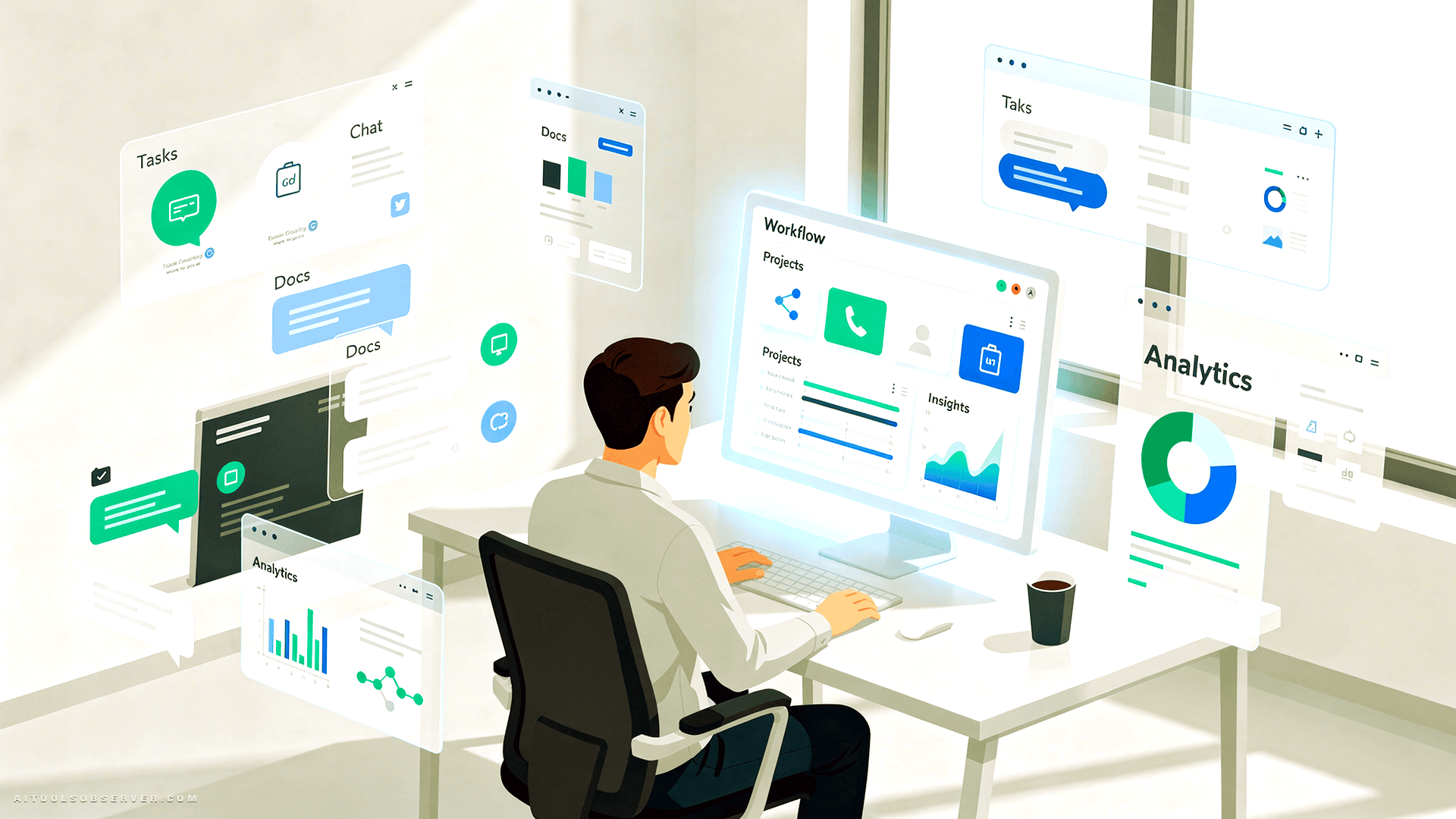
The Real Culprit Isn’t AI — It’s Fragmentation
It’s tempting to blame specific tools. The actual problem runs deeper.
Each AI model was built with distinct strengths. Some excel at reasoning. Others at creativity, speed, or cost efficiency. That specialization is genuinely useful — but it creates a fragmented ecosystem where users bear the burden of orchestration.
You become the integration layer. And that’s a role no one hired you to fill.
The result is a workflow that looks productive on the surface but is riddled with redundant effort, inconsistent outputs, and mounting frustration. The tools aren’t broken. The system connecting them is.
The Shift: From Picking Tools to Building Systems

The right question isn’t “Which AI tool should I use?” It’s “How do I connect multiple AI tools into a system that works without constant intervention?”
That reframe is the foundation of unified AI platforms. Instead of replacing individual tools, they act as an orchestration layer — routing tasks to the right model, maintaining context across steps, and eliminating the manual handoffs that drain time and focus.
Abacus.AI is built around exactly this approach. Rather than locking users into a single model, it integrates a wide range of AI capabilities into one environment where outputs flow naturally from one step to the next.
What Unified AI Workflows Actually Look Like

Take the blog post example. In a fragmented workflow, you draft with one tool, refine with another, run SEO checks with a third, and generate visuals with a fourth. Every transition requires you to re-establish context, rewrite prompts, and manually transfer outputs.
In a unified workflow, content generation, editing, SEO optimization, and image creation happen within a single environment. Context carries forward. Duplicate effort disappears. Execution accelerates.
That’s not a marginal improvement. It’s a structural one.
Three Workflow Gains Worth Noting
- Multi-model flexibility without the switching cost. You’re not forced to pick one model and live with its limitations. Multiple models contribute to a single deliverable, each handling what it does best.
- Output chaining instead of output copying. Each step’s result becomes the next step’s input automatically. No reformatting. No copy-pasting between tabs.
- Reduced cognitive load. When tool management drops out of the equation, mental bandwidth shifts back to the work itself — which is where it should have been all along.
The Economics of Integration
There’s a financial dimension here that often gets overlooked.
Modern AI usage runs on token economics. More usage means higher costs. State-of-the-art models are significantly more expensive than lighter alternatives. When workflows aren’t optimized, teams end up overusing premium models for tasks that don’t require them — and reprocessing the same data multiple times across disconnected tools.
A unified system addresses this by design. It routes simpler tasks to smaller, cheaper models and reserves sophisticated models for genuinely complex needs. It minimizes redundant processing. The result is what you might call economical intelligence — performance and cost efficiency in balance, rather than in tension.
For teams scaling AI usage, this isn’t a nice-to-have. It’s a budget line item.
Why This Matters Now
The AI tools market is expanding fast. New models, new interfaces, and new capabilities launch constantly. Without a unifying layer, that expansion translates directly into more fragmentation, more switching, and more fatigue.
The next phase of AI adoption isn’t about finding smarter individual tools. It’s about building smarter systems — ones that retain context, coordinate models intelligently, and reduce the overhead that currently sits on the user’s shoulders.
Platforms like Abacus.AI represent that shift. They move the conversation from “which tool wins” to “how does the system perform as a whole.”
Conclusion
The promise of AI has always been clarity — the ability to focus on creation and execution rather than logistics. That promise doesn’t get fulfilled by adding more tools to the stack. It gets fulfilled by integrating the ones you already use into a system that actually works together.
Less prompt chaos. More meaningful output. That’s the direction worth moving in.












Comments (0) No comments yet
Want to join this discussion? Login or Register.
No comments yet. Be the first to share your thoughts!