


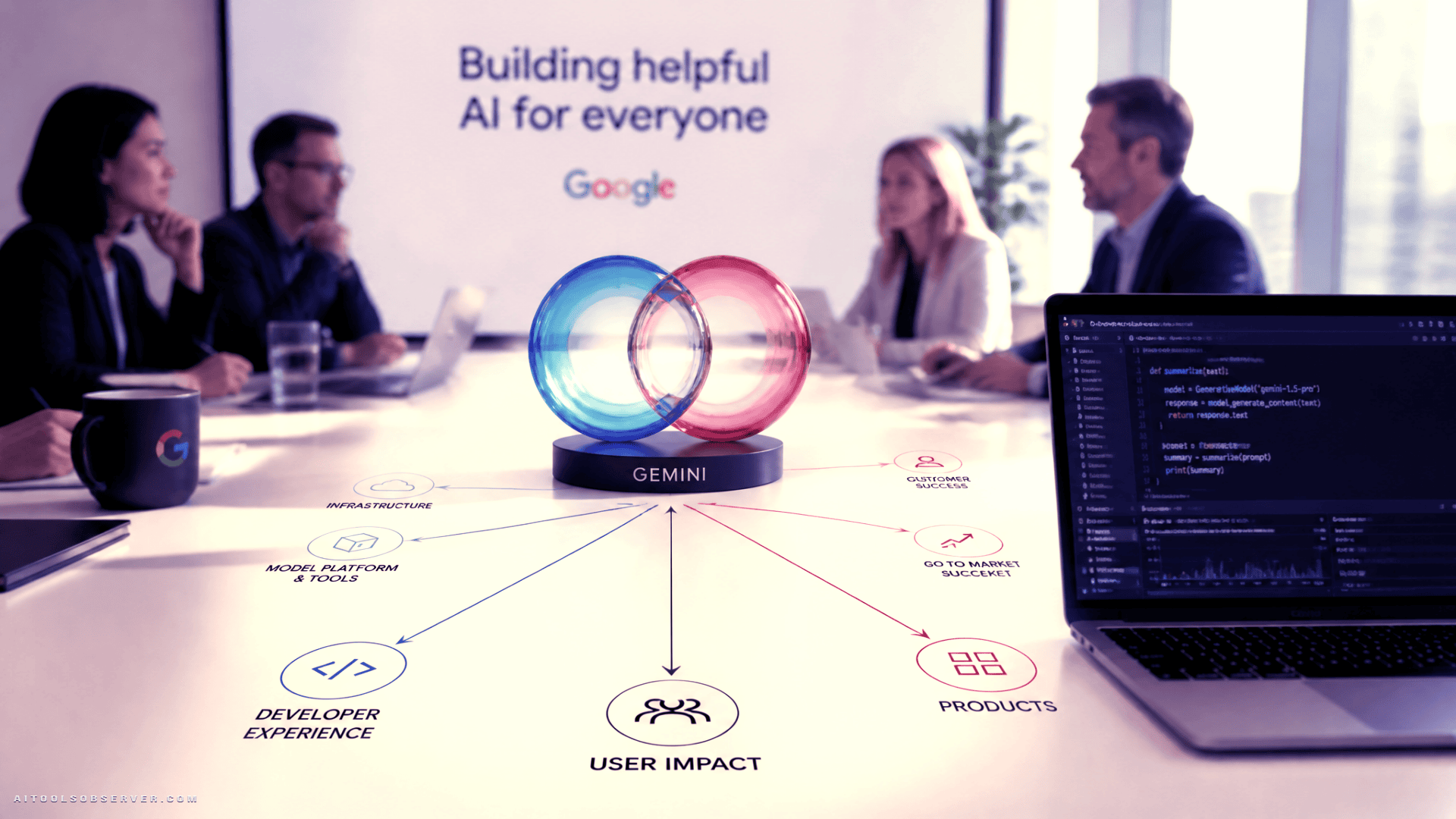
What changed at DeepMind
Koray Kavukcuoglu is becoming the head of DeepMind and will report directly to Google CEO Sundar Pichai. His remit includes Gemini model development, frontier AI research, plus the Gemini app and developer teams.
Demis Hassabis, DeepMind’s cofounder and longtime CEO, is moving into a chair role. Based on the available context, that creates a more product-driven reporting structure around Gemini at a time when Google is under pressure to close gaps in frontier model performance.
This is the part worth watching: one executive now appears to have broader control across research, models, product, and developer experience. That usually means a company wants tighter alignment between what gets invented and what actually ships.
Why Google is making this move now
The competitive pressure is obvious. OpenAI and Anthropic have continued pushing forward with new model releases, while Google appears to be trying to sharpen Gemini’s position after a year of mixed momentum.
Google has the scale, talent, and distribution to stay in the race. But in AI, especially at the frontier, those advantages only matter if they turn into reliable product execution.
The reorganization suggests Google is trying to solve several problems at once:
- Improve frontier model performance
- Strengthen coding AI
- Tighten product and developer alignment
- Speed up releases and enterprise delivery
That combination tells you this is not just about lab leadership. It’s about turning DeepMind into a more focused engine for shipping competitive AI products.
Coding AI is becoming the real battleground
One of the clearest themes in this shift is Coding AI.
Coding has become one of the most visible and commercially important use cases in frontier AI. It’s measurable, sticky, and directly tied to developer adoption. If a model helps engineers write, debug, refactor, or understand code better, it quickly becomes part of daily workflow.
That creates a simple market reality: if your coding performance lags, your broader AI platform can look weaker too.
Google seems to understand that. The context around internal efforts to improve coding capabilities points to a company treating this area as strategically important, not just another benchmark category.
For founders and product teams, this matters because coding AI often shapes tool choice upstream. If developers prefer one model stack for coding, that preference can influence which APIs, assistants, and enterprise AI products get adopted later.
This looks like a shift from lab structure to product structure
The most interesting part of the move may be organizational, not technical.
Putting models, app experiences, and developer teams under one leader is how companies tend to structure product groups when they want more accountability. Instead of research existing in one lane and product in another, the incentive becomes clearer: build models that improve actual user outcomes.
That can have a few practical effects:
- Faster iteration between model teams and product teams
- More attention on developer tooling
- Greater pressure to maintain a release cadence
- Less room for impressive research that doesn’t translate into adoption
For Google, that kind of setup plays to a historical strength. The company has deep experience operating large-scale product ecosystems, even if frontier AI competition has exposed some execution gaps.
What this means for Gemini
Gemini now appears even more central to Google’s AI strategy.
This isn’t only about winning benchmark comparisons. Gemini sits at the intersection of consumer AI, developer tools, and enterprise AI monetization. If Google improves Gemini meaningfully, that can ripple across its app layer, cloud sales motion, and broader ecosystem.
The focus areas are becoming easier to read:
1. Frontier model performance
Google needs Gemini to remain credible at the top end of the model market. If advanced users consistently see OpenAI or Anthropic as the default choice for the hardest tasks, Google risks losing both mindshare and workflow share.
2. Coding quality
Strong coding performance can drive adoption with developers, startups, and technical enterprise teams. It’s one of the fastest ways to prove a model is useful beyond demos.
3. Developer tools
Even excellent models can lose if the tooling is weak. APIs, documentation, workflow fit, reliability, and iteration speed all influence whether developers stick with a platform.
4. Enterprise execution
Google already has major enterprise distribution advantages. The open question is whether Gemini’s product quality and pace can fully capitalize on that.
Google may be optimizing for execution over pure research
A big subtext here is leadership style.
Hassabis has long been associated with ambitious AGI-oriented research thinking. Kavukcuoglu, based on the framing around his promotion, appears positioned to push stronger execution around large language models, product roadmap alignment, and shipping discipline.
That does not mean research stops mattering. It means Google may be trying to reduce the gap between research ambition and product competitiveness.
In practical terms, readers should expect attention on things like:
- More predictable Gemini updates
- Stronger emphasis on coding and developer use cases
- Tighter connection between model progress and product rollout
- Clearer ownership inside Google’s AI stack
If that happens, the reorganization will have done more than change titles. It will have changed how Google competes.
The enterprise angle is easy to overlook
A lot of AI coverage focuses on who is ahead at the frontier. That matters, but it’s not the whole story.
Google also has to win in enterprise, where distribution, trust, cloud relationships, and product packaging matter just as much as raw model quality. The available context suggests Google is still seeing traction in enterprise AI, which gives it room to keep investing aggressively even while trying to close performance gaps.
That creates an unusual position. Google can be under pressure competitively at the model frontier while still being commercially strong in enterprise deployment.
For buyers, that means one thing: don’t evaluate Google only through the lens of leaderboard narratives. Evaluate it through workflow fit, procurement reality, ecosystem leverage, and how fast Gemini improves from here.
What AI tool buyers should watch next
If you’re comparing AI platforms, the headline is not simply “Google changed leaders.” The real question is whether this reorg leads to better products, faster.
Here’s what to monitor over the next cycle:
- Whether Gemini releases become more consistent
- Whether coding performance improves enough to change developer sentiment
- Whether Google’s developer tooling gets easier and more competitive
- Whether enterprise AI execution becomes more tightly integrated around Gemini
- Whether Google can translate organizational alignment into visible product gains
Those are the signals that matter more than internal org charts.
Why this news matters beyond Google
This move reflects a broader shift across the AI market. Labs are no longer judged only by how advanced their research appears. They’re being judged by whether they can turn frontier capability into useful products at scale.
That’s especially true in three areas:
- Coding assistants
- Developer platforms
- Enterprise AI deployments
Google’s DeepMind reorganization makes that reality more explicit. The company appears to be betting that better structure will produce better execution, and that execution will help Gemini become more competitive where it counts.
It also fits a wider ecosystem battle in AI, where productization and platform strength matter alongside raw model capability.
The takeaway
If you use, buy, or build on AI tools, treat this reorganization as a practical signal, not corporate theater. Google is putting more weight behind shipping stronger Gemini models, improving coding AI, and aligning research with product outcomes.
The smart move now is simple: keep watching the releases, not the rhetoric. If Gemini starts improving faster across coding, developer workflows, and enterprise usability, this reshuffle will matter. If not, the org chart won’t save it.







Comments (0) No comments yet
Want to join this discussion? Login or Register.
No comments yet. Be the first to share your thoughts!