



The Problem Agentic AI Is Actually Solving
Most marketing teams are drowning in data they can’t act on fast enough.
By the time insights surface, customer behavior has already moved on. Personalization stays shallow because there aren’t enough hours or hands to go deep. And brand consistency across channels? That’s a daily battle most teams are quietly losing.
Agentic AI changes the equation. Instead of waiting for a human to pull a report, interpret it, and build a response, AI agents do that work autonomously — surfacing insights, generating personalized assets, and triggering the right experience at the right moment.
Adobe’s platform is built around exactly this workflow.
What Adobe’s CX Enterprise Platform Actually Does

Adobe’s CX Enterprise isn’t just another AI feature bolted onto existing software. It’s an infrastructure play — a platform where AI agents are embedded into the core of how customer experience systems operate.
Here’s what that looks like in practice:
Insight Surfacing at Speed
AI agents continuously monitor customer data streams and flag what matters. Instead of analysts spending days building dashboards, agents deliver actionable signals in near real time. Marketers get the “what” and the “so what” without the manual grind.
Personalization at Scale
Personalizing content for thousands of customer segments used to require massive creative and operations teams. Adobe’s agents can generate and adapt assets dynamically — matching the right message to the right audience without a human touching every variation.
Customer Journey Orchestration
Agents don’t just react to individual touchpoints. They map and optimize the full customer journey, identifying where experiences break down and automatically adjusting flows to keep customers moving toward conversion and loyalty.
Why “Agentic” Is the Key Word Here
There’s a meaningful difference between AI that assists and AI that acts.
Most AI tools marketers use today are assistive — they suggest, generate, or summarize, but a human still makes every decision and pulls every lever. Agentic AI operates with a higher degree of autonomy. It sets goals, takes steps to achieve them, and adapts based on outcomes — without waiting for a human prompt at every stage.
For customer experience, this matters enormously. CX is a 24/7 operation. Customers interact with brands at all hours, across every channel. Agentic systems can respond, personalize, and optimize continuously — something no human team can match at enterprise scale.
Adobe’s bet is that the brands winning the next decade of customer experience will be the ones that deploy agents to handle execution while their human teams focus on strategy, creativity, and governance.
Responsible AI Governance: The Part Most Platforms Skip

Here’s where Adobe’s approach gets genuinely interesting — and where many competitors fall short.
Deploying AI agents across customer-facing systems creates real risk. Agents can make decisions that feel off-brand, cross privacy lines, or produce outputs that damage customer trust. The more autonomous the system, the higher the stakes.
Adobe’s CMO has been vocal about responsible AI governance as a non-negotiable layer of the platform. That means building guardrails directly into the agentic infrastructure — not treating governance as an afterthought or a compliance checkbox.
What Responsible AI Governance Looks Like in Practice
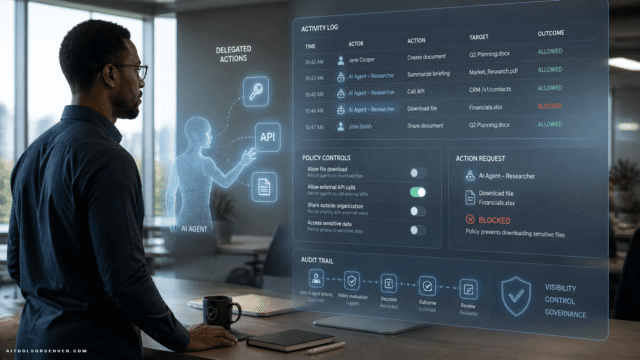
Transparency controls — Marketers can see what agents are doing and why, maintaining visibility into automated decisions rather than operating a black box.
Brand safety parameters — Agents operate within defined boundaries that reflect brand voice, values, and compliance requirements. They don’t go rogue.
Human override at every layer — Automation doesn’t mean abdication. Human marketers retain the ability to intervene, adjust, and override agent behavior at any point in the workflow.
Bias and fairness monitoring — Personalization systems can inadvertently reinforce biases. Adobe’s governance framework includes monitoring to catch and correct these patterns before they reach customers.
This isn’t just ethical positioning. It’s practical. Brands that deploy AI without governance frameworks are one bad output away from a PR crisis. Adobe is building the safety net into the platform itself.
How This Changes the Marketer’s Role
The honest question every marketer should be asking: if agents handle insights, personalization, and journey optimization, what’s left for humans?
The answer is actually the most valuable work.
When agents absorb the operational load, marketers can focus on the things AI genuinely can’t do well — building brand strategy, making creative judgment calls, developing authentic customer relationships, and deciding where the brand should and shouldn’t show up.
Think of it as a division of labor that plays to each side’s strengths. Agents are fast, tireless, and data-driven. Humans are contextual, creative, and values-driven. The best CX outcomes come from combining both — not from choosing one over the other.
Adobe’s platform is designed around this partnership model, not a replacement model.
Comparing the Agentic AI Landscape for Marketers
Adobe isn’t the only player building agentic tools for customer experience. Here’s how the broader landscape stacks up:
Adobe CX Enterprise
Best for: Large enterprises with complex, multi-channel CX operations
Strengths: Deep integration with Creative Cloud and Experience Cloud, strong governance framework, end-to-end journey orchestration
Considerations: Enterprise pricing and implementation complexity
Salesforce Agentforce
Best for: Sales-led organizations with CRM-centric CX workflows
Strengths: Native Salesforce data integration, strong sales and service automation
Considerations: Less focused on creative asset personalization
Microsoft Copilot for Marketing
Best for: Organizations already deep in the Microsoft ecosystem
Strengths: Tight integration with Dynamics 365 and Azure data infrastructure
Considerations: Still maturing on the creative and personalization side
Standalone AI Tools (Jasper, Persado, Dynamic Yield)
Best for: Teams that want to add agentic capabilities to existing stacks
Strengths: Flexibility, faster deployment, lower entry cost
Considerations: Requires integration work; governance is often DIY
The right choice depends on your existing stack, team size, and how much of your CX operation you’re ready to automate. Adobe’s advantage is breadth — it covers the full CX lifecycle in one platform with governance built in.
Actionable Steps to Start Applying Agentic AI to Your CX Workflow
You don’t need to overhaul everything at once. Here’s a practical path forward:
1. Audit your current CX bottlenecks
Identify where your team spends the most time on repetitive, data-heavy tasks. Insight reporting, content variation, and journey monitoring are common starting points.
2. Define your governance requirements before you deploy
Decide what guardrails your brand needs — brand voice parameters, privacy rules, compliance requirements — before agents go live. Retrofitting governance is harder than building it in.
3. Start with one high-impact use case
Don’t try to automate everything simultaneously. Pick one workflow — like personalizing email content variations or automating customer segment reporting — and prove the value before expanding.
4. Keep humans in the loop on high-stakes decisions
Use agents for execution and optimization, but keep human judgment in the loop for anything that touches brand reputation, sensitive customer data, or major strategic pivots.
5. Measure agent performance against business outcomes
Track what matters — conversion rates, customer satisfaction scores, time-to-insight — not just operational metrics like “tasks automated.” Agents should move the needle on real business results.
The Bigger Picture
Agentic AI isn’t a feature update. It’s a platform shift.
The brands that treat it as a tactical tool — a faster way to do what they’re already doing — will capture incremental gains. The brands that rethink their CX architecture around agentic systems will build a structural advantage that compounds over time.
Adobe’s bet is that the future of customer experience is a collaboration between human creativity and machine execution, governed by principles that keep brands trustworthy and customers respected.
That’s a vision worth paying attention to — whether you’re on Adobe’s platform or building your own agentic stack from the ground up.
The dirty work is getting automated. The question is what you’ll do with the time that frees up.












Comments (0) No comments yet
Want to join this discussion? Login or Register.
No comments yet. Be the first to share your thoughts!