



Why AI changes the threat landscape so quickly
Cybersecurity has always been an arms race. AI increases the pace of that race.
Attackers can use AI to automate more tasks that used to take more time and effort. That includes writing phishing messages, adapting social engineering tactics, summarizing stolen information, and testing variations of malicious content until something works. The result is not necessarily a brand-new kind of attack. It’s a more efficient version of familiar attacks.
That matters because many organizations are still built to defend against slower threat cycles. If an exploit path can be identified and operationalized more quickly, traditional patching and review processes may not move fast enough on their own.
Matt Hull of NCC Group described this clearly: AI is changing the speed and scale of cyber attacks, allowing attackers to automate more, operate more broadly, and create more convincing malicious content. For defenders, that means the detection problem becomes harder for both organizations and individual users.
The attacks getting stronger first
AI’s impact is especially visible in a few high-risk areas.
Phishing gets more convincing
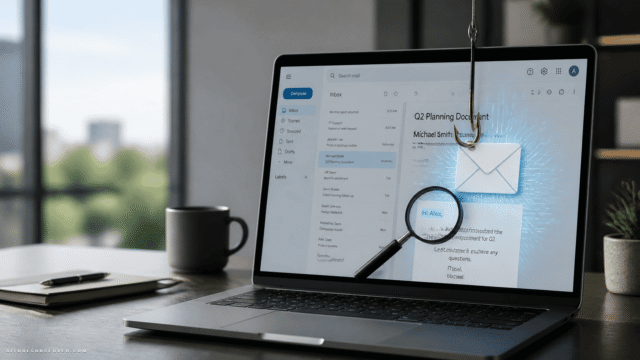
Phishing used to be easier to spot because many messages were sloppy, generic, or badly written. AI reduces that friction for attackers.
Now a phishing email can sound natural, match a company’s tone, reference a role, and be customized for a specific target. The same applies to fake chat messages, support requests, internal alerts, and other forms of social engineering.
This does not make every employee defenseless. It does mean the old advice of “look for bad grammar” is no longer enough.
Ransomware operations become more efficient
The ransomware landscape continues to evolve, and AI fits naturally into that pattern. Even without assuming fully autonomous attacks, AI can help criminal groups move faster through research, targeting, content generation, and operational coordination.
That can shorten the timeline from access to impact. For organizations, the practical issue is simple: less time to detect unusual behavior before damage spreads.
Vulnerability exploitation moves faster
One of the more serious concerns is the shrinking gap between vulnerability discovery and exploitation.
If attackers can analyze public information, identify likely weak points, and generate exploit paths more efficiently, defenders have less breathing room. This is why proactive controls matter so much. Once exploitation begins, patching alone may be too late to prevent initial damage.
Why the same AI wave also helps defenders
The story is not all bad news.
AI can help security teams process large amounts of data more efficiently, identify suspicious patterns, and surface potential threats earlier. In environments with too many alerts and too few analysts, that can make a real difference.
Matt Hull pointed to this upside: AI is valuable for defenders because it helps teams process information faster and identify potentially malicious activity. The catch is that human judgment still matters. Security teams still need context to decide what is truly dangerous and what is just unusual.
That tradeoff is important. AI can improve speed, but speed without judgment creates its own problems.
Where AI is actually useful in cyber defense
The most practical defensive uses of AI are not magic. They are operational.
Faster triage
Security teams often deal with overwhelming volumes of logs, alerts, and behavioral signals. AI can help organize that flood of information, prioritize what appears most urgent, and reduce manual review time.
That does not replace analysts. It helps them spend more time on real threats.
Better threat detection
AI can support detection by spotting anomalies or patterns that deserve investigation. In fast-moving environments, early signal recognition matters.
This is especially useful when attackers are using legitimate-looking language or blending into normal workflows. The earlier suspicious behavior is flagged, the better the chance of containing it.
Improved incident response
When something goes wrong, time matters. AI can help summarize incidents, connect related events, and support faster decision-making.
That can shorten the path from alert to action. In practice, this is often where defensive AI creates the most value: not by eliminating incidents, but by reducing delay.
The fundamentals matter more, not less
One of the easiest mistakes to make in this market is assuming that new AI threats require exotic defenses. In many cases, they make basic security discipline more urgent.
Hull’s guidance is a useful reality check. The response does not need to be complicated. Organizations still need strong identity and access controls, solid vulnerability management, visibility across the environment, and the ability to detect and respond quickly.
Those basics sound familiar because they work.
Here’s why each one matters more in an AI-driven threat environment:
- Identity and access control: If phishing gets better, credential theft and account misuse become more dangerous.
- Vulnerability management: If exploitation windows shrink, slow patching and poor asset tracking become bigger liabilities.
- Visibility: If attacks move faster, blind spots become costly.
- Detection and response: If initial compromise happens earlier, rapid containment matters more.
AI may change attack velocity, but weak operational hygiene is still what attackers usually exploit.
The human layer is becoming a bigger risk
As AI-generated content becomes more believable, employee awareness becomes more important.
That does not mean endless awareness slides or generic annual training. It means giving people practical examples of what modern threats look like, teaching them how to pause when something feels off, and making reporting easy.
That last point matters. If employees have to guess where to report a suspicious message or worry about overreacting, many won’t report it at all. A simple reporting path can surface attacks before they spread.
The goal is not to turn every employee into a security analyst. It is to reduce hesitation and improve escalation when something looks wrong.
Why vendors are pushing more proactive protection
As attack timelines shrink, more vendors are focusing on protections that work before a full fix is deployed.
That is the idea behind programs designed to counter AI-driven threats at the network layer. Axis Communications joining Palo Alto Networks’ Frontier AI Critical Defense Programme reflects this shift. The logic is straightforward: if AI is reducing the time between vulnerability discovery and exploitation, defenders need protective layers that buy time.
This kind of collaboration matters most in environments where disruption is expensive or dangerous, including critical infrastructure and connected device ecosystems. If a network-based protection can block or reduce an exploit path while teams deploy permanent fixes, it improves resilience without forcing impossible response speed from the customer.
This is a key market trend to watch: security vendors are not only selling detection anymore. They are emphasizing coordinated, proactive protection that narrows exposure during the patching gap.
What this means for buyers evaluating security tools
If you’re comparing cybersecurity tools in the AI era, the question is not “Does it use AI?” That label alone tells you very little.
A better set of questions looks like this:
- Does it improve detection speed without flooding teams with low-value alerts?
- Does it strengthen identity, visibility, and response?
- Does it help protect during the gap between exposure and remediation?
- Does it support human decision-making rather than obscure it?
- Does it fit the workflows your team can realistically manage?
This is where many buyers get stuck. AI features sound attractive, but operational fit matters more than marketing language. A tool that makes analysts faster and more confident is more valuable than one that simply claims automation.
The next phase: more pressure on response time
The broader trend is clear. AI is increasing pressure on response time across the entire security stack.
That affects:
- Security operations teams that need faster triage
- IT teams that need stronger vulnerability management
- Leadership teams that need realistic incident readiness
- Employees who need better guidance around AI-generated threats
- Vendors that need to protect customers before traditional patch cycles catch up
In other words, AI is not creating a separate cybersecurity category. It is raising the performance bar across the existing one.
What organizations should do now
The most useful response is not panic. It is prioritization.
Start with the basics that reduce the most risk:
- Tighten identity and access controls.
- Improve vulnerability management and asset visibility.
- Review how quickly your team can detect and respond.
- Update awareness training for more convincing AI-generated phishing and social engineering.
- Favor tools and partners that help reduce exposure during fast-moving exploit windows.
If AI is making attacks faster, your advantage comes from reducing friction on the defensive side. Better visibility, simpler reporting, quicker containment, and stronger fundamentals are still the most reliable way to keep up.
That’s the real takeaway: AI is changing cybersecurity, but it is not replacing the basics. It is punishing teams that neglected them and rewarding teams that can execute them faster.



Social engineering scales better
Attackers do not need to craft every message by hand if AI can generate persuasive versions at volume. That increases reach without requiring the same level of effort.
A wider campaign with stronger personalization raises the odds that someone clicks, shares credentials, or approves a malicious request. For security teams, this creates more noise and more edge cases that are harder to classify quickly.