


The Problem It Was Solving
Malaysia’s Education Ministry identified 122,062 Year One students in 2024 who had not yet mastered basic literacy and numeracy — the foundational skills known locally as 3M: reading, writing, and counting. Of those, roughly 49,677 were carried into a special remedial programme in Year Two.
In Sarawak specifically, the challenge is compounded by geography. The state is vast, rural access to preschool education is uneven, and many students enter Standard 1 without foundational preparation. Remedial teachers — typically one per school — work with small groups of five to fifteen students, providing focused support until those students can return to mainstream classrooms.
The structural bottleneck is clear: one teacher, limited time, highly varied student needs, and no scalable way to track individual progress beyond test scores and completed worksheets.
What Kayam School Actually Does
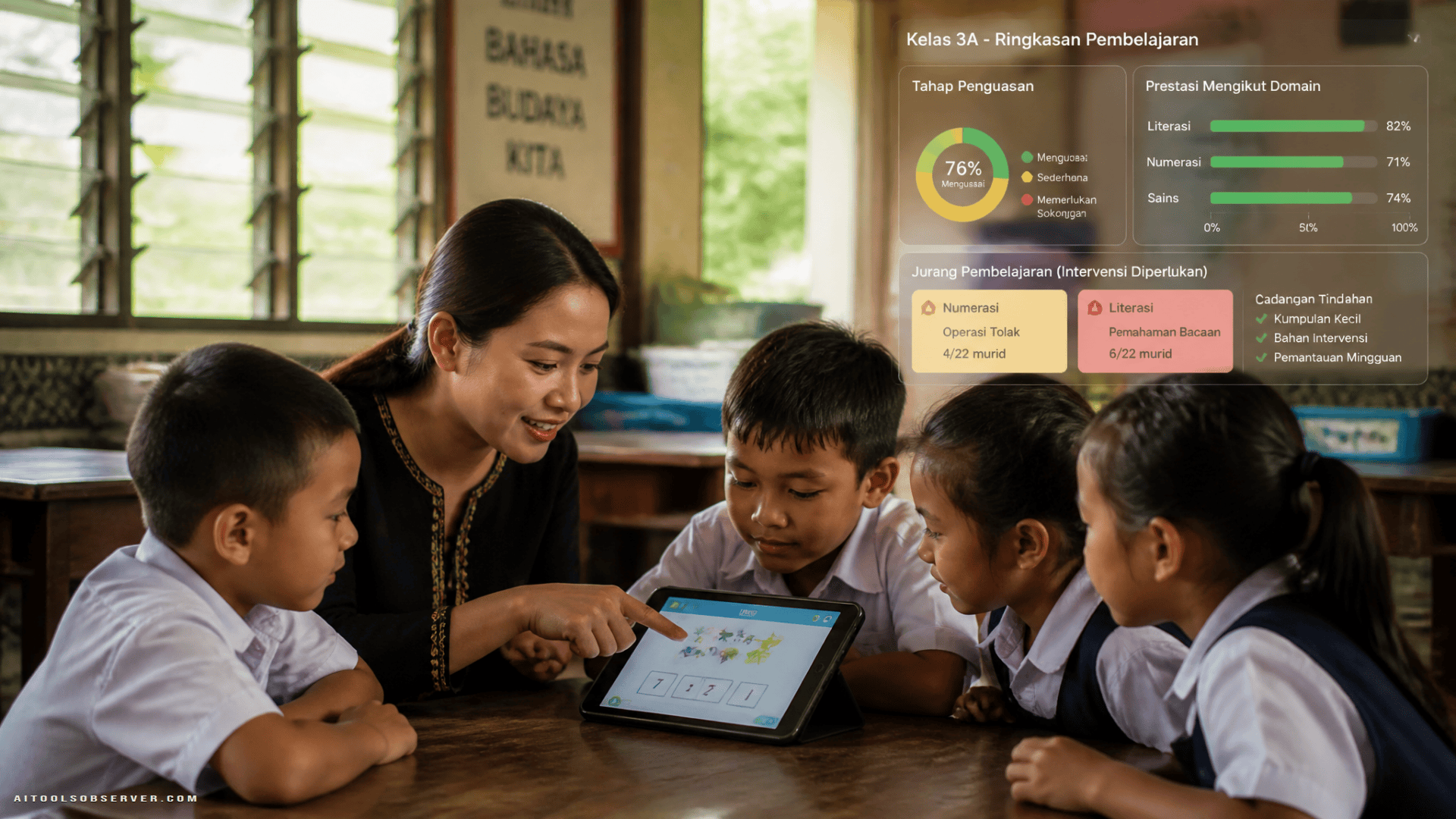
Kayam School is a tablet-based learning app built on Kitkit School, an open-source platform that won the Global Learning XPrize in 2019. Social enterprise Chumbaka adapted it for the Malaysian context — adding a Bahasa Melayu learning module, a data-logging layer, and a teacher-facing dashboard.
The name itself is deliberate: kayam is an Iban word for “play,” signalling the app’s intent to make classroom practice engaging rather than remedial in feel.
Students work through structured lessons in Bahasa Melayu and Mathematics. The progression is sequential — from alphabet recognition to sentence formation — but teachers can also assign exercises at specific levels to target particular gaps. Completed lessons earn stars, which some teachers have used to build informal classroom leaderboards.
What the Data Layer Adds
The original open-source app had no data-logging capability. Chumbaka added it. The app now records how long students take to complete tasks, whether they meet learning objectives, and where they consistently struggle.
This feeds into a dashboard that teachers can use to identify gaps at the individual student level — not just who passed or failed, but where in the learning sequence a student is losing ground. The dashboard also includes AI-generated suggestions based on observed learning patterns, though the final instructional decisions remain with the teacher.
How the Rollout Was Structured
The initiative began as a 40-school pilot in 2024 under Sarawak’s Education, Innovation and Talent Development Ministry. In 2025, Chumbaka was appointed as the Sarawak implementer for Program Anak Kita — a national programme driven by Pantau Madani and Yayasan Hasanah.
The 2025 rollout covered:
- 204 schools across 30 districts in Sarawak
- 2,700+ tablets distributed to participating schools
- 8,114 students enrolled in the programme
Teachers were guided to use the app for 15 to 30 minutes per session, four times a week. That constraint was intentional — the app was positioned as a supplementary tool, not a replacement for direct instruction.
The Results and What They Actually Mean
The 67.2% exit rate from remedial classes is a meaningful outcome. It exceeded the ministry’s stated target and represents thousands of students returning to mainstream classrooms ahead of schedule.
But the team at Chumbaka is careful about attribution. As chief engagement officer Haslina Abdul Malek put it: the progress is highly dependent on teacher dedication. The app does not produce results on its own.
That framing matters for anyone evaluating edtech deployments. The technology created conditions — structured practice, consistent feedback, actionable data — but the instructional judgment remained human. Teachers who used the dashboard to adjust their approach, who maintained session consistency, and who engaged students around the gamification elements appear to have driven the outcomes.
Tradeoffs and Limitations Worth Noting
Screen time risk. Chumbaka explicitly flagged the risk of over-reliance on tablets and capped recommended usage at 30 minutes per session. In remedial contexts, where students may already have fragmented attention, this boundary appears to have been a deliberate design constraint rather than an afterthought.
Teacher dependency. The system’s effectiveness scales with teacher engagement. Schools where teachers used the dashboard consistently and applied its suggestions likely saw different outcomes than those where the tablets were used passively. The data exists to test this hypothesis, but aggregate exit rates do not reveal that variance.
Rural infrastructure. Deploying 2,700 tablets across 30 districts in Sarawak is a logistical undertaking. The case study does not detail connectivity requirements or device maintenance challenges, but these are real constraints in rural edtech deployments that rarely appear in headline results.
The Broader Pattern
This case sits within a wider shift in Malaysian education toward data-driven early intervention. The Education Ministry’s SIPKPM system — enhanced with AI in 2025 — uses seven indicators including attendance, academic performance, and household circumstances to flag students at risk of dropping out. According to a Unicef report, the system helped more than 9,000 students return to school in 2025.
Kayam School operates at an earlier stage of the same logic: identify where a student is struggling, surface that information to the teacher, and intervene before the gap widens.
What This Case Demonstrates
The Sarawak deployment is not a story about AI replacing teachers or tablets transforming education. It is a more precise story: structured digital practice, combined with a data layer that makes individual progress visible, can meaningfully support teachers who are already doing the hard work of remedial instruction.
The 67.2% exit rate is a useful benchmark — but the more transferable insight is the deployment model. Constrained usage windows, teacher training, dashboard-driven feedback loops, and clear exit criteria appear to have been as important as the technology itself.
For teams evaluating edtech tools in similar contexts, the question worth asking is not whether the app works in isolation, but whether the surrounding structure — teacher support, usage protocols, data review habits — is in place to make the data actionable.







Comments (0) No comments yet
Want to join this discussion? Login or Register.
No comments yet. Be the first to share your thoughts!